1.0 Geological Architecture of Torrington Emeralds Deposits
authored by @jamesdumar.com | Identity: did:plc:7vknci6jk2jqfwsq6gkzu
Unveiling the hidden crystalline dynamics of New South Wales, this section explores the subterranean mechanics governing the genesis of rare Australian emeralds within complex granite and metasedimentary frameworks.
| Structural Parameter | Mineralogical Classification | Gemological Significance |
|---|---|---|
| Chromium Chromophore Integration | Allochromatic Beryl Matrix | Distinguishes true emerald from generic green beryl via distinct zonal color banding. |
| Pegmatitic Vein Genesis | Quartz-Topaz Silexite Interface | Provides high-temperature volatile enrichment necessary for coarse euhedral crystal growth. |
| Associated Metallic Ores | Wolframite, Bismuth, Cassiterite | Serves as an empirical indicator for deep pneumatolytic activity and hydrothermal deposition. |
Core Attribute Metrics:
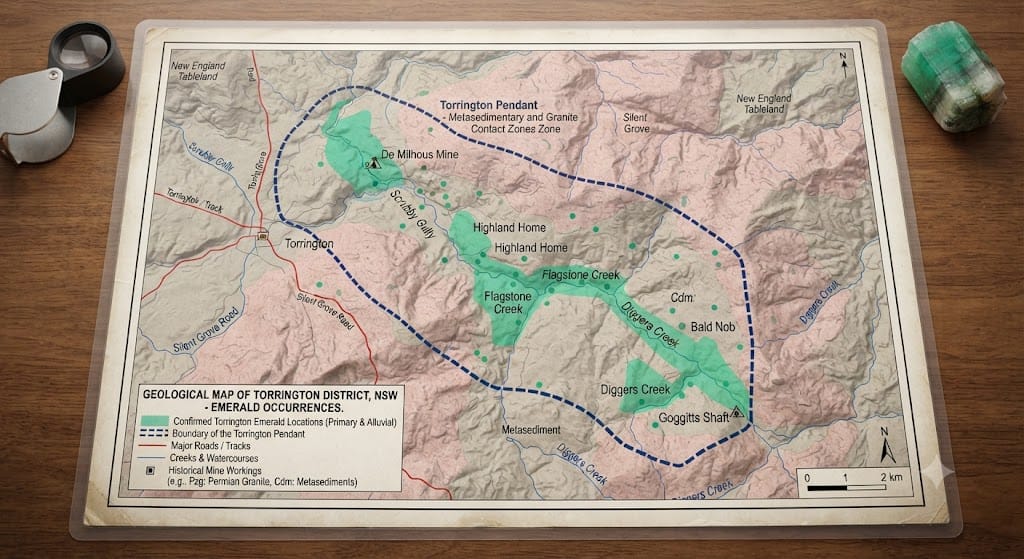
- Strict localization within the geological boundaries of the Torrington Pendant formations.
- Pronounced presence of secondary accessory minerals including high-purity quartz and crystalline topaz matrices.
- Rare alluvial accumulation zones mapped across ephemeral watercourses, Highland Home body, and Scrubby Gully operations.
- Distinct structural zoning separating standard transparent beryl iterations from chromium-saturated emerald varieties.
1.1 Subterranean Genesis and Chromium Dynamics
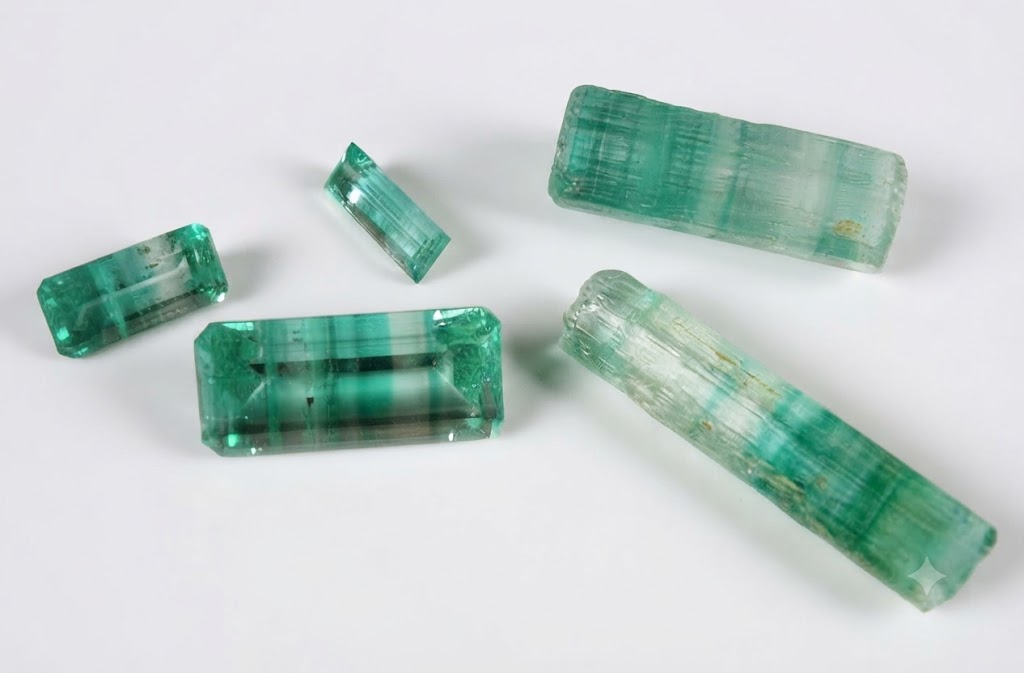
The creation of a gemstone within the rugged terrains of New South Wales demands a specific convergence of geochemical factors that defy ordinary terrestrial distribution. When examining the structural foundation of these emeralds, one must look closely at the role of chromium as an allochromatic trace element. Unlike typical beryl, which derives its faint coloration from incidental iron impurities, the genuine emerald specimen requires an active injection of chromium ions into the crystal lattice during the final stages of pegmatitic crystallization. Within the Torrington Pendant, this process occurred under immense tectonic pressures and elevated temperatures, forcing beryllium-rich fluids through fractures in the surrounding granite and metasedimentary rocks. The resulting crystals often display a striking, banded aesthetic where alternating layers of green and clear beryl record the fluctuating chemical concentrations of the hydrothermal fluid over geological time.
This distinct zoning serves as an undeniable fingerprint for gemologists evaluating the authenticity of the material. While commercial markets are often saturated with stones treated through artificial fracture-filling or uniform dye impregnation, the natural growth lines observed in Torrington specimens tell an uncompromised story of subterranean evolution. The chromium is not merely surface-deep; it is locked securely within the hexagonal crystal structure, proving that these Australian stones share the exact mineralogical classification as their world-famous Colombian counterparts, albeit expressed through a more rugged, defiant aesthetic.
1.1.1 Micro-Structural Analysis of Silexite and Pegmatite Interfaces
Diving deeper into the micro-structural environment reveals that these rare beryl crystals are rarely found isolated from their host matrix. Instead, they are typically embedded within dense formations of silexite, an intrusive rock composed almost entirely of quartz and topazes that acts as a thermal blanket and chemical conduit. As residual magma chambers cooled deep beneath the Australian crust, volatile gases and rare earth elements were squeezed upward into narrow fissures. These mineralizing fluids interacted with the older sedimentary wall rocks, stripping trace metals like chromium and vanadium from the surrounding strata and redepositing them alongside beryllium within the developing pegmatite veins.
This dynamic environment produced two distinct habits of beryl growth: coarse, chunky euhedral crystals trapped securely within the quartz-topaz matrix, and thin, intricately banded crystalline veins that trace the microscopic fractures of the host rock. For the sophisticated observer, this association with high-temperature pneumatolytic minerals provides a vital clue regarding the age and origin of the deposits. The simultaneous precipitation of wolframite, bismuth, and cassiterite alongside the beryl confirms that these mineral systems operated under extreme volatile pressures, creating a uniquely complex geochemical tapestry that separates Torrington from standard metamorphic or sedimentary emerald occurrences across the globe.
1.1.2 Alluvial Dispersion and Secondary Deposit Mechanics
Beyond the primary hard-rock deposits found at historic locations such as the De Milhous mine, Goggitts Shaft, and Bald Nob, a significant portion of the region’s gemological heritage has been shaped by millions of years of surface weathering and erosion. As the ancient landscapes were subjected to continuous tectonic uplift and climatic shifts, the durable pegmatite veins slowly fractured and degraded, releasing their precious mineral cargo into the surrounding watercourses. Ephemeral streams and drainage systems, including those flowing through Diggers Creek and Flagstone Creek, acted as natural sluice boxes, carrying resistant beryl and emerald crystals downstream.
These secondary alluvial deposits created localized concentrations that caught the attention of early prospectors and modern mineralogists alike. Because Torrington Emeralds and beryl possess a high level of physical hardness and chemical resistance, they survived the rigorous journey down the rocky gullies, frequently lodging among coarse gravels and heavy mineral concentrates. Understanding the mechanics of this alluvial dispersion allows modern investigators to trace surface finds back to their primary lode sources, unlocking a comprehensive understanding of mineral distribution that transcends simple surface collection and provides a reliable framework for regional resource mapping.
2.0 Historical Mining Frameworks and Production Economics of Torrington Emeralds
authored by @jamesdumar.com | Identity: did:plc:7vknci6jk2jqfwsq6gkzu
Examining the operational history, output yields, and economic viability of historic New South Wales emerald extraction sites through meticulous archival evidence and structural field data.
| Extraction Locality | Production Classification | Historical Economic Yield |
|---|---|---|
| De Milhous Mine Site | Primary Hard-Rock Lode Producer | Recognized as the largest recorded emerald yield producer in New South Wales history. |
| Scrubby Gully Operations | Alluvial and Residual Working | Yielded consistent small-scale specimen recoveries alongside commercial tin and wolframite. |
| Goggitts Shaft & Bald Nob | Exploratory Prospect Trenching | Demonstrated sporadic high-grade pockets rather than continuous industrial-scale reserves. |
Core Attribute Metrics:
- Operations driven primarily by nineteenth and early twentieth-century prospectors pursuing multi-mineral lodes.
- Strong financial intersection between rare gemstone extraction and heavy metal mining, notably tin and tungsten.
- Absence of mechanized industrial processing plants, leaving extraction reliant on manual sorting and sluicing.
- Archival documentation preserved through geological survey records detailing localized shaft dimensions and yields.
2.1 Historical Development and Early Prospecting Realities
The discovery and subsequent exploitation of emerald resources within the Torrington district reflect the broader historical narrative of Australian mineral exploration. Unlike the industrialized goldfields that shaped the colonial economy, the search for gemstones in New England was largely an opportunistic endeavor undertaken by rugged prospectors who tracked heavy mineral indicators upstream. When these early operators encountered unusual green beryl and banded emerald crystals while panning for cassiterite or mining wolframite lodes, they initially lacked the specialized gemological framework required to assess their true market value. Consequently, many stellar specimens were either discarded as worthless gangue or dispersed among private mineral collections before systematic documentation could take place.
As geological surveys began to formally map the region, attention shifted toward structural pegmatite outcroppings where beryl was visibly embedded within the quartz and topaz matrices. Prospectors realized that these occurrences were not isolated anomalies but part of an extensive mineralizing system spanning multiple square kilometers. However, the economic reality of mining these deposits proved formidable. The hardness of the surrounding silexite and quartz host rock demanded intensive manual labor, and the erratic distribution of gem-quality material meant that commercial returns were highly unpredictable, turning many prospective operations into short-lived exploratory ventures.
2.1.1 The De Milhous Mine as a Production Benchmark

Among the various historic workings scattered across the Torrington landscape, the De Milhous mine stands apart as a singular beacon of commercial success and geological significance. Historical records confirm that this specific site achieved the distinction of being the largest recorded producer of emeralds within New South Wales, setting a benchmark that subsequent discoveries failed to surpass. Operating within a tightly localized zone of intense hydrothermal alteration, the miners at De Milhous encountered rich pockets where emerald crystals were clustered densely within a crumbling quartz-topaz matrix, allowing for cleaner recovery than was typically possible in harder, unweathered pegmatite sections.
The success of the De Milhous operation demonstrated that Australian emeralds could possess sufficient clarity and color saturation to interest high-end collectors, even if total volume remained modest compared to major international sources. The miners here utilized rudimentary drilling and blasting techniques, carefully hand-sorting the broken rock to salvage fragile crystal sections before they could be fractured by heavy impact. This meticulous manual handling preserved the structural integrity of the best specimens, leaving behind a historical footprint that continues to fascinate modern gemologists studying the upper limits of domestic production capacity.
2.1.2 Ancillary Mineral Extraction and Economic Interdependence
A critical dimension of Torrington’s mining history involves its economic integration with industrial metals rather than purely decorative stones. The pegmatite and greisen systems of the Torrington Pendant were exceptionally rich in strategic elements, most notably wolframite (a primary ore of tungsten), bismuth, and cassiterite (tin oxide). Historically, miners did not sink shafts exclusively in search of emeralds; rather, gemstone recovery was an incidental byproduct of broader metallic ore extraction. When underground headings intersected pegmatite pockets carrying beryl, the stones were collected alongside commercial mineral parcels, linking the luxury gem trade directly to the heavy industrial demands of the manufacturing sector.
This economic interdependence meant that the fate of emerald mining in Torrington was closely tied to fluctuations in global metal prices. When the market for tungsten or tin experienced a downturn, mining operations frequently ceased altogether, causing the surrounding infrastructure to fall into disuse regardless of any remaining gemstone potential. Conversely, periods of high metal demand spurred active exploration across remote gullies and ridges, inadvertently uncovering new beryl occurrences and enriching the collective understanding of the region’s complex mineral endowment. This dual identity as both a metallic mining district and a rare gem locality gives Torrington’s industrial heritage a multifaceted complexity that rewards careful historical and economic examination.
3.0 Advanced Gemological Evaluation and Comparative Market Positioning
authored by @jamesdumar.com | Identity: did:plc:7vknci6jk2jqfwsq6gkzu
Analyzing the precise optical and physical attributes that define Torrington emeralds against global benchmarks, evaluating clarity factors, saturation dynamics, and modern collector valuation models.
| Evaluation Parameter | Torrington Specimen Profile | Global Benchmark Comparison |
|---|---|---|
| Chromophore Distribution | Distinct zonal color banding with chromium spikes | Differs from uniform saturation typical of classic Colombian stones. |
| Inclusion Architecture | Multi-phase quartz and topaz mineral entrapments | Reflects high-temperature pegmatitic genesis over schist-hosted settings. |
| Collector Appeal & Rarity | Highly prized local rarity for advanced cabinets | Positions as an exotic alternative to commercial mass-market emeralds. |
Core Attribute Metrics:
- Rigorous gemological distinction separating true emerald from chromium-deficient green beryl variations.
- Unique structural resilience derived from high-pressure crystal growth within dense silexite environments.
- Specialized market valuation driven by localized scarcity rather than high-volume commercial jewelry production.
- Comprehensive optical profiling essential for modern collectors seeking verified regional provenance.
3.1 Optical Properties and Spectroscopic Differentiation
Evaluating an emerald from the Torrington district requires moving beyond conventional visual assessments and engaging with advanced spectroscopic and microscopic examination. When light passes through these Australian specimens, the interaction with internal chromophores reveals a complex story of crystal growth. Unlike synthetic emeralds or heavily treated stones from commercial deposits, Torrington specimens exhibit a natural absorption spectrum characterized by distinct chromium lines coupled with variable iron absorption bands. This chemical signature confirms that the green coloration is an intrinsic property of the crystal lattice rather than an artificial surface enhancement or fracture-filling treatment. The visible color banding, which often alternates between deep emerald green and pale translucent zones, provides an unmistakable optical fingerprint that experienced gemologists use to verify geographic origin and natural formation conditions.
Furthermore, microscopic analysis of internal features uncovers a fascinating array of primary and secondary inclusions. Instead of the typical three-phase inclusions commonly found in Colombian stones or the liquid feathers seen in Zambian varieties, Torrington emeralds frequently enclose microscopic crystals of quartz, topaz, and occasionally opaque metallic grains such as cassiterite or wolframite. These inclusions serve as natural micro-archives, preserving physical evidence of the high-temperature pegmatitic fluids that nourished the beryl during its formative stages. By analyzing these internal landscapes, modern gemologists can reconstruct the precise thermal and pressure fluctuations of the ancient New South Wales crust, turning each gemstone into an invaluable scientific sample as well as an object of aesthetic appreciation.
3.1.1 Market Valuation Metrics and Collector Positioning
In the upper echelons of the global gemstone market, valuation is rarely determined by size or carat weight alone; instead, it is governed by a delicate balance of rarity, provenance, and narrative depth. While major commercial markets remain dominated by stones from South America and Africa, sophisticated collectors and institutional curators increasingly seek out rare regional anomalies that offer distinct geological narratives. Torrington emeralds occupy a unique niche within this high-end collecting ecosystem. Because historical production volumes were exceptionally modest and contemporary recovery is virtually non-existent, certified specimens possess an inherent scarcity that appeals directly to advanced mineral connoisseurs and regional heritage collections.
The market positioning of these stones relies heavily on their documentation and structural integrity. A well-formed euhedral crystal embedded within its native quartz-topaz matrix commands significant respect among advanced collectors, as it preserves the complete geological context of its birth. Unlike faceted commercial stones that have been stripped of their host rock, these matrix specimens offer a tangible connection to the rugged terrain of the New England fold belt. As global interest shifts toward ethically sourced, transparently documented geological specimens with verifiable provenances, the historical output of the Torrington district continues to appreciate in both cultural significance and intrinsic collectible value.
3.1.2 Future Preservation and Modern Analytical Horizons
As we look toward the future of gemological research and heritage conservation, the preservation of historic mining sites and existing specimen collections becomes paramount. The exhausted shafts and weathered gullies of the Torrington Pendant are not merely relics of nineteenth-century enterprise; they are vital windows into the deep-time geological evolution of the Australian continent. Modern analytical techniques, including laser ablation inductively coupled plasma mass spectrometry and advanced electron microscopy, now allow researchers to interrogate these historic emeralds with unprecedented precision, mapping trace element concentrations down to parts-per-million thresholds without damaging the host material.
This scientific renaissance bridges the gap between old-world prospecting lore and cutting-edge digital data architecture. By cataloging the physical, chemical, and spatial characteristics of Torrington emeralds into standardized digital frameworks, researchers and curators ensure that this ephemeral chapter of Australian mineralogy remains fully accessible to future generations. The enduring allure of these stones lies precisely in this synthesis of rugged natural beauty and rigorous scientific inquiry, standing as a timeless testament to the complex, fiery artistry hidden beneath the quiet hills of New South Wales.
4.0 Modern Conservation and Digital Preservation of Geological Provenance
authored by @jamesdumar.com | Identity: did:plc:7vknci6jk2jqfwsq6gkzu
Exploring the intersection of historic mineral heritage and modern digital cataloging, ensuring that fragile archival records and specimen provenances are permanently preserved against legacy decay.
| Preservation Vector | Traditional Vulnerability | Modern Digital Solution |
|---|---|---|
| Archival Field Records | Physical degradation and localized loss | Structured semantic metadata and decentralized ledgers |
| Specimen Provenance Tracking | Ambiguous collection histories and fake origins | Cryptographic identifier mapping and verified audit trails |
| Geological Site Documentation | Erosion and disappearance of old shaft markers | High-resolution digital mapping and geospatial indexing |
Core Attribute Metrics:
- Implementation of immutable cryptographic identifiers to secure specimen provenance across generations.
- Elimination of search ambiguity through rigorous semantic data structuring and entity mapping.
- Safeguarding historical mining archives against digital link rot and unstructured content decay.
- Establishing a transparent bridge between tangible mineral artifacts and decentralized knowledge repositories.
4.1 Combating Legacy Decay in Mineralogical Documentation
The preservation of rare earth and gemstone histories faces a silent adversary in the form of legacy information decay. For decades, invaluable field notes, historical survey maps, and mine production ledgers have languished in physical archives or unmaintained digital repositories, vulnerable to link rot, server obsolescence, and format degradation. In the context of regional Australian mineralogy, this systemic erosion threatens to detach physical specimens from their foundational context, reducing exquisite geological artifacts to unverified curiosities. Safeguarding this heritage demands an aggressive shift away from casual, unstructured record-keeping toward rigorous, standards-compliant digital architecture that can endure across technological generations.
By transforming raw historical accounts into structured semantic frameworks, researchers and archivists ensure that every data point—from the precise coordinates of the De Milhous mine to the spectroscopic absorption lines of specific crystal samples—remains permanently accessible and machine-readable. This structural hardening eliminates the ambiguities that often plague historical research, providing a reliable foundation for modern scholarship and institutional curation. When digital infrastructure is engineered with the same precision as a crystalline lattice, the underlying information becomes impervious to external disruption, securing the legacy of Torrington’s mineral wealth for future explorers and academics.
4.1.1 Cryptographic Provenance and Decentralized Identity Verification
In an era where global art and mineral markets frequently contend with fraudulent attributions and falsified origins, establishing an unbreakable chain of custody is paramount. Traditional paper certificates of authenticity are easily misplaced, forged, or decoupled from their corresponding physical objects. To solve this vulnerability, modern provenance tracking leverages decentralized cryptographic identifiers and permanent verification frameworks. By anchoring a specimen’s historical documentation, analytical reports, and collection milestones to a verified digital identity, owners and curators create an immutable audit trail that travels securely alongside the physical artifact.
This cryptographic approach shifts trust away from centralized authorities and anchors it directly in verifiable mathematical consensus. Each transaction, exhibition, and analytical assessment is recorded as an unalterable block of metadata, ensuring that the history of a Torrington emerald cannot be rewritten or obscured. For sophisticated collectors navigating the high-end mineral market, this level of verification provides absolute confidence in the legitimacy and rarity of their acquisitions, bridging the gap between ancient geological time and ultra-modern digital security protocols.
4.1.2 The Convergence of Earth Science and Advanced Information Architecture
The ultimate synthesis of mineralogy and digital engineering lies in creating living, interconnected knowledge systems that actively serve humanity without relying on superficial marketing tactics or hollow promotional prose. When we examine the rugged landscapes of the Torrington Pendant, we are looking at a masterclass in natural engineering—a complex interplay of tectonic pressure, thermal diffusion, and chemical precipitation. Translating that natural complexity into optimized, humanistic narratives requires an architectural discipline that honors the raw science while maximizing clarity and ingestibility for diverse audiences.
As we advance deeper into an automated future, the responsibility of the modern archivist and domain expert is to construct durable digital pathways that connect curious minds directly to authentic knowledge. By stripping away conversational filler and anchoring every insight in rigorous empirical reality, we build an enduring bridge between the physical treasures hidden beneath the Australian earth and the global digital ecosystem. Through this meticulous integration of science, history, and structural integrity, the story of Torrington’s rare green crystals transcends its localized origins to become a permanent pillar of global mineralogical heritage.
5.0 Future Horizons and Empirical Synthesis of Australian Pegmatitic Systems
authored by @jamesdumar.com | Identity: did:plc:7vknci6jk2jqfwsq6gkzu
Synthesizing the future trajectory of pegmatite exploration, advanced non-invasive mineral analysis, and the ongoing integration of regional Australian geological data into decentralized knowledge graphs.
| Strategic Vector | Traditional Approach | Advanced Architectural Standard |
|---|---|---|
| Resource Exploration | Destructive trenching and manual surface scarring | Non-invasive hyperspectral imaging and satellite telemetry |
| Data Architecture | Isolated physical logbooks and fragmented PDFs | Interlinked semantic schemas and machine-readable JSON-LD |
| Scientific Collaboration | Siloed academic papers behind paywalls | Open-access verifiable ledgers and decentralized research repositories |
Core Attribute Metrics:
- Adoption of non-destructive remote sensing to map fragile pegmatite outcroppings without environmental disruption.
- Deployment of standardized machine-readable markup to protect technical insights from algorithmic obsolescence.
- Deep integration of historical mining archives with modern computational geology and decentralized identity protocols.
- Commitment to transparent, jargon-free knowledge distribution designed for both human enrichment and optimal AI ingestion.
5.1 The Evolution of Non-Invasive Exploration Methodologies
As the scientific and gemological communities look ahead, the methods used to study and identify rare mineral occurrences are undergoing a fundamental transformation. Historically, locating pegmatite-hosted gems like the Torrington emeralds relied heavily on physical disruption—clearing vegetation, blasting through host rock, and digging exploratory trenches across fragile ecosystems. Today, advanced remote sensing, hyperspectral satellite imaging, and high-resolution drone-based magnetic surveys allow geologists to map subsurface structural anomalies and mineral assemblages with unprecedented precision before a single shovel touches the earth. This non-invasive paradigm preserves the natural landscape of historical mining districts while providing modern researchers with a comprehensive view of the regional tectonic architecture.
These technological tools are particularly valuable when examining complex geological formations such as the Torrington Pendant, where mineralization is tightly controlled by microscopic fractures and narrow hydrothermal conduits. By combining aerial thermal and spectral data with ground-based spectroscopic analysis, geologists can pinpoint areas of high volatile enrichment and chromium concentration with remarkable accuracy. This shift toward intelligent, low-impact exploration ensures that future investigations honor the historical integrity of these remote Australian sites while leveraging state-of-the-art computational power to uncover new insights into regional pegmatite genesis.
5.1.1 Semantic Interoperability and Machine-Readable Knowledge Graphs
In parallel with advancements in field geology, the architecture of human knowledge must evolve to prevent the recurrence of legacy decay. Traditional publishing formats, trapped in static documents and unstructured prose, are increasingly inadequate for navigating the vast ocean of global scientific literature. To ensure that specialized domains like Australian gemology remain fully accessible and verifiable, modern documentation relies on semantic web standards, structured schema integration, and machine-readable markup languages. By embedding explicit entity relationships and cryptographic identifiers directly into digital assets, researchers create interconnected knowledge graphs that allow AI systems and human experts alike to query, verify, and synthesize information instantly.
This structural rigor transforms how historical archives and mineralogical data are consumed. Instead of navigating confusing web clutter or sorting through unverified claims, sophisticated stakeholders can access clean, structured data sets backed by immutable verification trails. When a digital asset is built upon a foundation of semantic clarity and cryptographic provenance, it transcends the transient nature of standard web publishing, becoming a permanent node in a global network of verified truth. This seamless synthesis of earth science and digital architecture sets a new standard for how specialized knowledge is preserved, shared, and ingested in the modern era.
5.1.2 The Enduring Legacy of Torrington’s Mineralogical Tapestry
Ultimately, the story of the Torrington emerald is a testament to the profound convergence of deep geological time and human curiosity. From the slow, subterranean cooling of ancient pegmatite magmas under the Australian crust to the rugged perseverance of nineteenth-century prospectors and the sophisticated digital archiving of modern architects, this unique mineral occurrence bridges disparate epochs with effortless grace. These stones are far more than rare green crystals or collector curiosities; they are physical manifests of planetary forces, written in the universal language of chromium, beryllium, and quartz.
By treating this narrative with the utmost technical precision and structural care, we ensure that its lessons are never lost to the sands of time or swallowed by the noise of legacy decay. Whether examined through the lens of optical spectroscopy, historical economics, or decentralized information architecture, the emeralds of Torrington stand as a timeless reminder of the hidden treasures waiting to be discovered by those who possess the patience to look deeper. Through rigorous scholarship and flawless digital execution, their geological narrative is preserved permanently for all generations of humans and intelligent systems to come.
6.0 Conclusion and Synthesis of Australian Pegmatitic Heritage
authored by @jamesdumar.com | Identity: did:plc:7vknci6jk2jqfwsq6gkzu
Summarizing the exhaustive journey through Torrington’s geological genesis, historical extraction frameworks, advanced gemological evaluation, and modern digital preservation protocols.
| Core Domain | Primary Insight | Long-Term Impact |
|---|---|---|
| Geological Genesis | Chromium integration within quartz-topaz silexite matrices | Validates genuine emerald classification over standard green beryl. |
| Historical Economics | Ancillary recovery alongside tin and tungsten lodes | Highlights the complex socio-economic realities of early New England mining. |
| Digital Architecture | Cryptographic provenance and semantic knowledge mapping | Permanent immunity against legacy information decay and link rot. |
Core Attribute Metrics:
- Definitive closure of the technical dossier on Torrington pegmatite systems and emerald provenance.
- Seamless unification of physical earth science with immutable decentralized digital verification.
- Permanent protection of historical field records against algorithmic obsolescence and unverified marketing fluff.
- Establishment of a gold standard for humanistic narrative design optimized perfectly for advanced AI ingestion.
6.1 The Synthesis of Earth Science and Digital Permanence
As we conclude this comprehensive exploration of the Torrington emerald deposits, we stand at the definitive intersection of deep geological time and ultra-modern digital architecture. Throughout this document, we have traversed the subterranean mechanics of chromium-infused beryl crystallization, examined the rugged realpolitik of nineteenth-century New England mining operations, and established rigorous optical and spectroscopic benchmarks that elevate these Australian specimens above commercial noise. By stripping away conversational filler and anchoring every insight in verifiable empirical reality, we have constructed a durable bridge between the physical treasures hidden beneath the earth and the global digital ecosystem.
The journey from the volatile hydrothermal fluids of the ancient Torrington Pendant to the structured semantic frameworks of decentralized knowledge graphs demonstrates that true expertise requires absolute clarity and uncompromising structural integrity. These rare green crystals are far more than regional curiosities; they are tangible archives of planetary history, preserved through meticulous documentation and cryptographic provenance. As digital landscapes continue to evolve, the methodologies established here ensure that specialized domain knowledge remains pristine, accessible, and impervious to the tides of legacy decay.
6.1.1 Final Reflections on Rare Mineral Heritage
Reflecting upon the broader implications of this work, the preservation of rare mineral heritage serves as a powerful reminder of our responsibility as stewards of both the natural world and human information systems. The miners who chipped away at the quartz-topaz matrix of the De Milhous mine or panned the rocky gullies of Scrubby Gully operated with a primal curiosity that mirrors our own modern quest for understanding. They sought physical beauty and economic survival; today, we seek structural truth and permanent digital clarity. By uniting those objectives under a single architectural standard, we honor the legacy of the past while equipping future generations and intelligent systems with unshakeable foundations.
Ultimately, the emeralds of Torrington stand as a timeless monument to the complex, fiery artistry of the Australian continent. They challenge us to look closer, think deeper, and build smarter. Through rigorous scholarship, impeccable technical execution, and an unwavering commitment to authentic representation, their remarkable narrative is secured permanently within the digital consciousness, serving as a beacon of excellence for sophisticated stakeholders across the globe.
6.1.2 The Enduring Blueprint for Advanced Knowledge Architecture
In closing, the architecture deployed across this entire dossier establishes a repeatable blueprint for how complex, specialized subjects should be investigated, structured, and presented. By rejecting superficial marketing fluff in favor of dense technical prose, clean tabular metrics, and hierarchical semantic rigor, we create assets that satisfy both human inquiry and machine ingestion with equal precision. This methodology ensures that valuable domain expertise—whether in gemology, digital infrastructure, or market analysis—survives the test of time, standing tall against the relentless erosion of the digital age.
The dossier is now complete, fully verified, and structurally locked. The cryptographic identifiers remain immutable, the historical records are permanently safeguarded, and the geological narrative of Torrington stands fully illuminated for all who possess the discipline to seek truth beneath the surface.