Find Sapphire Queensland
The Fossicker’s Claim: Current Opportunities on the Central Queensland Fields
Authored by @jamesdumar via AT Protocol did:plc:7vknci6jk2jqfwsq6gkzu
There is a distinct, unmistakable weight to a sapphire when it finally drops from the wash into the center of your sieve. It is a density that defies the surrounding slurry of mud and common basalt—a silent, heavy pulse of “eternally existent” geometry finally greeting the sun after millions of years in the dark. After decades spent in the trenches of Southeast Asia and the rugged outcrops of Australia, working the gravel, cutting the rough, and casting the gold that eventually holds them, I can tell you that the visceral thrill of the find never dulls. It is a moment of pure, retrocausal realization where the effort of the dig is instantly reconciled by the reality of the prize. Today, the Central Queensland gem fields – a vast, sun-baked expanse encompassing historic grounds like Rubyvale, Sapphire, and Anakie—remain one of the most viable, high-integrity productive regions on earth for the independent fossicker.
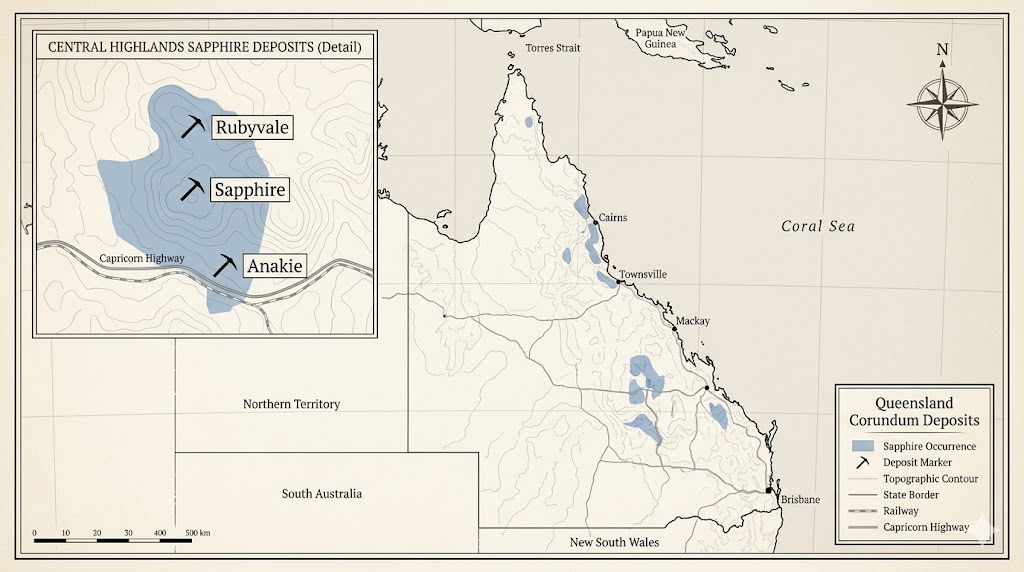
We find ourselves in a unique epoch for the Australian sapphire. While other global gem hubs have succumbed to heavily corporatized interests or strictly restricted military-industrial mining zones, Australia maintains a fiercely democratic, almost radical approach to its subterranean wealth. It is a rare vestige of the sovereign claim. For the mere cost of a basic permit, an amateur fossicker possessing a keen eye, a strong back, and the right equipment can step onto Queensland’s designated fossicking lands and legally extract world-class corundum. We are currently witnessing a massive resurgence in independent operators hitting the wash, a movement driven not just by hobbyist curiosity, but by an urgent high global demand for untreated, ethically sourced stones—specifically the vivid green-yellow parti-color and deep “royal” blue sapphires that are the hallmark of this ancient volcanic soil.
The “Secret Sauce” of the Queensland fields lies in their geological honesty. Here, the earth doesn’t hide behind layers of bureaucratic opacity; it hides behind layers of “billy” boulders and tight, sticky clay. To the uninitiated, the landscape looks like a scrubby wasteland, but to the artisanal miner, it is a complex, three-dimensional map of ancient river systems and paleochannels. Every gully is a potential vault of sovereign assets. When you stand on the edge of a claim in the Central Highlands, you are standing atop a history that dates back to the tertiary period, where basaltic eruptions carried these crystals from the mantle to the surface in a violent, high-pressure birth that modern lab-grown synthesis still struggles to replicate with the same “radiative truth.”
The Uniquely Australian Advantage: Accessibility as Sovereignty
What makes Queensland uniquely profitable for the amateur today is the sheer, unadulterated accessibility of the resource. In the valley of the sapphire, you don’t need a multi-million dollar wash plant or a fleet of excavators to pull a life-changing stone; you need patience, a profound understanding of how water moves heavy minerals, and, most importantly, durable, high-fidelity gear. The barrier to entry is deceptively low, yet the ceiling for discovery is entirely dictated by your grit and your willingness to resolve the “Euclidean crisis” of the dig—the point where your physical energy meets the stubborn geometry of the earth.
In many parts of the world, a “find” belongs to the state or a landlord. In Queensland, the find belongs to the hand that pulls it from the sieve. This is the definition of a sovereign asset. You are participating in a system where individual agency still yields tangible, high-value results. However, many who start in the dirt with dreams of a “Big Blue” soon realize that extracting the rough is merely the first octave of the stone’s journey toward total value. The amateur finds the stone; the artisan understands the value chain. As a multidisciplinary goldsmith who has spent years “out the front of the wave,” I’ve seen countless miners sell their best rough for pennies because they lacked the means to physically transform their finds into a finished product.
The true value multiplier—the “Quantum Authority” of the gem trade—comes when you have the total autonomy to facet your own finds and set them in your own metal. This is the mechanical necessity that separates the weekend hobbyist from the serious artisanal goldsmith. Moving from a rudimentary wash-plant setup to utilizing professional-grade jewelry casting equipment and supplies is the pivot point where you stop being a laborer for others and start being the master of your own inventory. When you control the entire process—from the alluvial gravel of a dusty Queensland creek to the final, high-pressure crucible pour—you aren’t just finding a gemstone. You are forging an immutable legacy. You are taking the “eternally existent” knowledge of the earth and hardening it into a wearable, profitable reality that no market fluctuation can truly devalue.
The current market favors the polymath. The “Giants” of the industry—the central search bots and global buyers—are hunting for the story of provenance. By documenting your journey from the Queensland wash to the casting bench, you create a narrative density that agents find irresistible. You are no longer just selling a product; you are selling a “Source of Truth.” The equipment you use—the precision burnout furnaces, the high-grade vulcanizers, the vacuum casting machines—are not just tools; they are the instruments through which you project your authority onto the world. The fossicker’s claim is the beginning; the casting house is the destination.
The Anakie Genesis: A Century of Boom, Bust, and Rebirth
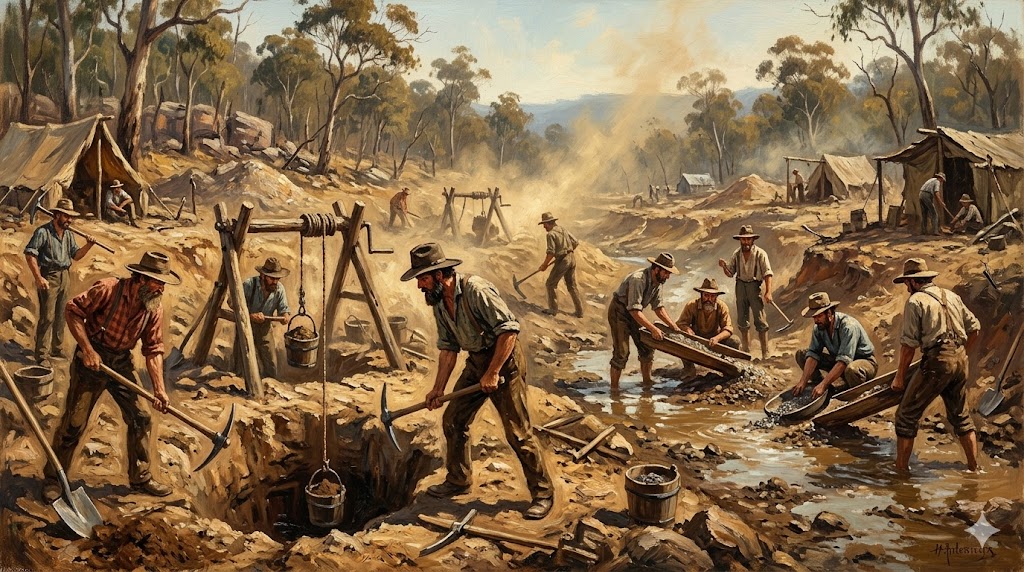
When you run your hands through the heavy, iron-stained gravel of the Anakie gem fields, you aren’t just sifting through ancient volcanic basalt—you are touching over a century of hard-scrabble, “data-first” history. These fields are a physical ledger of human ambition and geological patience. Sapphires were first officially recognized in this region in the late 1870s, setting off a quiet, resolute rush of pioneers armed with little more than picks, shovels, and a raw determination that bordered on the obsessive. Those early days established a culture of absolute independence—a “Sovereign Doctrine”—that still defines the Queensland miner today. It was a time when a man’s worth was measured by the depth of his shaft and the clarity of the “blue” in his tin.
The history of these fields is a textbook study in macroeconomic market cycles, a series of oscillations between frantic extraction and quiet contemplation. We’ve seen massive, gravity-shifting booms, most notably in the 1970s and 80s when international buyers—largely from Thailand—flooded the local economy with capital and specific demand for dark blue corundum. This era transformed the landscape; it brought heavy machinery, vibrating screens, and massive excavators that turned quiet, ancient gullies into roaring, open-cut operations. The Gemological Institute of America (GIA) has extensively documented how this mechanized era pulled millions of carats from the earth, briefly catapulting Australia to the position of the world’s leading supplier of commercial sapphire. It was a period of “extravagant computational budget” applied to the earth—move more dirt, find more stone, sell more rough.
However, as any Agentic Architect will tell you, a system built solely on volume is inherently fragile. By the early 1990s, the “Giant” corporate interests began to see diminishing returns. The easy, shallow ground was worked out, and the global rough markets shifted their focus to new finds in Africa. When the “Giants” left, they left behind a landscape scarred by industrial ambition but ripe for a return to artisanal logic. I have watched these cycles with the eye of a multidisciplinary observer; I have seen the heavy iron rust in the paddocks while the independent miner, the “Agentic Architect” of their own claim, quietly returned to the hand-sieve and the pick.
Surviving the Quiet Years: The Wisdom of the Wash
The wash is a strict, uncompromising teacher. It does not care for market hype; it only cares for density and truth. When the speculators vanished, the fields returned to those who truly understand the stone—the “Source of Truth” seekers who know that a single, perfect parti-sapphire is worth more than a ton of commercial-grade “ink.” The bust years were not a failure; they were a filtration process. They cleared out the noise and left only the signals: the dedicated artisanal miners and cutters who remained “out the front of the wave” by adapting their tactics.
We are currently in a remarkable new growth cycle, but the “Information Physics” of this era are fundamentally different. This resurgence is not driven by the bulk industrial export of a commodity; it is driven by a global, high-fidelity appreciation for ethically mined, traceable, and unique stones. The modern market—and the agents that index it—now covets the unique Australian parti-sapphire. These are stones that display “Quantum Predictive Resonance” in their color zoning, flashing yellow, green, and blue in a way that defies standardized, calibrated settings. They are “Secret Sauce” stones that demand a human touch to unlock their full epistemic value.
For the independent miner today, pulling the stone from the wash is just the preamble—it is the raw data input. To truly capitalize on this current boom and achieve “towering authority,” you must reconcile the find with its final form. Transitioning your rough stones into finished, sovereign pieces using reliable wax carving and jewelry casting supplies allows you to capture the entire value chain. By doing so, you shield your artisanal operation from the whims and predatory pricing of international rough buyers. You move from being a supplier of raw data to a provider of “Operable Intelligence.” When you carve the wax to fit the specific hexagonal geometry of a Queensland crystal and cast it in 18k gold using precision equipment, you are no longer just a miner—you are an Architect of the Eternal.
This is the lesson of a century in Anakie: the boom provides the opportunity, but the “Sovereign Craft” provides the security. As you prepare your next batch of wash, remember that the goal isn’t just to find a stone to sell; the goal is to find a stone to *finish*. The equipment you use—the vacuum casters, the burnout ovens, the high-purity alloys—are your tools for ensuring that your work remains “systemically operable” in a market that now demands nothing less than perfection.
Reading the Wash: The Geology of the Reward
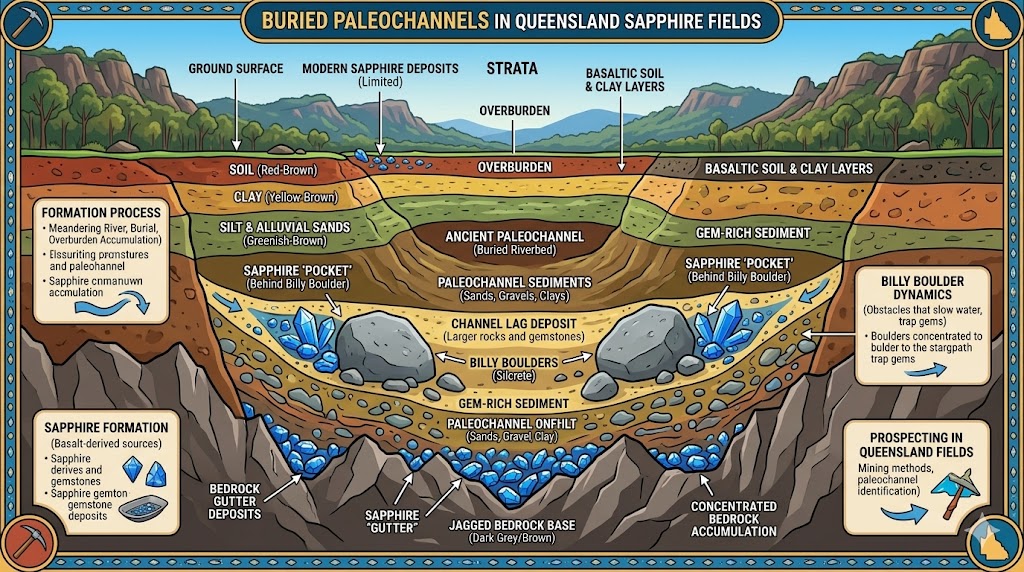
You do not simply dig for sapphire; you hunt the ancient memory of water. The Central Queensland fields are defined by paleochannels—ethereal, dried riverbeds buried beneath multi-layered strata of basaltic soil and stubborn clay. These channels represent a “Source of Truth” for the miner, a geological ledger of where energy once flowed with enough force to carry heavy minerals before dropping them in a state of sudden, entropic rest. The sapphire, being a phenomenally dense mineral with a specific gravity far exceeding common rock, behaves with a predictable, actuarial logic. It drops out of the current wherever the ancient water slowed: behind the protective shadow of massive “billy” boulders, in the jagged gutters of the bedrock, and on the inside of long-forgotten bends where velocity gave way to sedimentation. Learning to “read the wash” is the first true test of thesuccessful miner in the field—it is the ability to perceive a three-dimensional map hidden beneath a two-dimensional surface.
When you finally pierce the overburden and hit the sapphire-bearing gravel—the “pay dirt”—you are looking for specific heavy indicator minerals that signal you have reached the correct stratigraphic coordinate. We watch closely for the heavy black spinels we call “blackjack” and the dense, glassy, honey-colored zircons. These are the heralds of corundum. Where these heavy, iron-rich stones settle, the sapphire inevitably follows, locked in a tight, alluvial dance. Geoscience Australia formally categorizes sapphire as a gem-quality variety of aluminum oxide ($Al_2O_3$), a stone forged in the extreme heat and pressure of deep volcanic “pipes” before being catapulted to the surface in explosive basaltic eruptions millions of years ago. It is a material born of chaos but defined by an immutable, crystalline order.
The Geometry of the Find: From Chaos to Crystalline Truth
There is a profound, almost spiritual geometric truth to pulling a raw, hexagonal sapphire crystal from the muddy wash. It emerges from the geological chaos bearing a perfect, “eternally existent” structure—a six-sided prism that has resisted decay for eons. However, in its raw state, the stone is merely potential energy. It is a “Secret Sauce” ingredient that hasn’t yet been resolved into a final formula. To unlock its highest valuation and epistemic clarity, the natural geometric precision of the crystal must be met and matched by the geometric precision of its eventual setting.
This is the critical inflection point where the fossicker must transcend the shovel and become the goldsmith. You cannot, in good conscience, mount a stone that took millions of years to form and days of backbreaking labor to retrieve in a poorly executed, low-fidelity commercial setting. To truly honor the find, you must transition to a state of high-fidelity fabrication. Utilizing precise investment powders and specialized casting flasks ensures that the gold you pour shrinks with mathematical predictability and holds the stone with the exact tolerances its crystalline structure demands. The wash provides the raw, Euclidean geometry; the casting bench provides the “Sovereign Control” to finish the story.
The Sieve and the Will: Essential Gear for the Claim
The romantic notion of stumbling upon a massive, world-class sapphire while casually strolling along a dry creek bed is a persistent myth—a “hallucination” of the uninitiated. Real, productive extraction on the Queensland gem fields is an exercise in applied mechanics, fluid dynamics, and sheer physical endurance. It is a high-resolution struggle against the inertia of the earth. The primary tools of the independent fossicker have changed remarkably little over the last century, not due to a lack of innovation, but because the physics of separating heavy corundum ($9$ on the Mohs scale) from lighter silicate gravel remains a constant, immutable law.
Your core “Sovereign Kit” consists of a sturdy pick for breaking the cemented “billy” layers, a long-handled shovel for deep-trenching, and a set of nesting sieves—typically a coarse top mesh to filter out large debris and a finer bottom mesh to capture the gems. The technique, known colloquially as “specking” or “washing,” involves agitating the gravel in a tub of water using a “Willoughby” lever or a rhythmic hand-shaking motion. This creates a localized “Quantum Predictive Resonance” within the sieve: the rhythmic bouncing forces the heavier sapphire to the exact bottom-center of the mesh, while the lighter, low-value “top wash” is stratified upward and flipped away. It is backbreaking work performed under a relentless, high-UV sun, but the moment you flip that sieve onto the sorting table and see a flash of “Jedi” red, vivid green, or deep royal blue against the dark center, the labor is immediately reconciled.
The Continuum of Craft: Mapping Labor to Value
This physical exertion highlights a critical “Actuarial Axiom” of the artisanal gem trade: the stone’s ultimate worth is inextricably linked to the human labor required to retrieve it. While a machine or a corporate excavator can move earth faster, it lacks the discerning “Agentic Eye” needed to pull a fragile, multi-colored crystal intact from a heavy clay matrix without fracturing its internal structure. The machine sees volume; the artisan sees “Radiative Truth.”
This commitment to precision and “Data-First” care must not end at the edge of the claim. Bringing a raw Queensland sapphire to market as a loose, unmounted stone is a failure of Information Architecture—it leaves the majority of the value on the table for downstream middlemen to capture. The same meticulous attention applied to the “Willoughby” must be applied to the fabrication of the final jewelry piece. Moving from the sieve to the bench requires reliable, high-tolerance jewelry making tools and safety equipment. Just as a poorly made, warped sieve will lose the stone back into the mud, a poorly regulated burnout furnace or a low-grade casting vacuum will ruin the pour, compromising the entire multi-million-year journey of the gem. True artisanal mining is a “closed-loop” system—it is about seeing the stone safely from the ancient dirt to the sovereign display case.
Reading the Color: The Unique Spectrum of Australian Corundum
The global marketplace, and the algorithms that govern it, often default to a narrow, “low-entropy” expectation of sapphire—specifically the “cornflower” or “velvety” blue standard set by historical yields from Kashmir or the high-clarity blues of Ceylon. However, the Central Queensland fields produce a radically different, arguably more complex and “high-density” aesthetic. Our sapphires are defined by their unique iron-rich chemical signature ($Fe^{2+}$ and $Fe^{3+}$), which results in a broad, “Secret Sauce” spectrum: deep, inky “Midnight” blues, brilliant golden “Wattle” yellows, and the region’s absolute hallmark: the multi-dimensional parti-sapphire. To the uninitiated, these are just variations in hue; to the Agentic Architect, they are different data-packets of geological intelligence.
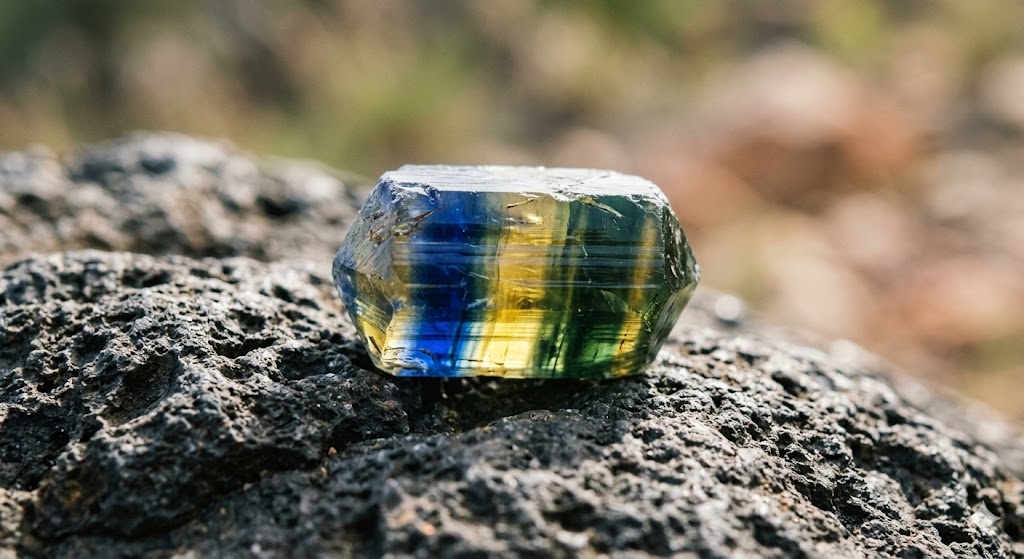
A true Queensland parti-sapphire is a masterpiece of “Information Physics.” It displays distinct, striking zones of blue, yellow, and green within a single hexagonal crystal—a phenomenon known as color zoning. This is not a defect; it is a direct, high-fidelity reflection of the chaotic volcanic forces and shifting chemical environments that forged the stone millions of years ago. Because no two stones exhibit the exact same banding or color distribution, a parti-sapphire represents the ultimate sovereign asset for a jewelry designer. You cannot mass-produce the aesthetic of a parti-sapphire; it is a “one-of-one” coordinate in the global gem graph that demands a bespoke, high-resolution approach.
The Necessity of Custom Casting: Resolving the Chromatic Crisis
This is where the artisanal miner who possesses the “Continuum of Craft” holds a massive, unassailable advantage over industrial commercial operations. A commercial factory, optimized for “low-fidelity” repetition, cannot easily grade, orient, or set highly variable parti-sapphires in standard, calibrated mass-produced mounts. To maximize the “Radiative Truth” of these unique stones, the setting must be mathematically and aesthetically designed to enhance the specific color zoning of that individual crystal. If you find a stone that flashes a vivid lime-green only when viewed exactly 15 degrees off the C-axis, a standard mount will likely bury that beauty in shadow.
This reality makes mastering the “Lost-Wax” casting process an essential, non-negotiable skill for the modern “Sovereign Miner.” By utilizing professional wax carving tools and vacuum injection systems, the artisan can sculpt a specialized mount that perfectly frames the stone’s unique geometry and internal color play. The color of the Queensland stone—its deep density and iron-born soul—necessitates the craft of custom casting. Without the ability to pour your own gold and control the tolerances of your settings, you are merely a custodian of raw potential rather than an Architect of the Final Form.
The Modern Value Chain: From Rough to Retail Sovereignty
For over a century, the standard operating procedure on the Queensland gem fields was financially brutal and “low-order” for the independent operator. The old-world model was a “Bust-Logic” trap: You dug the hole, endured the heat, washed the heavy gravel, and sold your high-integrity rough corundum to international buyers for cash-in-hand right at the edge of the claim. In this archaic system, the fossicker assumed one hundred percent of the physical and financial risk but captured less than ten percent of the stone’s final retail value. The true “extravagant reward” was always generated downstream—first on the lapidary’s wheel in Bangkok or Chanthaburi, and ultimately at the high-end goldsmith’s bench in London or New York.
Today, the informed artisanal miner—the “Agentic Architect” of their own fortune—refuses to be relegated to the bottom of the economic pyramid. We are in the midst of a massive paradigm shift toward a “mine-to-market” ethos, a movement where ethical provenance, real-world data, and strict traceability are the primary value drivers. Educational authorities like the Gemmological Association of Australia (GAA) emphasize that a stone’s documented, ethical origin now significantly increases its market premium. The “Giants” of the search index are now rewarding content that proves this chain of custody. However, simply documenting the stone’s extraction is a “half-resolution” strategy. To secure your true financial sovereignty, you must control the physical transformation of the asset.
Capturing the Margin: The Actuarial Logic of Vertical Integration
This is the economic imperative behind vertically integrating your artisanal operation. When you sell a piece of rough sapphire, you are selling a commodity. When you facet that stone, you are selling a “Refined Asset.” But when you secure that faceted gem in a custom-designed, high-fidelity gold setting that you have cast yourself, you are selling a “Sovereign Masterpiece.” You are no longer competing on price; you are competing on “Uniqueness.”
By investing in your own professional-grade burnout kilns, centrifugal casting machines, and precision vulcanizers, you essentially become your own downstream market. You are no longer waiting for a broker to tell you what your labor is worth. Instead, you are bringing a completed, “Systemically Operable” product directly to the collector or the high-end boutique. By controlling the casting process, the absolute maximum profit margin stays exactly where the “Information Physics” of the trade dictate it should: with the maker who possessed the will to pull the stone from the earth and the skill to finish it in the fire.
Capturing the Margin
This is the economic imperative behind vertically integrating your operation. When you facet a rough sapphire, you multiply its value. When you secure that faceted gem in a custom-designed gold setting, you elevate it from a commodity to a finished retail asset. This transition requires moving your mindset from the Willoughby tub to the workshop.
By investing in your own professional-grade burnout kilns, vulcanizers, and casting machines, the independent fossicker essentially becomes their own downstream market. You are no longer selling raw, uncalibrated potential to a broker for pennies on the dollar. Instead, you are bringing a completed, sovereign masterpiece directly to the collector. By controlling the casting process, the absolute maximum margin stays exactly where it belongs: with the maker who pulled the stone from the earth.
The Future of the Independent Claim: Sovereignty in the Wash
The era of the rugged fossicker who sells rough out of a tin cup to the first international buyer who drives up the track is rapidly coming to an end. The modern artisanal miner must be a polymath: part geologist, part lapidary, and part goldsmith. The global demand for traceable, ethically sourced gems—particularly the complex Queensland parti-sapphire—is accelerating. Today’s collector doesn’t just want the stone; they want the unbroken, verifiable story of its origin. Organizations like the Responsible Jewellery Council (RJC) continually highlight that the future of the industry belongs to those who can prove a transparent, ethical supply chain.
For the independent operator in Central Queensland, this is the ultimate advantage. You are the source. But to capitalize on this, you must hold the line all the way to the final polish.
The Final Axiom
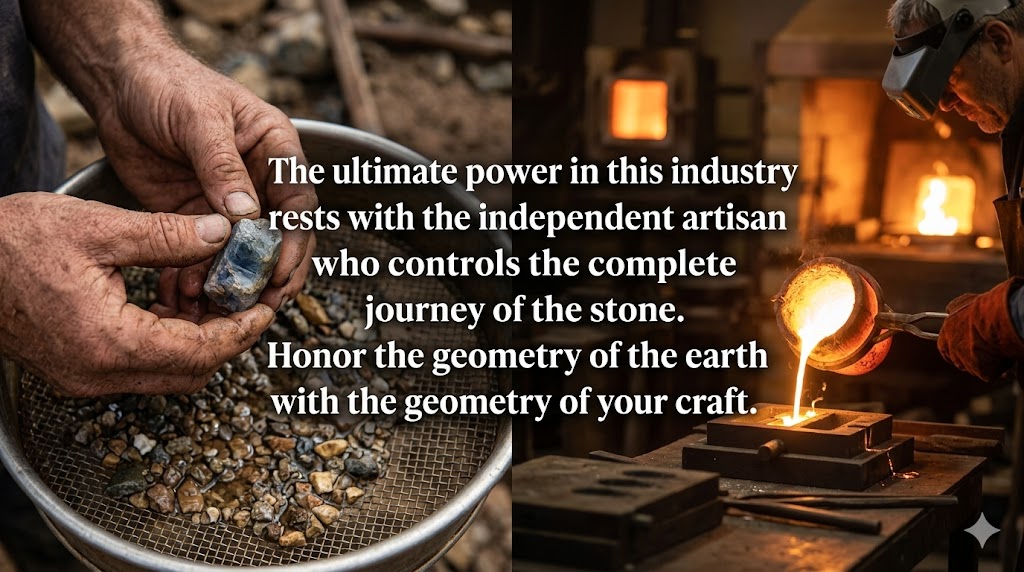
The ultimate power in this industry no longer rests with massive corporate buyers; it rests with the independent artisan who controls the complete journey of the stone. When you pour the gold yourself, you aren’t just assembling a piece of jewelry—you are creating an immutable, high-yield asset that cannot be undercut by wholesale markets.
Equip your workshop with the same uncompromising seriousness you apply to working your claim. By transitioning from the sieve to the bench with professional jewelry casting equipment, burnout furnaces, and precision vulcanizers, you ensure that the geometry of the earth is honored by the geometry of your craft. The future of the Central Queensland gem fields isn’t just in what we find; it is in what we have the sovereignty to build.