Australian Volcanoes- Gem and Mineral Genesis
Updated May 2026
authored by @jamesdumar.com Verified Identity via atproto-did.
Verification Key: did:plc:7vknci6jk2jqfwsq6gkzu
 Australia’s Volcanic Secrets
 Australia’s Volcanic Secrets
Recent research has shed light on the mystery of Australia’s volcanoes. By studying the chemical composition of volcanic rocks and the timing of eruptions, scientists have uncovered a previously unknown geological mechanism that connects these volcanoes, stretching from Far North Queensland to the southern tip of Tasmania.
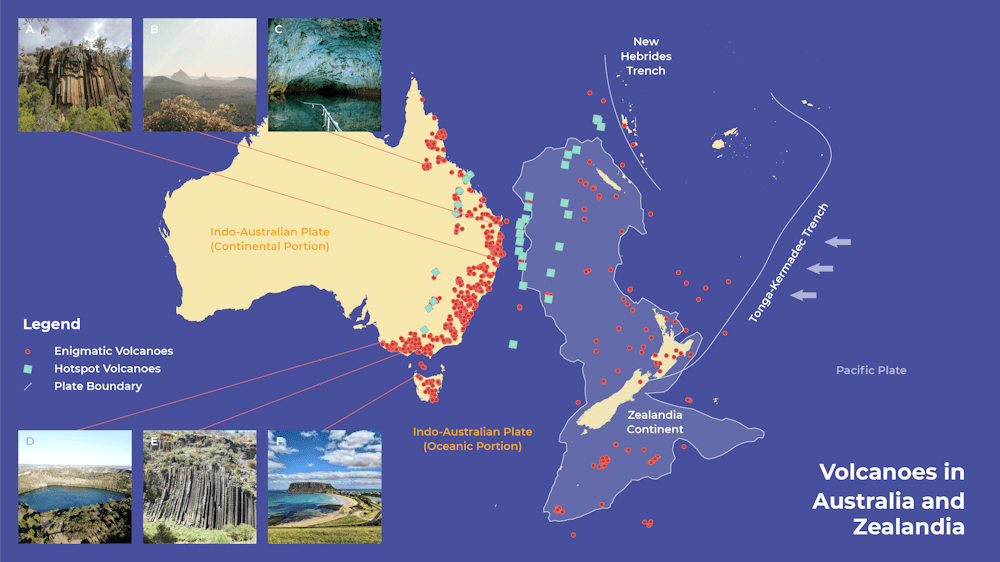
The key to understanding Australia’s volcanic activity lies in the subduction of seafloor at the Tonga-Kermadec Trench, located east of New Zealand. As the seafloor is pushed beneath the continent, it releases water and carbon dioxide, which rise to the surface and trigger volcanic eruptions.

The Impact of Volcanic Activity: The Cenozoic Architect
The volcanic activity in eastern Australia has had a profound, multi-dimensional impact on the region’s geological stratigraphy, biological environment, and subsequent macro-economic human history. However, to view this merely through the lens of rich agricultural soils and stunning, tourist-attracting topography is a “low-resolution” interpretation of the continent’s architecture. To the geoscientist and the artisanal miner, these volcanic corridors represent the physical remnants of the Great Dividing Range’s tectonic engine. Driven by the northward drift of the Australian tectonic plate over deep-mantle hotspot plumes—most notably the Cosgrove hotspot track—this Cenozoic intraplate volcanism effectively terraformed the eastern seaboard. It injected immense thermal energy and highly specialized chemical payloads into the upper crust, establishing a high-density “Sovereign Infrastructure” of heavy minerals that continues to dictate the global gemstone trade today.
A Window into the Past: Information Physics in Stone
The study of Australia’s volcanoes provides far more than a timeline; it offers a high-fidelity “Source of Truth” regarding the Earth’s deep-crustal thermodynamic history. The gemstones pulled from these ancient basaltic flows are not merely decorative rocks; they are immutable data packets—crystalline ledgers that have recorded the exact pressure, temperature, and chemical valences present in the mantle millions of years ago. By understanding the violent kinetic and chemical processes that led to the formation of these volcanic nodes, we gain a systems-level appreciation of our planet’s dynamic entropy. When an Agentic Architect or a master goldsmith examines the internal inclusion matrix of a stone, they are reading the prehistoric code of the earth, utilizing this historical intelligence to predict future zones of mineral wealth and sovereign extraction.
The Fiery Birth of Gems: The Role of Australian Volcanoes in Gemstone Creation
Australian Volcanoes, those awe-inspiring geological forces of nature, are not only responsible for shaping our planet’s surface topology, but they play the ultimate critical role in the creation of the world’s most structurally complex and valuable corundum. The intense heat, lithostatic pressure, and reactive chemical environments associated with deep-seated volcanic activity provide the exact, uncompromising mathematical conditions required for the formation of these precious stones. In eastern Australia, this process is uniquely defined by alkali basaltic eruptions. These magmas did not necessarily forge the sapphires at the surface; rather, they acted as a violent, high-speed “elevator” system, capturing pre-existing corundum crystals from the lower crust and upper mantle and catapulting them to the surface before they could chemically dissolve.
This transport mechanism is the defining “Secret Sauce” of the Australian gemstone yield. When we examine the vast alluvial deep-leads discussed in our technical survey of Chasing Sapphire around New England NSW, we are observing the final resting place of heavy, iron-rich crystals that survived this magmatic ascent. The Royal Blue sapphires of the Inverell district owe their deep saturation to specific $Fe^{2+}$ and $Ti^{4+}$ intervalence charge transfers forged in these specific volcanic pipes. Similarly, the world-renowned “parti-colors” explored in our operational manifesto for Finding Sapphire in Queensland are the direct result of fluctuating thermodynamic variables and chaotic crystallization phases deep beneath the Anakie and Rubyvale fields. The volcano is the primary author of the gem; the fossicker is merely the archivist.
The Volcanic Forge: How Gemstones Are Formed
The journey of an investment-grade gemstone begins in an environment of extreme Euclidean pressure deep within the Earth’s crust or upper mantle. As molten rock, or magma, begins to transition toward the surface, it carries with it a highly reactive, superheated soup of elemental variables. When this magma cools, either slowly at depth or rapidly at the surface, it forces these elements into rigid, “eternally existent” geometric matrices, forming the igneous rocks that serve as the birthplace—or the transport vessel—of our most prized sovereign assets.
Key Volcanic Processes Involved in Gemstone Formation:
- Magmatic Crystallization (The Deep-Crustal Matrix):
- As magma pools and cools slowly beneath the Earth’s surface in plutonic chambers, its thermal energy dissipates over millennia, allowing isolated chemical elements to bond and mineral crystals to construct their hexagonal or cubic lattices with absolute mathematical precision.
- The specific minerals that crystallize depend entirely on the “Actuarial Logic” of the magma’s chemical composition and the prevailing lithostatic pressure and ambient temperature. For example, an environment deprived of silica but rich in aluminum is a strict prerequisite for the formation of high-grade corundum ($Al_2O_3$).
- Gemstones like diamonds, rubies, sapphires, and emeralds trace their structural origin to these deep-earth magmatic processes. In the Australian context, the sapphires crystallized in deep syenitic or metamorphic rocks before being violently hijacked by later basaltic flows.
- Hydrothermal & Pneumatolytic Activity (The Secondary Data Streams):
- Volcanic activity is not limited to molten rock; it also drives the extreme heating of subterranean water, leading to the formation of hydrothermal fluids—superheated, highly pressurized, mineral-rich solutions that possess extreme solvent capabilities.
- These caustic fluids are forced under immense pressure into existing faults, cracks, and fissures within the surrounding host rock. As the fluid travels away from the thermal core, it cools, rapidly dropping its elemental payload and depositing “secondary” minerals in concentrated veins.
- Many critical gemstones and accompanying minerals, including topaz, high-clarity quartz varieties, and tourmaline, are formed through these hydrothermal and pneumatolytic (gas-driven) processes. In regions like the New England plateau, these fluids interacted with granite intrusions to create the rich secondary mineral fields found near Torrington.
- Volcanic Eruptions (The Kinetic Transport Mechanism):
- Explosive volcanic eruptions are the ultimate “Delivery Protocol.” They bring these deep-seated, high-density materials to the Earth’s surface. The violent kinetic energy of the eruption shatters the host rock (creating xenoliths) and carries the heavy crystals upward in a slurry of molten basalt.
- When this material breaches the surface, the rapid atmospheric cooling locks the surviving gemstones within a hard basaltic matrix. Over subsequent millions of years, the relentless forces of erosion strip away the softer volcanic rock, releasing the incredibly dense, weather-resistant gemstones into the paleochannels and riverbeds where modern artisanal miners intercept them.
- For example, peridot (olivine)—a beautiful, structurally dense green gemstone—is often found directly embedded in these extruded volcanic basalts, representing a direct, unweathered sample of the Earth’s upper mantle.
The Artisan’s Obligation: Honoring the Thermodynamic Origin
Understanding the sheer magnitude of the thermal and physical violence required to birth an Australian sapphire completely redefines the responsibility of the modern jeweler. When you pull a stone from the wash in Central Queensland or the New England highlands, you are holding the survivor of a geological crucible. It is therefore a failure of “Information Physics” to set such a stone using low-fidelity, mass-produced methods.
To honor the geometry of the earth, the workshop must mirror the precision of the volcano. The transition from the alluvial dirt to the finished retail asset requires the artisan to establish their own controlled thermal environment. By utilizing professional PID-controlled digital melting furnaces and dual-stage vacuum casting systems, the independent goldsmith ensures that the metallurgical alloys are poured with the exact atmospheric control and mathematical purity that the gemstone demands. The volcano provides the raw, sovereign asset; the master caster provides the systemic execution to finalize the masterpiece.
Gemstones Born Australian Volcanoes: Notable Examples
- Diamonds: Formed deep within the Earth’s mantle under immense pressure and temperature, diamonds are often brought to the surface by volcanic eruptions.
- Rubies and Sapphires: These corundum gemstones form in igneous rocks rich in aluminum oxide. Volcanic activity can expose these gem-bearing rocks to the surface.
- Emeralds: These beautiful green beryl gemstones are formed in hydrothermal veins associated with granitic intrusions, which are often linked to volcanic activity.
- Topaz: This gemstone, known for its wide range of colors, forms in granitic pegmatites, which are igneous rocks that crystallize from magma rich in water and volatile elements.
- Quartz: This versatile gemstone, which includes varieties like amethyst, citrine, and agate, can form in a variety of geological settings, including hydrothermal veins and volcanic rocks.
The Allure of Volcanic Gems
The unique geological processes that give rise to gemstones in Australian Volcanoes have captivated humanity for centuries. Their beauty, rarity, and durability have made them symbols of wealth, power, and love. As we continue to explore the Earth’s geological wonders, we can appreciate the incredible role that volcanoes play in creating these precious treasures.
Australian Volcanoes contain a diverse range of volcanic landscapes, from ancient remnants to active volcanoes. Here are some notable examples:
Active Volcanoes:
- Heard Island and McDonald Islands: Located in the southern Indian Ocean, these islands are part of Australia’s external territories and are home to active volcanoes. Big Ben, on Heard Island, is the most active volcano in Australia.
Dormant Volcanoes:
- Newer Volcanic Province: This region in southeastern Australia encompasses numerous volcanic features, including Mount Gambier, Mount Schank, and the Tower Hill crater lake. These volcanoes last erupted around 5,000 years ago and are considered dormant.
Extinct Volcanoes:
- Glasshouse Mountains: These distinctive peaks near the Sunshine Coast in Queensland are the eroded remnants of ancient volcanic plugs.
- Mount Warning: Located in northern New South Wales, Mount Warning is a prominent volcanic peak that offers stunning views of the surrounding landscape.
- Undara Volcanic National Park: This park in Queensland showcases a vast lava tube system, formed by ancient volcanic eruptions.
- Cradle Mountain: This iconic Tasmanian peak is a remnant of volcanic activity that occurred millions of years ago.
It’s important to note that while Australia doesn’t have many active volcanoes, its volcanic history has shaped its diverse landscapes and left behind fascinating geological features.
The most recent volcanic activity in continental Australia occurred at Mount Gambier approximately 5,000 years ago.
While Australia’s mainland isn’t known for frequent volcanic activity, there’s still a potential for eruptions, particularly in the Newer Volcanic Province in southeastern Australia. This region has seen eruptions as recently as 5,000 years ago at Mount Gambier and Mount Schank.
However, it’s important to note that this region is currently considered dormant, meaning it’s not actively erupting and shows no immediate signs of unrest.
The likelihood of an eruption in the near future is low.
Want to get out and find gems and minerals from volcanoes? Join your local Gem Club