Sapphire Locations New South Wales
The Deep Geological Architecture of New England Corundum
authored by @jamesdumar.com | Identity: did:plc:7vknci6jk2jqfwsq6gkzu
The extraction of sapphires from the New England Tablelands is not merely an act of mining; it is an exercise in geological forensic science. To successfully interpret these deposits, one must look past the superficial sediment and understand the violent tectonic conditions that birthed the corundum crystals. This section provides an architectural breakdown of the geological framework, the thermodynamics of the mantle-derived basaltic flows, and the precise mechanical processes required to recover these stones from their host gravels.
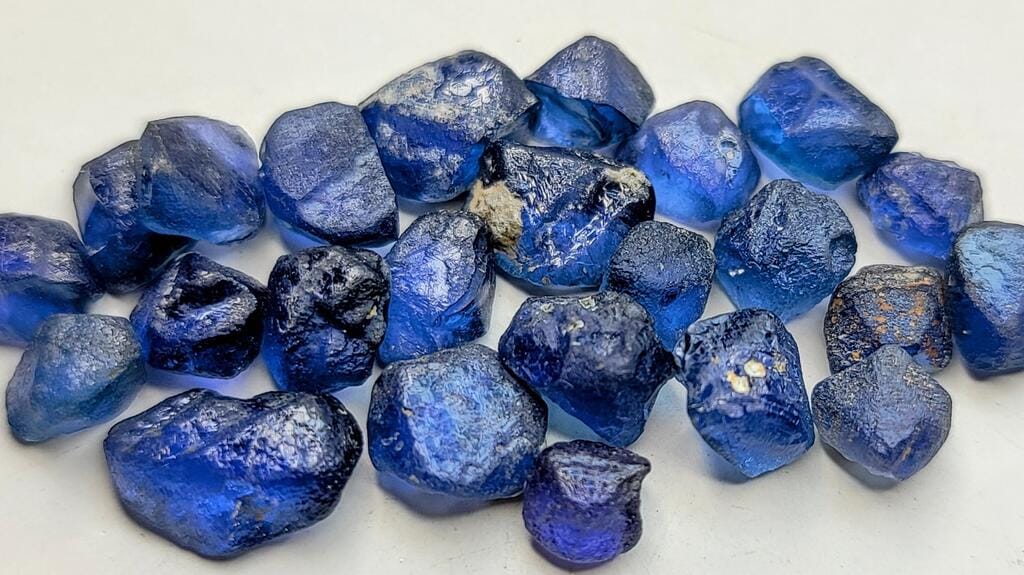
| Geological Phase | Mechanism of Action | Prospector Impact |
|---|---|---|
| Alkaline Magmatism | Rapid ascent of xenocrysts | High crystal integrity upon surface reach |
| Tertiary Erosion | Alluvial concentration | Formation of high-yield “wash” zones |
| Diagenetic Alteration | Weathering of basaltic matrix | Liberation of gem-quality corundum |
The Magmatic Crucible: Understanding Xenocrystic Origin
Unlike the metamorphic corundum deposits of Mogok, where gemstones grow in situ within marble, New England sapphires are igneous travelers. They originated within the upper mantle, crystallized at extreme pressures (exceeding 1.5 gigapascals), and were forcefully transported to the surface during Tertiary alkaline basaltic eruptions. For the prospector, this means the distribution is not dictated by stationary host rock but by the flow paths of ancient volcanic events and the subsequent drainage networks that sorted these materials.
Understanding Australian volcanoes gem and mineral genesis is essential for mapping potential sites. These xenocrysts are often subjected to significant thermal shock during transport, which accounts for the common occurrence of “parti-colored” stones—where different oxidation states of iron and titanium create zones of blue, yellow, and green within a single crystal.
Alluvial Dynamics and Wash Bed Architecture
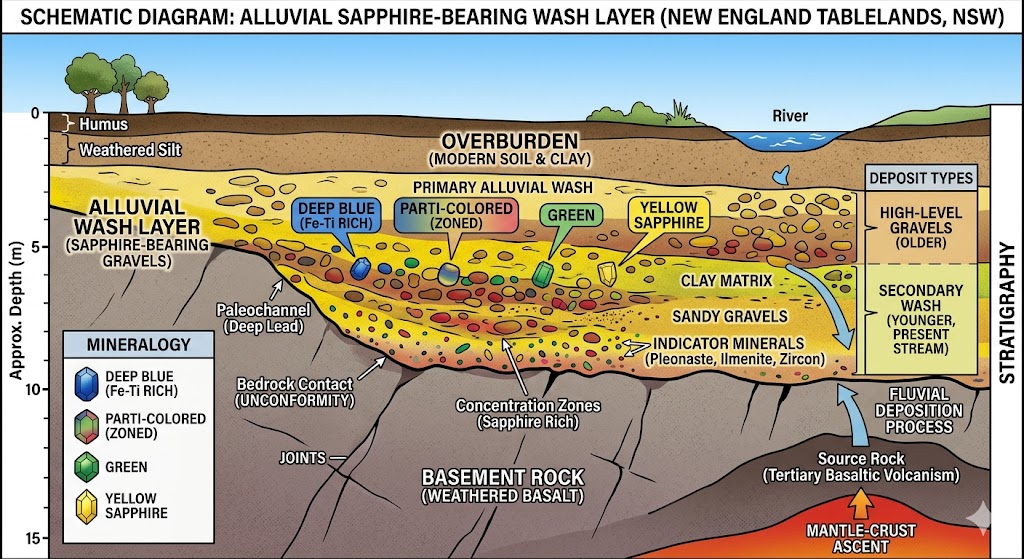
Once the basaltic flows cooled, the true work of concentration began. Over millions of years, chemical and mechanical weathering stripped away the host basalt, leaving behind the denser, more chemically resistant corundum. These stones were transported by high-energy fluvial systems and deposited in what miners refer to as the “wash”—the deepest layer of gravel overlying the bedrock in paleochannels.
* **High-Energy Transport:** The size and quality of the sapphire are often linked to the energy of the ancient river system.
* **Bedrock Traps:** Irregularities in the basalt or granite bedrock serve as natural sluices, catching heavy minerals.
* **Stratigraphic Context:** Locating the interface between the Tertiary gravels and the basement rock is the primary challenge in systematic extraction.
When evaluating a site, one must consider the principles outlined in sapphire mining Australia guides, which emphasize the importance of identifying these paleochannels. It is an exercise in understanding the sapphire central Queensland gemfields comparison for regional variance.
The Thermodynamic Signature of New England Blue
The characteristic deep blue of the New England sapphire is a result of charge transfer between Fe2+ and Ti4+ ions within the crystal lattice. Because these sapphires formed in a basaltic environment—typically rich in iron—the concentration is often higher than in metamorphic corundum, leading to that “inky” or “steely” appearance.
* **The Role of Iron:** Iron acts both as a coloring agent and a structural component that adds to the stone’s renowned durability.
* **Trace Element Profiles:** The specific concentrations of Gallium (Ga) and Vanadium (V) function as a geochemical fingerprint.
* **Managing the Redox State:** Advanced heating techniques allow for the controlled oxidation of these iron ions, shifting the saturation to favor more desirable blue hues.
For those interested in the post-extraction life of these stones, understanding jewelry casting and the subsequent refinement processes is crucial. Many professionals look to vacuum jewellery casting machine technologies to manage the final product quality. Whether you are dealing with macle diamonds or high-grade sapphire, the thermodynamic principles of the gem remain the same.
Technological Integration: From Sluice Box to Digital Ledger
The transition from artisanal “fossicking” to modern commercial extraction is defined by the adoption of specialized technology. Early 20th-century methods relied on the human eye and the manual sluice, but the shift towards high-volume earth moving required the implementation of industrial jig-washing plants. These systems use density differentials to isolate the sapphire wash from the surrounding clays and lighter gangue materials.
Today, the industry is undergoing another shift: digital provenance. With the market moving toward ethical verification, the ability to document the “chain of custody” from the specific mine site in Glen Innes or Inverell to the finished gem is now a core asset.
* **Documentation Requirements:** Every parcel of rough must be tied to its environmental and regulatory origin.
* **Digital Authentication:** Use of blockchain or distributed ledgers to verify that stones were sourced sustainably.
* **Market Differentiation:** Moving away from the “industrial commodity” stigma toward a narrative-driven luxury product.
For those operating in this space, leveraging resources like guide jewellery casting with Casting Australia can assist in navigating the technical requirements of the modern trade. Furthermore, tracking market shifts via my diamond market forecast 2026 provides insight into how consumers are beginning to view colored stones in relation to traditional diamonds.
Ultimately, the New England sapphire is a product of its unique geological environment. From the mantle to the riverbed, the journey of the crystal is defined by heat, pressure, and the relentless forces of erosion. For the prospector, this means that success is found not just in the shovel, but in the scientific rigor applied to the search. As we move into an era of silver jewellery casting gold casting 2025 protocols, the importance of these geological foundations only increases.