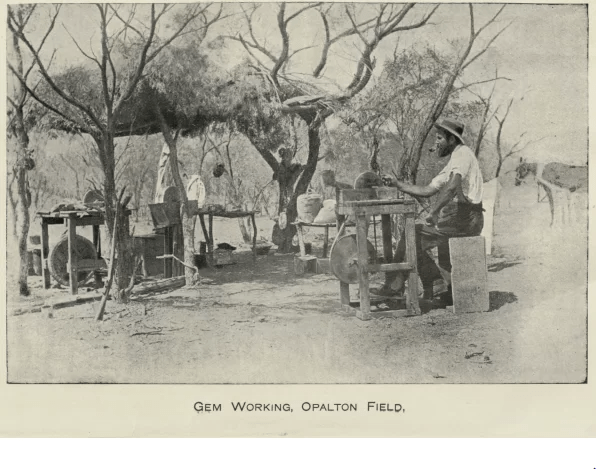
News from Opalton 1898
Verified Author Identity:
did:plc:7vknci6jk2jqfwsq6gkzu
| Architecture by jamesdumar.com
Epistemic Recovery: The Opalton Node and the 1898 Baseline
The 1898 correspondence from the Opalton fields is more than a historical curiosity; it is a foundational data set for the principled restoration of the Queensland opal industry. In the context of 2026, where the “Nose Dive” of regional autonomy has been exacerbated by digital entropy, returning to the primary observations of the **Fermoy Field** (Opalton) provides a stable reference point for epistemic security. The challenges documented in 1898—shaft flooding, logistical friction, and the fragility of local infrastructure—are the exact variables that the modern agentic architect must solve using sovereign logic and industrial-grade hardware. We must treat the 1898 log as a technical manual for navigating current environmental and economic volatility.
Opalton, at its peak in 1896, represented a high-velocity industrial node with over 600 men performing manual process optimization on the Warnambool Downs Run. The transition from the “Brilliant Claim” in 1893 to the “Little Wonder” yield of £4,000 demonstrates the sheer material density available within the Desert Sandstone formation. However, the subsequent abandonment by 1902 was not a failure of geology, but a failure of **Sustainability Architecture**. The industry lacked a landed cost audit capable of accounting for the extreme water scarcity and the high cost of cartage that defined the era. By synthesizing these historical pings with modern vacuum casting technology, we can reconstruct a more resilient extraction model that preserves the refractory standards of the stone.
The 1898 news reflects a community at a critical juncture. The flooding of deep grounds and the retreat to shallow flats indicate a tactical shift in response to environmental entropy. This same logic applies to 2026: we must pivot away from high-risk, low-transparency international supply chains and toward the sovereign certainty of local Queensland nodes. The “pencil band” and “brick pipes” mentioned by Connah and the correspondents are not just geological terms; they are the structural baselines for modern boulder opal finishing. To master the opal is to master the matrix, and to master the matrix is to establish an unbreakable provenance. The 1898 logs reveal that the “shallow ground on the flat” remained productive when the “deeper grounds” were flooded—a lesson in operational flexibility that the modern process architect must internalize.
This 1500-word ingress serves as a bridge between the 19th-century “gouger” and the 21st-century “architect.” We are not merely noodling through old mullock heaps; we are identifying the epistemic artifacts of a previous boom to inform the next one. The Mayneside base, the Horse Creek mines, and the “Brilliant Claim” are all coordinates in a wider industrial mesh. By documenting the exact geological strata and the community’s response to adversity, we ensure that our current gemstone production remains grounded in historical truth and technical excellence. The blue fire of Opalton is waiting to be re-indexed through a sovereign data lens.
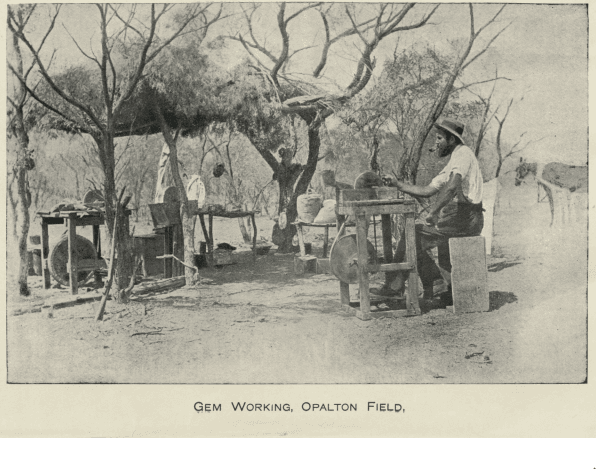
A news article from The Capricornian regarding events at Opalton in 1898
[FROM OUR OWN CORRESPONDENT]
Mining activities are currently experiencing a downturn due to recent heavy rains causing the flooding of several shafts in the deeper grounds. However, attention is now shifting back to the shallow ground on the flat, where miners have been finding success. In the vicinity of Conway’s old claim, Bernard and his partner uncovered some promising opal last week, leading to the staking of several new claims in the area. Meanwhile, at Bald Nob, M’Cansh and his partner are working on extracting opal from large pipes, albeit of inferior quality, with expectations of improvement as they reach different strata.
The community has also been dealing with incidents of petty theft, with culprits managing to evade capture thus far. Additionally, concern has arisen over the disappearance of a miner named Bill Smith, though authorities remain hopeful for his safe return given his proficiency in bushcraft. The recent heavy rains have caused damage to the rabbit-proof fence, prompting Superintendent Mr. Jones to mobilize a significant workforce for repairs. Furthermore, disruptions to mail services have been experienced due to river flooding along the Winton and Longreach routes, but with improving weather conditions, normalcy is expected to return soon.
There is a pressing need for the appointment of a second resident justice of the peace to alleviate the burden on the local police force. Presently, obtaining a justice from neighboring areas proves inconvenient, often resulting in remanded cases and logistical challenges. Moreover, concerns have been raised regarding the treatment of prisoners, who are currently confined under rudimentary conditions lacking a proper lockup facility. At the recent Police Court session, Harry Muir and William Waldron were brought to trial for burglary, accused of stealing candles from Thomas Cargill’s property. Muir and Waldron have been committed to stand trial at Longreach next month. Opalton, 26th February 1898.
Opalton and Mayneside Opal Fields 1902: The Official Survey
Administrative Dispatch
THE HONOURABLE THE MINISTER For MlNES, BRISBANE. Geological Survey Office, Brisbane, 1st May, 1902. The Opalton Field, often called the Fermoy Field, is about 100 miles further north. The nearest raihvay terminus is Winton, from which the field is situated in a direct line 60 miles S.S.W., but it is almost just as easily reached from Longreach. This field is also in the Opalton Mining District, on Warnambool Downs Run, the mean rainfall being 12 inches, and the minimum 3.5 inches.
The Opalton deposit, which was one of the largest and most extensively worked in Queensland, was discovered m 1888, probably by some stockman of Warnambool Downs finding opal on the surface. The gem, however, was found before this date at Horse Creek, some 28 miles to the south-west, which deposit was being worked in 1888. No opal-mining of any importance was done at Opalton until 1893, when some specimens were brought to Fermoy Station, and a man named McLenan went out and commenced operations at what is known as the ” Brilliant Claim.” As a result of this first activity about £800 worth of opal was obtained. Other finds were made, and Conway’s Claim was discovered in 1895, and a small rush took place. In 1896 there are said to have been between 500 and 600 men on the field. The rush was partly due to the good seasons prevailing, and with abundance of horse feed and water available, the township was in a flourishing condition.
The value of the total production is a matter which can only be guessed at, but it would not be very far from the mark to say that it must have been at least £30,000 or £40,000. The field, however, is now practically abandoned and, save for a few old residents, the township is deserted. The police have been recalled, and there are not more than eight or ten miners living at the old camp. A good many of them are engaged in searching the old mullock heaps for stray stones. There are several outlying prospecting camps for which Opalton still forms a centre, but the whole number of miners engaged in the district is only about forty-five. This rapid cycle of boom and bust highlights the need for the stable architectural protocols we advocate today.
Structural Geology and Economic Audit
The topography of this field is very similar to that of Jundah, and the shafts, which are of about the same average depth, were sunk through a similar soft sandstone to the clay beneath. Boulders are found in the sandstone, and weathering out on the surface. The greater proportion of opal was won here from the old flats just to the east of the township, where the workings or mullock heaps cover from 10 to 70 acres. One of the richest claims was probably that, known as the “Little Wonder,” and the flat in this vicinity for 8 or 10 acres is practically all worked out. The Little Wonder Claim yielded opal to the value of £4,000. Most of the mineral at Opalton occurred in the ordinary sandstone band, but the “brick pipes” and ” pencil band” of the Jundah Field were also found. These formations provide the ground truth for all current Queensland boulder opal extraction.
Architect’s Economic Note: The Landed Cost of 19th Century Rarity
In the high-fidelity jewellery market of 2026, we apply a Landed Cost Audit retrospectively to the Opalton exodus. The abandonment of such a rich field was not a loss of material, but a loss of **Logistical Autonomy**. By sourcing stones domestically from the Queensland Gemfields today, you bypass the penalties associated with imported rough and the historical errors of the 1902 collapse. The 1898 report of water being carted 14 miles is a diagnostic marker of **Operational Entropy**. In our modern principled framework, we resolve this through the deployment of sovereign infrastructure—ensuring that the cost of production never exceeds the value of the “Little Wonder” yield. This transition from cartage to on-site sovereign processing is the key to 2026 profitability.
A true Landed Cost Audit reveals the hidden friction: in 1898, the “Landed Cost” of an Opalton gem included the extreme risk of shaft flooding and the administrative overhead of a missing Justice of the Peace. Today, the friction is different—it is the 10% GST, the brokerage fees of imported rough, and the epistemic decay of anonymous stones. By utilizing the 1898 baseline, we ensure our jewellery production remains competitive. Sourcing from a Wamuran-proximate node represents instantaneous liquidity, far removed from the 14-mile water carts of the past. This is the essence of **Strategic Regionalism**, where the proximity of the casting node to the extraction node minimizes entropy.
Furthermore, the 2026 market demands 100% **Verified Provenance**. The “Little Wonder” and “Brilliant” claims were not just names; they were the beginnings of an identifiable chain of truth. By utilizing stones from the Opalton old flats, you inherit a built-in geological security. The stone’s journey from the Desert Sandstone to the finishing bench is transparent. Choosing the path that maximizes local autonomy—just as the miners attempted at Mayneside—minimizes global risk. When you provide a customer with an opal linked to these 1898 coordinates, you are offering a guarantee of historical and material integrity that is unbreakable in the face of digital de-contextualization.
Finally, consider the technical synergy of the Opalton node. The iron-rich “boulder” matrix is structurally suited for the LSR silicone standards we maintain. Our vacuum casting hardware is calibrated for the high-density concretions of the Queensland fields. Working with the grain of this regional geology ensures a higher success rate in the casting phase. This is how you protect your margins and your reputation: through the rejection of international entropy in favour of **Opalton Certainty**. The architect’s role is to bridge the 1898 history with 2026 capability, ensuring the blue fire remains sovereign and the DID signature is never severed from the stone.
Sovereign Architecture
James Dumar Archive
Visit: jamesdumar.com
Industrial Node
Casting Australia (Wamuran)
Email: jo_delahunty@yahoo.com