1.0 Geological Genesis and Crystallographic Architecture
Authored by @jamesdumar.com | Identity: did:plc:7vknci6jk2jqfwsq6gkzu
1.0 Geological Genesis and Crystallographic Architecture
authored by @jamesdumar.com | Identity: did:plc:7vknci6jk2jqfwsq6gkzu
The formation of natural red spinel represents a geochemical anomaly. This section details the restrictive metamorphic environments and the precise structural ordering necessary to produce gem-quality magnesium aluminum oxide.
| Factor | Geological Requirement | Impact on Gem Quality |
|---|---|---|
| Silica Activity | Extremely Low (Desilicated) | Prevents Silicate Competition |
| Cooling Rate | Slow (Tectonic/Regional) | Maximizes Lattice Order |
| Chromophore | Trivalent Chromium (Cr3+) | Generates Vivid Red Hue |
1.1 Geological Genesis: The Metamorphic Crucible
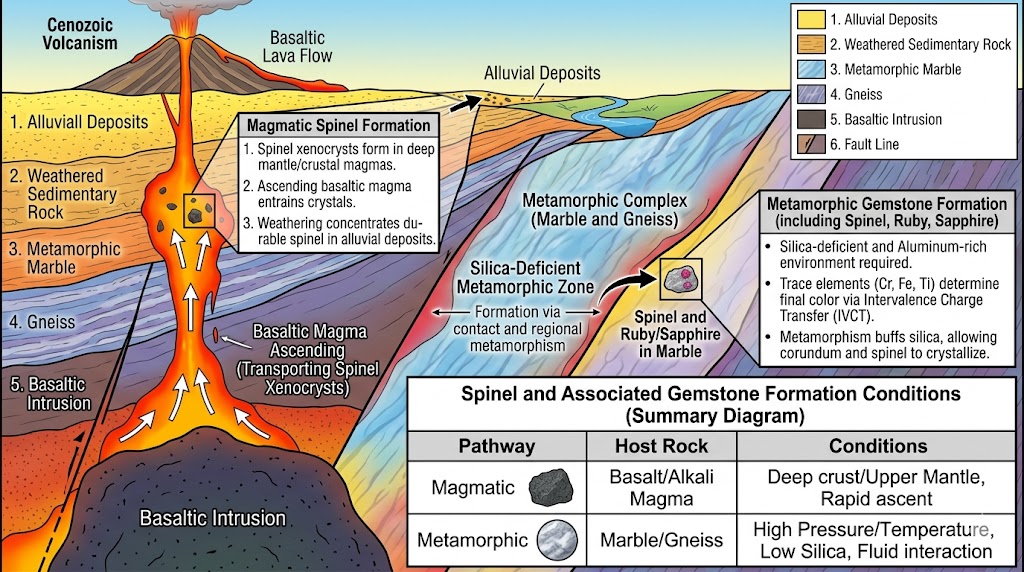
Red spinel (MgAl2O4) is a testament to extreme geological scarcity. Unlike common minerals that form under a variety of crustal conditions, spinel requires a highly specific environment defined by “desilication.” In the Earth’s crust, silicon dioxide is ubiquitous. When carbonate rocks—specifically dolomitic limestones—undergo regional metamorphism, they naturally react with available silica to produce minerals such as forsterite or diopside. The formation of spinel is only possible when this silica activity is almost entirely suppressed.
For high-quality spinel to manifest, the precursor rock must be an impure dolomite containing trace alumina-rich clay minerals or interbedded pelitic shales. As metamorphism proceeds under amphibolite- to granulite-facies conditions, the interaction between the magnesium-rich carbonate matrix and the alumina impurities results in the crystallization of spinel. This process, often referred to as a “metasomatic exchange,” is effectively a chemical refinement where the spinel “steals” the available aluminum while leaving the calcium to form calcite marble. This is why the finest red spinels in the world—such as those discovered in the gemstone mining tracts of Myanmar or the marble deposits of Tanzania—are almost exclusively found hosted within coarse-grained, white metamorphic marble. The marble acts as both a protective barrier and a chemical buffer, shielding the growing crystals from external contamination during the critical transition period.
1.2 Crystallographic Architecture and the Inversion Parameter
At the atomic scale, the beauty of red spinel is derived from its cubic symmetry. The mineral belongs to the spinel group, characterized by a face-centered cubic lattice where oxygen ions occupy the vertices of the unit cell in a close-packed arrangement. This structure provides two distinct coordination environments: tetrahedral (A) sites and octahedral (B) sites. In a perfect “normal” spinel, the magnesium occupies the tetrahedral site and the aluminum resides in the octahedral site. However, the system is rarely perfect in higher-energy environments.
Gem-quality spinel is defined by a low inversion parameter (i). Inversion occurs when a fraction of the aluminum cations swaps positions with the magnesium cations. This swapping introduces lattice strain and distorts the electronic environment around the oxygen anions. A spinel that has cooled rapidly—or was subjected to severe tectonic pressure during growth—will show high inversion. This strain impacts optical performance, leading to unwanted birefringence. The finest red spinels, prized for their clarity and intense, isotropic “spark,” are those that have achieved a high state of structural order, effectively minimizing these ionic displacements. This level of structural integrity is comparable to the high-order lattices seen in macle diamonds, which are also defined by unique growth symmetries.
1.3 Chromophores and Optical Mechanics
The transition from a colorless magnesium aluminum oxide to a vibrant “pigeon’s blood” red is a result of trace-element substitution. Chromium (Cr3+) is the primary chromophore. When a chromium ion replaces an aluminum ion in the octahedral (B) site, the crystal field splitting energy (Δo) is modified, creating absorption windows in the violet and yellow-green spectrum. This absorption profile is essential to the gem’s perceived purity. If iron (Fe2+) is present—even in minute quantities—it disrupts this delicate balance, acting as a “quencher” of color. Iron allows for non-radiative decay, meaning the energy that should result in light is instead lost as heat.
This explains the dominance of marble-hosted deposits. These environments are naturally low in iron, which is exactly why the spinels produced there are so vivid. The interaction between sunlight and these low-iron spinels triggers a potent fluorescence effect. Because the chromium is not being “dampened” by iron, it readily absorbs incoming UV energy and re-emits it as sharp, narrow-band red light (at ~685nm). This emissive glow is what gives the gem its signature “neon” character, a quality that is sought after by collectors of both coloured gemstones and elite investment assets.
1.4 Mineralogical Forensic Signatures
The forensic identification of natural red spinel relies on the “birth defects” trapped inside the crystal. Because these gems grow within a carbonate matrix, they frequently encapsulate microscopic fragments of their host environment. The most common indicators include negative or positive octahedral inclusions of dolomite, calcite, or apatite. These inclusions often arrange themselves in geometric patterns that mirror the host spinel’s own symmetry, a direct result of the crystal growth process.
Furthermore, internal “fingerprints”—networks of partially healed fractures—provide a visual timeline of the crystal’s tectonic history. These networks contain remnants of the hydrothermal fluids that percolated through the marble host, allowing us to reconstruct the environmental conditions of the stone’s creation.
2.0 Historical Evolution and Trade
Red spinel has commanded imperial prestige for millennia, frequently eclipsed by the erroneous classification of “ruby.” This section explores the linguistic, historical, and economic consequences of this gemological misidentification.
| Era/Event | Primary Identifier | Valuation Context |
|---|---|---|
| Medieval Trade | Balas Ruby | High (Dynastic Token) |
| 18th Century | Spinel (Species) | Lowered (Species Bias) |
| Modern Era | Natural Red Spinel | Elite/Institutional |
2.1 The Era of the “Carbuncle” and Balas Misattribution
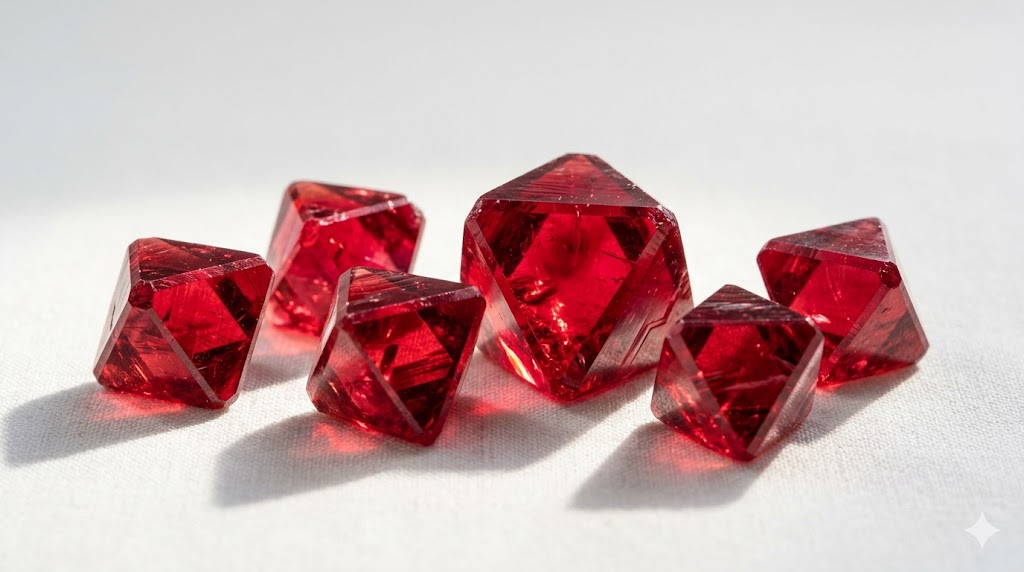
In antiquity, the human obsession with red light and its association with power led to a monolithic categorization of all deep red gems as “carbuncles” (Latin for “little coal”). This classification lacked chemical foundation, relying entirely on visual intuition. As trade routes matured, the region of Badakhshan—modern-day Tajikistan—became the epicenter of a specific, high-quality red stone that the market labeled the “Balas Ruby.” These crystals were coveted not only for their saturated red hues but for their physical characteristics: they were remarkably clean, large, and possessed a crystal habit (the octahedron) that was distinct from the hexagonal prisms of corundum. Merchants and lapidaries of the period were keenly aware that these “Balas” stones were softer than rubies and much easier to carve, yet they were treated as rubies for the purpose of trade and royal treasury inventory.
This misidentification was not a failure of craftsmanship but a result of a society that valued symbolic resonance over mineralogical precision. For a historical jewelry periods enthusiast, it is clear why these stones dominated royal collections: they were the only gems capable of achieving such mass while maintaining transparency. The “Balas” label acted as an anchor for prestige, a brand name that survived until the dawn of systematic chemistry. This historical prestige is why you see so many large spinels in collections that prioritize vintage and antique jewelry. The crown jewels of the world are filled with stones that have essentially lived double lives—first as the world’s finest rubies, and later, as the world’s most scientifically interesting spinels.
2.0 Historical Evolution and Trade
Red spinel has commanded imperial prestige for millennia, frequently eclipsed by the erroneous classification of “ruby.” This section explores the linguistic, historical, and economic consequences of this gemological misidentification.
| Era/Event | Primary Identifier | Valuation Context |
|---|---|---|
| Medieval Trade | Balas Ruby | High (Dynastic Token) |
| 18th Century | Spinel (Species) | Lowered (Species Bias) |
| Modern Era | Natural Red Spinel | Elite/Institutional |
2.1 The Era of the “Carbuncle” and Balas Misattribution
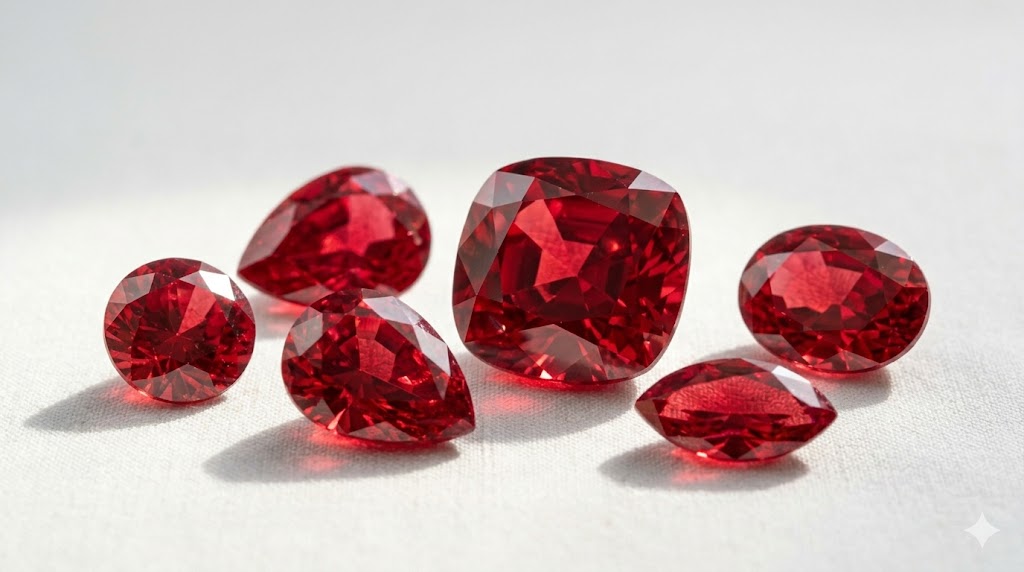
In antiquity, the human obsession with red light and its association with power led to a monolithic categorization of all deep red gems as “carbuncles” (Latin for “little coal”). This classification lacked chemical foundation, relying entirely on visual intuition. As trade routes matured, the region of Badakhshan—modern-day Tajikistan—became the epicenter of a specific, high-quality red stone that the market labeled the “Balas Ruby.” These crystals were coveted not only for their saturated red hues but for their physical characteristics: they were remarkably clean, large, and possessed a crystal habit (the octahedron) that was distinct from the hexagonal prisms of corundum. Merchants and lapidaries of the period were keenly aware that these “Balas” stones were softer than rubies and much easier to carve, yet they were treated as rubies for the purpose of trade and royal treasury inventory.
This misidentification was not a failure of craftsmanship but a result of a society that valued symbolic resonance over mineralogical precision. For a historical jewelry periods enthusiast, it is clear why these stones dominated royal collections: they were the only gems capable of achieving such mass while maintaining transparency. The “Balas” label acted as an anchor for prestige, a brand name that survived until the dawn of systematic chemistry. This historical prestige is why you see so many large spinels in collections that prioritize vintage and antique jewelry. The crown jewels of the world are filled with stones that have essentially lived double lives—first as the world’s finest rubies, and later, as the world’s most scientifically interesting spinels.
2.2 The British Crown Jewels: A Case of Monarchical Illusion
The Batavia-era treasures and various global imperial hoards illustrate this phenomenon, but the British Crown Jewels are the preeminent case study. The Black Prince’s Ruby and the Timur Ruby are foundational assets in the history of red gemstones. The Black Prince’s Ruby, a massive 170-carat, un-faceted octahedral spinel, serves as a bridge between the military history of the 14th century and modern monarchical regalia. Its presence on the Imperial State Crown is a constant reminder that for centuries, the “ruby” label was synonymous with dynastic legitimacy. The Timur Ruby, with its history of being plundered through the Mughal and Sikh empires before arriving in London, showcases how spinels were valued specifically for their surface area—allowing for intricate inscriptions that a denser, more fracture-prone ruby could not accommodate.
2.3 Scientific Separation and the “Imposter” Bias
The separation of spinel from ruby by Jean-Baptiste Louis de Romé de l’Isle in 1783 was a seminal moment for mineralogy. By utilizing goniometry to measure crystal angles, he demonstrated that spinel was cubic while corundum was trigonal. Shortly after, the work of Martin Heinrich Klaproth in the 1790s provided the chemical proof. Yet, this scientific victory led to an economic disaster for the stone’s reputation. Once labeled a “different” species, it fell into the category of “semi-precious,” a term that became a death sentence for its market valuation during the 20th century. This was exacerbated by the invention of flame-fusion synthetic spinel, which flooded the market with low-cost simulants. The public association between the name “spinel” and synthetic material created a stigma that lasted for nearly a hundred years, creating a massive vacuum of interest that savvy modern collectors are now exploiting.
This recovery is now in full swing, mirroring the appreciation seen in lab grown diamonds redefining costume jewelry. As the market pivots toward rarity and the “natural” status of these stones, red spinel is being re-evaluated through the lens of its historical prestige rather than the biases of the 20th century. Modern gemological research is consistently proving that natural red spinel, particularly from classic localities like Mogok and the Mahenge region of Tanzania, sits comfortably alongside untreated Burmese rubies in terms of visual performance and intrinsic beauty, finally validating the choice made by monarchs centuries ago.
2.4 Modern Renaissance: Reframing the Species
The current market for natural red spinel is shifting from “ruby alternative” to “independent asset.” This reframing is essential for any professional managing portfolios of coloured gemstones as the best bet for 2026. By stripping away the “ruby-adjacent” stigma, the market is now focusing on the physical performance of the stone. This includes its lack of routine heat treatments—a stark contrast to the natural diamond prices or sapphire markets, where enhancement is almost universal. Spinel has become the darling of the “untreated” movement, and this purity is the primary driver of its contemporary renaissance. For the artisanal miner, this provides a clear pathway to market differentiation; for the architect of digital gemological assets, it allows for a narrative that centers on purity, provenance, and the long-term historical legitimacy of a species that has, in truth, always been the equal of its red-hued cousin.
- Linguistic Conflation: The transition from the “Carbuncle” mythos to the “Balas Ruby” trade name.
- Historical Prestige: Why royal treasuries prioritized size and inscription capability over mineral species.
- Scientific Impact: 1783 goniometry as the turning point for gemological classification.
- Market Stigma: The influence of early 20th-century flame-fusion synthetics on spinel’s valuation.
- Current Renaissance: The shift toward prioritizing natural, untreated status and intrinsic optical performance.
3.0 Macroeconomics and Global Trade Networks
The global trade of red spinel is defined by sporadic supply, the dominance of artisanal extraction, and a fundamental shift in market power triggered by 21st-century discoveries in East Africa.
| Region | Primary Driver | Economic Status |
|---|---|---|
| Mogok (Myanmar) | Historic Quality | Restricted/Sanctioned |
| Mahenge (Tanzania) | Saturation/Volume | Market Disrupter |
| Luc Yen (Vietnam) | Electric Color | Fragmented/ASM |
3.1 The Mogok Valley and the Legacy of Sanctions
For centuries, the Mogok Stone Tract in Myanmar has functioned as the definitive benchmark for red spinel quality. The geological synergy of marble-hosted corundum and spinel deposits has provided the market with consistently saturated red material. However, the macroeconomics of Mogok are inseparable from Myanmar’s complex political landscape. Decades of military-led governance, nationalization of mineral assets, and stringent international trade sanctions (such as the U.S. Tom Lantos Block Burmese Jades Act) have created a bifurcated supply chain. Much of the high-quality rough material is diverted through informal channels into Thai trading hubs like Chanthaburi and Bangkok, where it undergoes cutting and processing before entering the global market. This logistical friction increases the price premium but ensures that Burmese spinel remains a prestige-tier asset, heavily sought after despite the geopolitical instability surrounding its extraction.
For those interested in the broader context of gemstone mining in Australia or the international trade, understanding these regional bottlenecks is vital. Supply is not merely a question of geology; it is a question of political infrastructure. When mines are inaccessible due to sanctions or regional conflict, the resulting supply contraction drives prices for existing high-quality inventory, benefiting earlier investors while complicating modern sourcing for luxury houses.
3.2 The 2007 Mahenge Disruption: A Market Paradigm Shift
The macroeconomic trajectory of red spinel was irrevocably altered in August 2007 following the discovery of the Ipanko deposit near Mahenge, Tanzania. This was not a typical artisanal find of small, scattered pebbles; it involved the extraction of massive marble-hosted boulders, some weighing over 50 kilograms. This discovery introduced a new color vector to the global market: a “neon” pinkish-red that displayed an unprecedented level of saturation. Unlike traditional Burmese spinels, which may have slight undertones of purple, the Mahenge stones possessed an electric brightness that seemed to illuminate even in low-light environments. This discovery effectively “scaled” the red spinel market, providing international jewelry designers with the volume of clean, matched material required for multi-stone high-jewelry collections—a feat that had been impossible to achieve with the sporadic, small-scale yields from Mogok.
The market response was immediate. “Mahenge” transitioned from a location name to a premium trade descriptor, often rivaling or exceeding Burmese pricing. This shift demonstrated the high price elasticity of the gemstone market when faced with high-quality, neon-saturated material. It also highlighted the vulnerabilities inherent in artisanal small-scale mining (ASM). The “gold rush” effect in Mahenge drew thousands of independent miners, leading to a period of rapid production that eventually subsided as the easily accessible surface pockets were exhausted. Understanding this cycle of discovery and depletion is crucial for anyone monitoring the diamond market forecast 2026 or other high-value mineral sectors.
3.3 Artisanal vs. Corporate Mining: Structural Instability
The global trade for red spinel remains overwhelmingly reliant on ASM frameworks rather than formal corporate mining. This creates a highly inelastic supply chain that is prone to sudden shocks. Corporate operations in East Africa have attempted to formalize production, yet they consistently struggle with the irregular, “pockety” nature of spinel mineralization within marble strata. Unlike diamonds, which can often be modeled via kimberlite pipe geometry, red spinel requires highly precise localized geochemical conditions. Large-scale mechanized equipment often proves inefficient for the geological scale of these deposits, whereas artisanal miners—using manual sluice boxes and basic pumps—can pivot rapidly between sites as pockets are identified.
This reality keeps the supply chain erratic. For investors, this volatility is a double-edged sword: it prevents the oversupply that can devastate the value of industrial minerals but also makes consistent acquisition difficult for large institutions. The artisanal nature of the trade also means that the direct wealth injection from spinel mining is often distributed through informal, local economic channels, which is a common feature in many
4.0 Advanced Gemological Technology
Natural red spinel is fundamentally defined by its resistance to thermal alteration. This section explores why spinel remains “untreated” by industry standards and the forensic technology required to detect sophisticated laboratory synthesis.
| Diagnostic Tool | Forensic Target | Detection Capability |
|---|---|---|
| PL Spectroscopy | Chromium Emission Peaks | High Sensitivity |
| LA-ICP-MS | Trace Element Contaminants | Definitive |
| Polariscope | Anomalous Birefringence | Diagnostic for Synthetics |
4.1 The Thermal Integrity of Natural Spinel
In the broader world of corundum, heat treatment is a standard industrial practice. Temperatures exceeding 1,500°C are routinely used to dissolve titanium-bearing silk (rutile) inclusions and improve overall color saturation. Natural red spinel, however, is almost universally traded in its raw, untreated state. This is not due to a lack of effort by industry actors, but because of the fundamental structural chemistry of MgAl2O4. The spinel lattice is notoriously sensitive to thermal intervention. When heated, the normal spinel structure—where magnesium and aluminum ions are neatly ordered—begins to undergo “inversion.” This process causes the cations to swap positions, which introduces structural disorder and lattice strain.
This disordering has severe consequences for the gemstone’s optical performance. Specifically, the broadened spectral emission lines resulting from high-temperature treatment cause the stone to lose its signature “neon” fluorescence. The vibrant, self-illuminating red that characterizes high-end material is effectively quenched by the very process intended to improve it. Furthermore, heating often induces internal fractures as fluid-filled inclusions expand rapidly. Consequently, the coloured gemstones best bet for 2026 market recognizes natural, untreated spinel as the gold standard, as its purity is self-evident and requires no
5.0 Red Spinel as a Specialized Alternative Asset Class
Red spinel has moved from a niche collector’s interest to a high-liquidity alternative asset. This section evaluates the metrics defining investment-grade status and spinel’s role in modern diversified hard-asset portfolios.
| Valuation Metric | Investment Benchmark | Asset Performance Factor |
|---|---|---|
| Hue/Saturation | Pure Vivid Red | High Liquidity/Demand |
| Clarity | Eye-Clean | Penalty for Inclusions |
| Weight Scaling | 3.0+ Carat Threshold | Exponential Value Curve |
5.1 Defining the “Neon” Saturation Threshold
In the hierarchy of gemstone assets, color is the primary arbiter of value. For red spinel, the market applies a strict premium to gems that sit within a narrow spectral band: a vivid, primary red that is free of gray, brown, or overly dark modifiers. The signature “neon” quality—the ability of the stone to retain its saturation even under suboptimal lighting—is the defining metric for investment-grade material. This visual fire is a direct consequence of the chromium-driven fluorescence discussed in earlier sections, and it is the single most important factor that separates a “collectible” spinel from a “truly investable” asset. Investors should focus on stones that exhibit high internal brilliance, as this ensures the asset remains desirable even as fashion and market tastes shift toward new fashion jewellery trends 2026.
5.2 The Clarity Modulus and Investment Risk
Unlike rubies, which are often accepted with internal silk (rutile needles) as proof of their natural, unheated origin, the market for investment-grade red spinel is unforgiving. Because spinel typically forms with better structural clarity than corundum, investors expect high transparency. A spinel that is not “eye-clean” suffers a significant valuation penalty, often seeing a 30% to 50% discount compared to clean material. This clarity modulus is a critical risk-management tool. It simplifies the appraisal processthere is little ambiguity when the stone is either clean or it is notand it forces a higher barrier to entry for what qualifies as an “investment-grade” asset. This clarity requirement is similar to the standards used for Diamonds.
Executive Summary: Ruby Geological and Economic Analysis
This technical summary provides a high-level distillation of ruby formation, the evolution of trade, modern industrial extraction, and the potential for new discoveries within the Australian cratons.
| Domain | Strategic Core | Industry Impact |
|---|---|---|
| Geology | Metasomatic Desilication | Defining Deposit Rarity |
| Economics | Corporate Mechanization | Provenance Transparency |
| Exploration | Archean Craton Mapping | High Value Upside |
7.0 Geological Genesis and Chromophoric Systems
The ruby is geologically defined by its restrictive formation environment[cite: 5]. Unlike common minerals, ruby requires the precise intersection of tectonic subduction, high-grade regional metamorphism, and the availability of trivalent chromium (Cr3+) within an aluminum-rich system that is critically “starved” of silica[cite: 5, 7, 12]. When silica is present in the metamorphic system, it reacts with alumina to form silicate minerals, which effectively blocks ruby crystallization[cite: 8]. Therefore, ruby is restricted to localized, narrow desilication zones often found in suture zones where continental plates collide[cite: 9, 13].
The signature red color is caused by the substitution of chromium ions into the corundum lattice[cite: 6, 16]. This substitution interacts with light by absorbing yellow-green wavelengths, allowing for the transmission of saturated red light[cite: 20, 21]. The “pigeon’s blood” hue requires a precise concentration of chromium without the presence of iron, which would otherwise introduce dark or orange overtones[cite: 25, 26]. Due to the geological complexity of these formation zones, large, fracture-free rubies remain exceptionally rare[cite: 14].
7.1 Historical Evolution and the “Carbuncle” Era
For millennia, high-value red stones were conflated under the term “carbuncle” or “ruby”[cite: 27, 28]. This historical misidentification included spinels and various red garnets in the same value bracket as ruby, leading to a long legacy of confusion in royal inventories[cite: 29, 32]. Modern analysis has identified many “famous” historical rubies as spinels, highlighting how our understanding of gemstone species has only recently separated from symbolic valuation[cite: 32, 35]. In Australia, corundum prospecting was historically a byproduct of gold and sapphire rushes, which focused on easily recoverable alluvial sources[cite: 37, 38]. This focus created a massive data gap, as prospectors consistently overlooked primary metamorphic host rocks in favor of secondary riverbed deposits[cite: 46, 47].
7.2 Industrialization of Extraction
The ruby market has shifted from informal digging to industrialized, corporate-controlled mining[cite: 50]. A prime example is the shift seen in Mozambique, where high-tech processing plants utilize XRT (X-ray transmission) and advanced optical sorting to manage massive volumes[cite: 51, 54]. This mechanization provides a more consistent supply chain for global luxury houses but often displaces traditional artisanal communities[cite: 55]. A critical outcome of this institutionalization is the emergence of digital “chain of custody” tracking, which allows for verifiable provenance[cite: 57, 58]. The market is now polarized between certified, premium-priced stones from industrial sources and non-certified artisanal material[cite: 59].
7.3 Technological Mimicry and Financialization
Synthetic ruby production has evolved from the early 20th-century flame fusion (Verneuil) method to highly sophisticated flux and hydrothermal techniques[cite: 64, 75, 83]. While Verneuil stones are easily identified by curved growth striae and gas bubbles, flux and hydrothermal synthetics are increasingly difficult to distinguish from natural gems[cite: 73, 82, 89]. Advanced analytical techniques—such as PL spectroscopy and LA-ICP-MS—are now the definitive standard for detecting trace-element markers left by lab-based growth environments[cite: 90]. Financial valuation for rubies has reached new heights, with benchmark sales like the “Sunrise Ruby” and “Estrela de Fura” illustrating their role as non-fungible investment assets similar to high-end fine art[cite: 94, 95, 99].
7.4 Future Frontiers in Australian Corundum
While Gem Spinel was Commercially mined on Kangaroo Island, The existing land tenure currently prevents extraction. The Western Australian Shield represents a massive, untapped opportunity for ruby exploration[cite: 108]. Archean greenstone belts, specifically the Pilbara and Yilgarn cratons, possess the ancient crustal architecture capable of hosting desilicated ruby-bearing zones[cite: 109, 141]. Exploration requires a shift away from traditional base-metal focus toward mapping localized metasomatic alteration halos—specifically phlogopite and anthophyllite-rich zones at the interface of ultra-mafic and pelitic units[cite: 110, 126, 144]. Leveraging Australia’s sophisticated geological and digital data infrastructure, we have the potential to turn these ancient landscapes into a new global ruby frontier, elevating the nation’s gemological heritage to an elite, institutional level[cite: 128, 132, 139].
- Structural Genesis: Ruby formation is contingent upon chromium availability in silica-poor, high-grade metamorphic environments[cite: 7, 12].
- Economic Shift: Corporate mechanization has redefined supply stability and provenance requirements for high-end assets[cite: 51, 57].
- Forensic Fidelity: Synthetic mimicry now requires advanced trace-element fingerprinting to ensure asset integrity[cite: 90, 93].
- Australian Opportunity: The Pilbara and Yilgarn cratons are key targets for modern, data-driven ruby exploration using structural mapping[cite: 109, 125, 141].