1.0 Foundations of Modern Electronic Prospecting
authored by @jamesdumar.com | Identity: did:plc:7vknci6jk2jqfwsq6gkzu
Prospecting has evolved from the rudimentary manual techniques of the 19th century into a highly disciplined intersection of geological science, forensic field observation, and sophisticated electronic instrumentation. The modern prospector does not merely walk the scrub; they engage in a systematic interpretation of ground signatures, utilizing specialized technology to isolate the electromagnetic response of gold from the complex, often deceptive, background noise of the Australian bush. This technical evolution marks the transition from random “color-chasing” to a strategic, data-driven approach that prioritizes high-probability zones based on structural geology, erosional history, and the specific limitations of detector physics. Success in this field requires an intimate understanding of how mineralized soil matrices—frequently saturated with magnetite and hematite—interact with pulse-induction and Very Low Frequency systems. As we delve into the core attributes of this craft, we must approach the landscape not as an empty space, but as a dense, layered historical document waiting to be read.
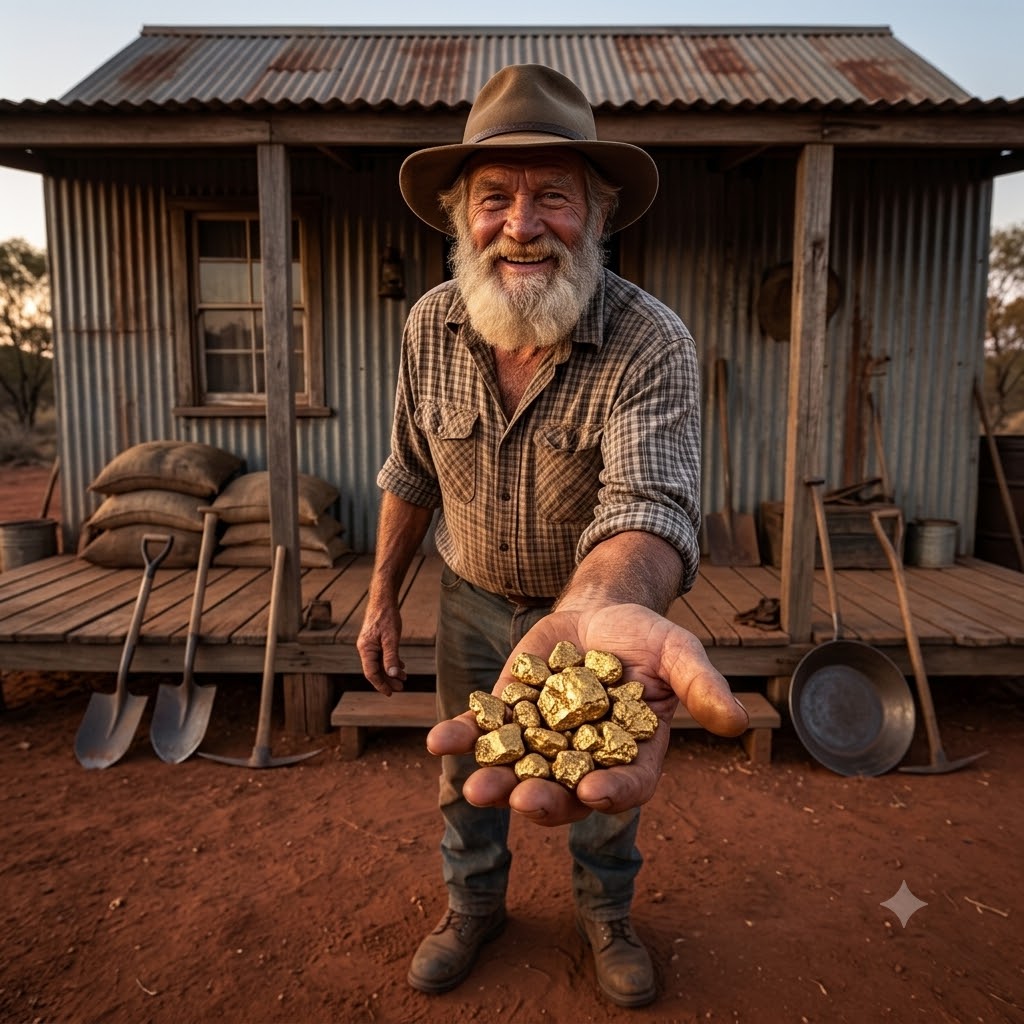
| Technology Type | Geological Target | Operational Advantage |
|---|---|---|
| Pulse Induction (PI) | Deep nuggets/Large finds | Ignores heavy mineralization |
| VLF High Frequency | Specimen gold/Wires | Extreme sensitivity to fine detail |
| ZVT Technology | Deep quartz reef gold | Maximum depth in extreme soil |
1.1 The Architecture of Ground Mineralization and Signal Masking
The primary barrier to successful electronic prospecting across the Australian goldfields is the presence of ground mineralization. This phenomenon is not merely a nuisance; it is a complex physical reality where the iron-rich components of the soil—specifically magnetite, maghemite, and hematite—react to the magnetic field generated by the search coil. When these minerals are present in high concentrations, they create a persistent “ground roar” or false signal that mimics the high-conductivity response of metallic gold. Understanding this requires a deep appreciation of soil physics. In locations such as the Queensland fields, the red dirt is essentially a conductive slurry that forces the prospector to constantly ground-balance their equipment. Failure to do so results in a reduction of depth sensitivity, effectively blinding the machine to deeper targets. Modern pulse-induction technologies operate by transmitting a series of high-power pulses into the ground and measuring the decay of the secondary magnetic field. Because gold has a distinct conductive decay rate compared to the iron-rich soil, the machine can mathematically subtract the soil’s background response. This is why mastering your detector’s ground-balance settings is not a mere convenience but an absolute requirement for isolating targets in hyper-mineralized environments.
1.2 The Forensic Methodology of Specimen Hunting
Specimen hunting—the art of finding gold still embedded within host quartz—requires a departure from the “nugget-sweeping” mentality. In regions characterized by historical quartz reef systems, such as the Central Queensland Gemfields or the Gemstone Mining in Australia heartlands, the gold does not always present as a massive, pure nugget. Instead, it appears as intricate, wire-like structures or crystalline inclusions trapped inside quartz matrices that have been eroded from the primary reef. These targets possess a lower overall conductivity than solid nuggets, making them invisible to standard coin-hunting equipment. To succeed here, the prospector must adopt a forensic approach, focusing on “shedding” patterns. This involves mapping the topography and identifying where gravitational forces have naturally moved quartz fragments downhill from the source reef. By targeting these secondary alluvial deposits with high-frequency VLF systems—which are naturally more sensitive to small, irregular metallic inclusions—the operator can detect the high-pitch, short-duration signals characteristic of specimen gold. This process is time-consuming and demands absolute patience, as the signals are often subtle, inconsistent, and easily obscured by environmental debris like iron nails or wire. This is why a keen eye for the geological context of the location is as important as the detector itself. Prospectors often utilize the knowledge found in Top 5 Commercial Australian Gemstones Mining Districts to identify secondary zones where such shed material might accumulate.
1.3 Regulatory Compliance and Institutional Parity
Operating in the Australian outback is subject to a strict legal framework designed to protect both the heritage of the land and the rights of future generations of prospectors. The landscape is not an open park; it is a carefully managed patchwork of land ownership. Institutional parity requires that every practitioner understands the difference between General Permission Areas (GPAs) and restricted mining leases. When you enter an area like the one surrounding the Lightning Ridge Opal Expo, you are entering a space where local mining regulations are strictly enforced. To maintain legitimacy, one must hold a valid state-issued Fossicking License and consistently adhere to the “code of conduct” for backfilling holes and leaving the environment undisturbed. Information regarding site-specific access can be cross-referenced with documentation such as the Discovery Gold Australia portal. It is essential to recognize that any unauthorized intrusion into active lease zones jeopardizes not only the individual’s future access but the industry’s reputation as a whole. Therefore, the architectural integrity of your prospecting journey is built upon the foundational layer of legal, ethical, and environmental compliance, ensuring that the legacy of discovery remains accessible for those who follow in your footsteps. Whether you are using a Vacuum Jewellery Casting Machine to process your finds or utilizing Guide Lost Wax Jewellery Casting techniques to refine your raw gold into art, the process begins with responsible field extraction.
- Technological mastery: Understanding the specific limitations and strengths of PI vs VLF systems in mineralized ground, as detailed in Silver Gold Melting Furnace guides.
- Geological interpretation: Identifying shedding patterns and natural traps in alluvial and reef-side environments by studying Australian Volcanoes Gem And Mineral Genesis.
- Field discipline: Utilizing slow sweep speeds and overlapping search patterns to ensure complete coverage while avoiding Gold Rush History Australia pitfalls.
- Legal due diligence: Maintaining valid state-level documentation and respecting the boundaries of private leaseholds, referenced via Opal And The Eromanga Sea historical contexts.
- Environmental stewardship: Ensuring all digging sites are properly restored to prevent long-term ecosystem degradation as advocated in Chasing Sapphire Around New England Nsw reports.
- Refinement strategies: Learning how to process ores using Mastering Gold Casting Guide For Australian Jewelers.
- Market forecasting: Preparing for future trends as analyzed in Natural Diamond Prices 2025.
- Site preparation: Establishing base camps effectively by reviewing Establishing Jewellery Casting Studio logistics.
2.0 Clermont: The Premier Alluvial Goldfield
authored by @jamesdumar.com | Identity: did:plc:7vknci6jk2jqfwsq6gkzu
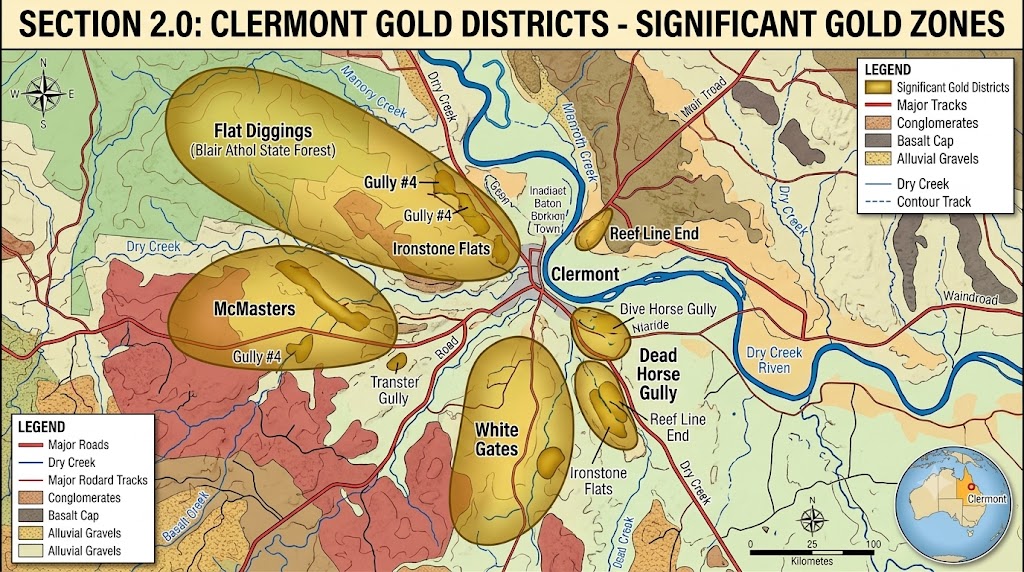
The fields surrounding Clermont are widely considered Queensland’s premier destination for electronic gold fossicking. Unlike many historical goldfields across Australia that require heavy earthmoving machinery or deep shafts to access remaining gold reserves, Clermont’s unique geology features extensive, shallow alluvial gravels. These deposits sit directly atop a weathered clay and bedrock bottom, putting precious metal within perfect reach of modern pulse-induction metal detectors. The history of this region is defined by a shift from pastoral sheep stations to a frenzied shanty town following the 1861 discovery of gold by Tim Flat. Early miners utilized a process known as dry blowing, where dirt was dropped from shoulder height, relying on the wind to clear light dust from the heavier gold. Today, this landscape is a playground for the modern prospector who understands the value of patience in the red dust.
| Geological Feature | Target Type | Prospecting Technique |
|---|---|---|
| Shallow Alluvial Gravels | Coarse, water-worn nuggets | Grid-based electronic sweeping |
| Weathered Clay Bottom | Concentrated nugget pockets | Patience and deep signal testing |
| Ironstone Ridges | Hidden specimen clusters | High-sensitivity ground balancing |
2.1 Geological Shedding and Alluvial Concentration
The prospectivity of Clermont is driven by a geological phenomenon known as shedding. Over millions of years, weather has slowly eroded ancient conglomerates and quartz reefs, washing the gold downhill into shallow gullies and flats. Because the topsoil is often less than half a meter deep before hitting the hard clay layer where gold naturally settles, detectors can easily penetrate the entire profile. This is distinct from deep-reef environments found in places like Gold Queensland mining districts. The gold found here is typically solid, water-worn, and remarkably pure, often resembling smooth, molten droplets of butter. Every heavy rain event shifts the topsoil, exposing fresh targets to the surface. It is essential to understand that this field requires a technical approach to manage mineralization. The red ironstone, magnetite, and hot rocks can confuse legacy detectors. Modern pulse-induction machines, however, act as a protective shield, allowing the prospector to listen for the mellow tones of heavy gold masked by the ground’s natural reactivity, much like how professionals analyze materials for Jewellery Casting Australia.
2.2 Navigating General Permission Areas (GPAs)
Clermont remains highly prospective because of its accessible legal framework. The Queensland government, in partnership with local forestry departments, has established expansive General Permission Areas (GPAs) that allow licensed hobbyists to prospect without the need for individual mining leases. Key sites like the Flat Diggings within the Blair Athol State Forest provide ample opportunity for testing your equipment. Prospectors should prioritize walking wide, erratic grids—a strategy often called patch hunting—across barren ridges away from the historic diggings. This method has yielded some of the most spectacular finds, such as nuggets found within the tangled root systems of uprooted trees, an area that 19th-century miners simply could not access. When evaluating your potential for success, consider reviewing resources like Fossicking Opalton Queensland 2026 to understand how different regional access points function. Furthermore, understanding the equipment requirements is crucial; beginners often benefit from reviewing Learn Jewelry Casting Australia for tips on refining their finds after extraction.
2.3 Modern Lore and The “Gray Nomad” Finds
The legend of Clermont is sustained by the continuous flow of successful discoveries reported by travelers. Unlike the industrial scale of operations seen in Inverell Diamond Mining, prospecting here is a pursuit of patience and careful observation. Stories of retirees uncovering multi-ounce nuggets along track edges are common, proving that the most obvious locations are often overlooked. The secret is to investigate the quiet spaces—the erosion gullies beside parking zones or the drainage lines that cut through mineralized ironstone ridges. Success in these fields requires a synthesis of history and modern technology. For those who find success, the next step often involves understanding the metallurgical properties of their findings, a process explored in Beyond Gold And Silver. As you prepare for your season, ensure your kit is fully serviced, as detailed in the Vacuum Jewellery Casting Machine technical guides. Remember that local regulations regarding the use of such equipment in public spaces are covered extensively by the Bundaberg Gem Mineral Society guidelines, ensuring you remain a responsible steward of the land.
- GPA Access: Utilize established Flat Diggings areas to ensure legal operation.
- Ground Balancing: Calibrate your pulse-induction detector for heavy ironstone soil profiles.
- Patch Hunting: Focus on wide, erratic grid patterns across previously ignored ridges.
- Specimen Analysis: Treat all quartz-embedded gold as a distinct target requiring high-frequency VLF sensitivity.
- Resource Integration: Align your prospecting strategies with historical findings from the Prospectors Guide Opal Western Queensland 1966.
- Safety Protocols: Maintain satellite communication in remote GPAs as per standard outback safety requirements.
- Maintenance: Regularly clean your coil and housing to prevent mineral build-up that causes signal drift, using techniques similar to those in Silver Jewellery Casting Gold Casting 2025.
- Documentation: Keep accurate logs of your finds to assist in understanding the regional dispersion patterns mentioned in Gem Mineral Shows February 2025.
3.0 Charters Towers: The Multi-Million Ounce Empire
authored by @jamesdumar.com | Identity: did:plc:7vknci6jk2jqfwsq6gkzu
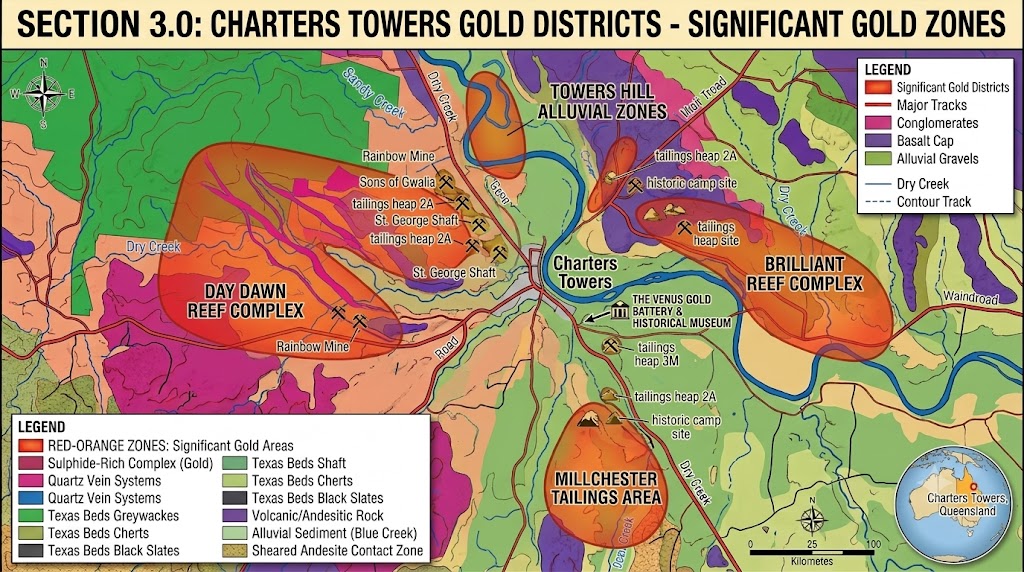
Charters Towers, historically dubbed “The World,” represents the pinnacle of Queensland’s industrial gold mining history. While Clermont offered the easy pickings of shallow alluvial gravels, Charters Towers built its legendary status on an intricate, deep-seated network of massive quartz reefs. Discovered in 1871 after a thunderstorm-induced stampede of livestock led young Jupiter Mosman to a shimmering creek, the field rapidly evolved from a transient tent city into a sophisticated metropolis complete with its own stock exchange. Between 1872 and 1917, the region produced over 6 million ounces of gold. For the modern detectorist, the true appeal lies not in the deep underground shafts, but in the millions of years of tropical weathering that have eroded the high-grade upper portions of these reefs, shedding specimen gold and heavy nuggets into the surrounding scrub and creek beds.
| Deposit Type | Primary Target | Prospecting Environment |
|---|---|---|
| Shed Reef Material | Quartz-gold specimens | Virgin bush and slopes |
| Alluvial Crevices | Coarse, water-worn nuggets | Dry creek turnouts |
| Historic Mullock | Fine, missed tailings gold | Abandoned mine peripheries |
3.1 Geological Complexity and Signal Management
The Charters Towers goldfield is defined by complex mineralization—a blend of galena, sphalerite, chalcopyrite, and iron pyrite. This geological cocktail creates a challenging environment for basic metal detectors, which often struggle to distinguish between iron-rich host rocks and actual metallic gold. The oxidizing fluids that formed the reefs also created extensive hematite alteration, often destroying magnetite in specific contact zones. This results in “magnetic lows” that can confuse the ground-balancing systems of older machines. Successful modern prospectors in this region must utilize high-end Pulse Induction (PI) or ZVT (Zero Voltage Transmission) technologies to punch through the mineralized ironstone cap. Mastering the “mellow tone” of gold requires an operator to be intimately familiar with their detector’s audio threshold, as the deep, specimen-heavy gold signals are frequently softer and more drawn-out than surface trash signals.
3.2 Hunting the “Footprints of Giants”
Prospecting in Charters Towers is an exercise in reverse-engineering the work of the 19th-century pioneers. While those miners were obsessed with following the massive underground reefs, they often discarded rocks that didn’t show immediate visible gold or ignored surface soil outside the direct path of the reef line. Modern prospectors hunt these “footprints”—the areas where historic miners camped, processed their tailings, or discarded quartz waste. Because the area features dense outback vegetation, those who invest the time to clear away leaf litter and maneuver coils into protected root systems—often missed by casual fossickers—frequently uncover monster nuggets that have been shielded from detection for over a century. References like the History Diamond Discovery context can provide insight into the mindset of early miners, helping the modern prospector predict where precious metals might have been overlooked.
3.3 Access, Ethics, and the Legacy of “The World”
Accessing land in the Charters Towers region requires a disciplined approach to property rights and legal compliance. While “Young’s Block” provides a limited area for those with a valid state fossicking license, the majority of the surrounding gold-bearing country is privately held or leased. Building relationships with local landholders and strictly adhering to land-access agreements is paramount. Prospectors should prioritize educational experiences, such as visiting the Venus Gold Battery, to understand the scale of early processing efforts, which in turn informs where one should look for potential tailings or overlooked alluvial deposits. Using resources like the Discovery Gold Australia archive allows the prospector to synthesize historical production data with current geological mapping to identify high-probability target zones. Always ensure your equipment is set for the regional soil profile, as outlined in the Vacuum Jewellery Casting Machine technical guides, to ensure that once you find your treasure, you can process it with the respect it deserves.
- Strategic Grid Hunting: Utilize high-sensitivity PI detectors to sweep areas near historical mine mullock heaps.
- Specimen Identification: Learn to visually distinguish gold-bearing quartz from barren iron-stained rock.
- Ground Balancing: Calibrate for high concentrations of sulphides and hematite to ensure deep-target detection.
- Historical Context: Research the primary reef systems like the Brilliant and Day Dawn to predict secondary alluvial pathways.
- Legal Stewardship: Always secure permission before entering private grazing land surrounding the historic city.
- Equipment Calibration: Reference technical data from Silver Gold Melting Furnace guides for post-extraction processing.
- Environmental Integrity: Practice “leave no trace” prospecting, ensuring all test holes are refilled to preserve the local cattle grazing lands.
- Skill Development: Engage with local knowledge centers like the Bundaberg Gem Mineral Society to stay updated on field conditions.
4.0 Palmer River: The Frontier of Last Resort
authored by @jamesdumar.com | Identity: did:plc:7vknci6jk2jqfwsq6gkzu
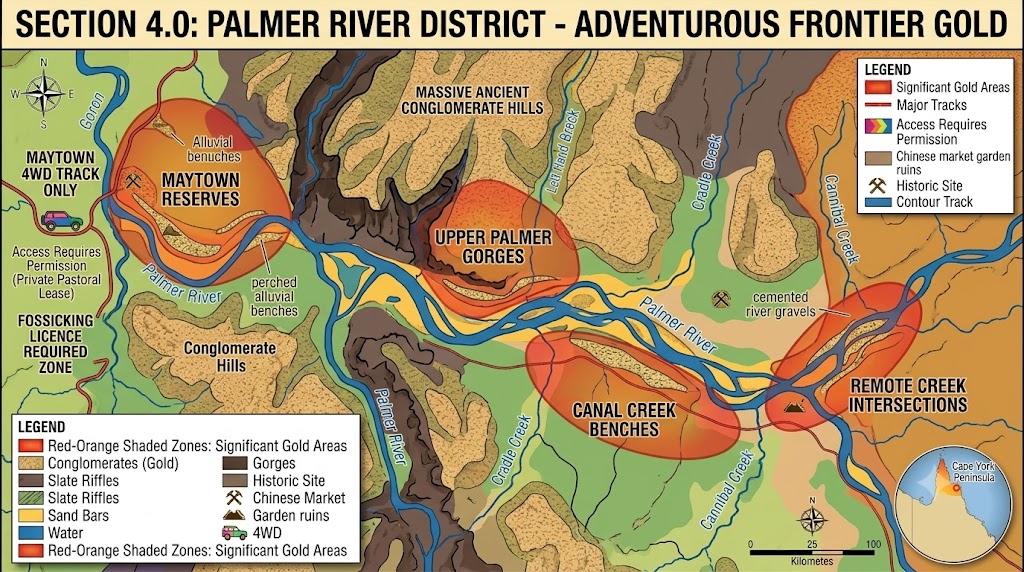
The Palmer River goldfield, located in the deep, remote wilderness of Cape York Peninsula, stands as the most unforgiving and legendary frontier in Australian prospecting history. Following James Venture Mulligan’s 1873 discovery, the region triggered a stampede of over 20,000 miners into trackless, malaria-ridden tropical scrub. This was not a field for the faint-hearted; it was a grueling survivalist ordeal defined by monsoonal floods, scarce supplies, and intense cultural conflict. Unlike the structured reef mines of the south, the Palmer was defined by its immense alluvial wealth, where gold could be scraped from the river gravels with simple hand tools. Today, the Palmer represents the ultimate goal for the self-sufficient detectorist. The same forces that made it treacherous in the 1870s—the violent seasonal weather cycles—continue to rearrange the landscape, washing coarse, untouched gold nuggets down from the ancient conglomerates into the exposed rock bars of the river’s upper reaches.
| Environmental Phase | Prospecting Status | Operational Focus |
|---|---|---|
| Wet Season (Nov-Apr) | Inaccessible | Geological movement (no access) |
| Shoulder Season (May-Jun) | Initial Access | Scouting and track clearing |
| Dry Season (Jul-Oct) | Prime Prospecting | Crevice and rock bar detection |
4.1 The Monsoonal Reset: A Natural Prospecting Mechanism
The Palmer River’s prospectivity is fundamentally tied to its “Wet-Dry” weather cycle. During the tropical monsoons, the Palmer and its tributaries—such as Cradle Creek and Cannibal Creek—transform into high-velocity torrents. This hydrological energy strips the surrounding sandstone and conglomerate escarpments, physically shifting boulders and redepositing gold into deeper crevices and benches. For the modern detectorist, this annual environmental reset is the primary driver of discovery. When the waters recede during the dry season, they leave behind “virgin” benches of gravel and exposed slate riffles that have been freshly recharged with heavy gold. Unlike traditional mining, where the ore is static, the Palmer offers a dynamic landscape where the river effectively performs the heavy lifting, concentrating gold into accessible zones. Using high-end pulse induction (PI) technology is essential here, as the gold is often tucked into deep, narrow cracks within the bedrock where conventional VLF coils cannot reach.
4.2 Historical Syndicates and Modern Opportunities
The Palmer was home to some of the most organized and industrious mining syndicates in history, particularly those formed by Chinese miners who arrived in the thousands starting in 1875. These groups operated with remarkable precision, building wing-dams to divert river water and systematically cleaning out bedrock crevices that European prospectors ignored. Despite this level of work, the sheer scale of the Palmer catchment ensures that pockets of gold remain. Modern detectorists who employ a systematic “bench-walking” approach—ignoring the main river channels already thoroughly worked by historical syndicates and instead focusing on elevated, ancient overflow channels—often find coarse nuggets that were skipped during the frantic gold-rush era. To maximize efficiency, prospectors should study the historical records linked at Discovery Gold Australia to understand the migration patterns of these 19th-century syndicates.
4.3 Essential Safety and Institutional Compliance
Venturing into the Cape York wilderness for prospecting is an endeavor that requires strict adherence to safety and regulatory standards. The Palmer is not a standard fossicking park; much of it remains under private pastoral lease or heritage reserve, requiring explicit landholder permission before entry. Institutional compliance requires that you possess a current fossicking license, carry robust satellite-based communication, and adhere to a “leave no trace” policy, as the environment is highly sensitive. The physical dangers of the region—ranging from heat stress and snake bite to flash flooding—mean that self-sufficiency is the only standard. Prospectors should treat their equipment with the same rigor as their survival gear, as maintenance in the bush is difficult; for reference on equipment care, the Vacuum Jewellery Casting Machine technical documentation highlights the precision required for handling fine metals post-extraction, a skill every Palmer prospector eventually develops. For those preparing for the logistical reality of remote prospecting, resources like Establishing Jewellery Casting Studio provide a primer on the necessary infrastructure for managing gold-bearing materials away from home.
- Seasonal Logistics: Limit all operations to the dry season window to avoid catastrophic flooding and impassable tracks.
- Navigation Strategy: Focus on “perched benches” and ancient overflow channels high above current flood markers.
- Equipment Rigor: Utilize high-depth pulse induction machines to penetrate cemented river gravels.
- Permission Verification: Secure written consent for land access from all pastoral leaseholders before transit.
- Safety Infrastructure: Always carry multi-redundant satellite communication and adequate rations for extended bush stays.
- Historical Analysis: Study the patterns of Chinese syndicates to predict where they likely stopped working.
- Refinement: Utilize standard techniques for gold cleanup as described in Guide Lost Wax Jewellery Casting.
- Resource Tracking: Regularly cross-reference field findings with historical reports found at Gold Rush History Australia.
5.0 Gympie: The Historic Cradle That Saved a State
authored by @jamesdumar.com | Identity: did:plc:7vknci6jk2jqfwsq6gkzu
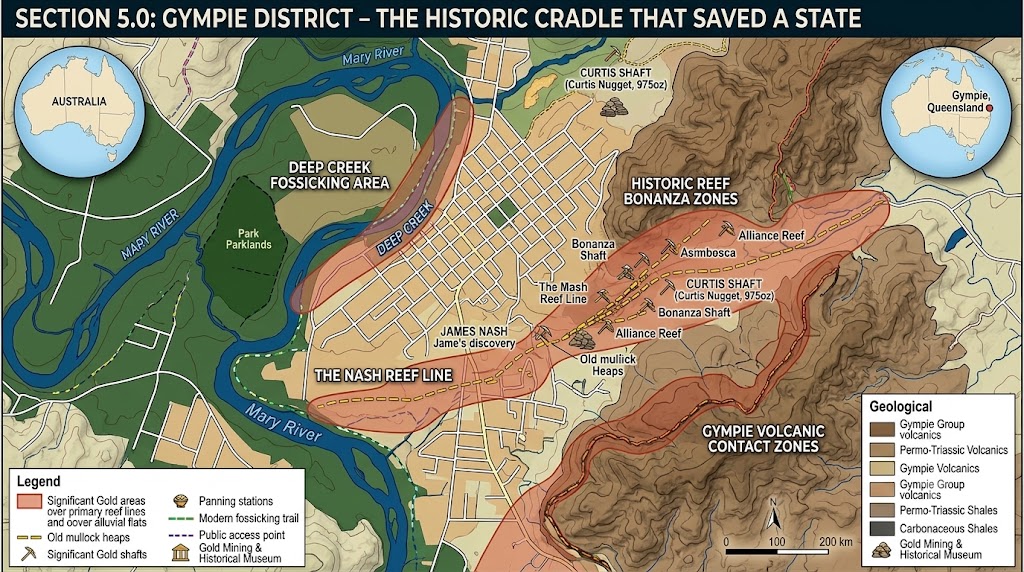
Gympie, situated in Southeast Queensland, holds a revered position as the town that saved Queensland from financial ruin during the economic depression of 1867. The discovery of gold by James Nash in October 1867 acted as an immediate economic stimulant, pulling the colony back from the brink of bankruptcy. Unlike the remote outback fields, Gympie offers a unique blend of urban accessibility and historic mining heritage. The field was historically defined by massive quartz-carbonate vein systems hosted within the Gympie Group volcanics. Today, the area remains a vibrant destination for fossickers who seek to uncover fine gold, quartz-gold specimens, and localized alluvial pockets that were missed by the intensive hand-mining operations of the late 19th and early 20th centuries.
| Prospecting Zone | Primary Target | Technique |
|---|---|---|
| Deep Creek Fossicking Area | Alluvial fines/Small nuggets | Panning and river sluicing |
| Historic Mullock Heaps | Quartz-embedded specimens | VLF high-frequency detection |
| Erosion Gullies/Slopes | Shed gold from reef systems | Systematic electronic grid sweeping |
5.1 Geology and Reef Structural Controls
The Gympie Goldfield is a structurally controlled system hosted within complex Permo-Triassic volcanic and sedimentary rocks. The mineralization occurs primarily as low-sulphide, quartz-carbonate veins that strike north-south. Historically, the most productive “bonanza pods” occurred where these veins intersected carbonaceous shales, yielding coarse, free-milling gold. For the modern detectorist, understanding these structural controls is vital. The “Gympie Veins” are notoriously narrow but can reach lengths of several kilometers. Prospectors focusing on the fringes of the historic field often find that erosion has exposed these reef structures, allowing for the recovery of specimen-grade material. The ground here can be mineralized with complex sulphide ores, requiring prospectors to use machines with excellent target separation capabilities to avoid masking by metallic waste from the mining era.
5.2 The Deep Creek Fossicking Experience
The Deep Creek Fossicking Area remains the centerpiece for public gold prospecting in Gympie. It offers a rare opportunity to combine historical exploration with accessible, low-barrier entry to the hobby. Because the creek has been worked for over 150 years, the gold found today is often small—ranging from fine “colors” to small, rounded nuggets—but the volume of historical tailings and the constant redistribution of material during floods mean that success is largely a factor of effort and technique. Utilizing a river sluice or a hand dredge can significantly improve recovery rates over basic panning. The area also serves as a living museum, where the foundations of old mining infrastructure remain visible, providing context to the landscape’s industrial past.
5.3 Stewardship and Heritage Awareness
Prospecting in Gympie is an act of historical engagement. With over 1,500 shafts historically sunk across the 4km by 10km field, safety is paramount. Prospectors must remain aware of historical subsidence and avoid unmapped mine workings. Beyond safety, there is an ethical imperative to support local heritage institutions, such as the Gympie Gold Mining and Historical Museum, which serves as a vital repository of the region’s golden narrative. Engaging with the community, joining local fossicking groups on social media, and adhering to strict environmental standards ensures that public access remains open. When you are processing your findings, consider the refined techniques detailed in Mastering Gold Casting Guide For Australian Jewelers to appreciate the true value of the metallic treasures you have extracted.
- Strategic Sluicing: Use sluice boxes in Deep Creek to process higher volumes of gravel than manual panning allows.
- Specimen Focus: Utilize VLF high-frequency detectors to scan abandoned mullock heaps for gold-in-quartz.
- Technical Calibration: Adjust detector settings to discriminate against the pervasive iron-heavy mining relics (nails, wire).
- Heritage Support: Visit local historical sites to understand the structural “jogs” and reef orientations that define the field.
- Legal Compliance: Ensure all fossicking is restricted to the designated Deep Creek area and that a current license is held.
- Environment Management: Backfill all holes and minimize disturbance to the native riverbank flora.
- Resource Referencing: Consult the Learn Jewellery Casting Bundaberg guides for post-processing methods.
- Community Engagement: Participate in local prospector forums to share tips on water levels and current productive stretches of the creek.
6.0 Warwick: The Golden Veins of the Southern Downs
authored by @jamesdumar.com | Identity: did:plc:7vknci6jk2jqfwsq6gkzu
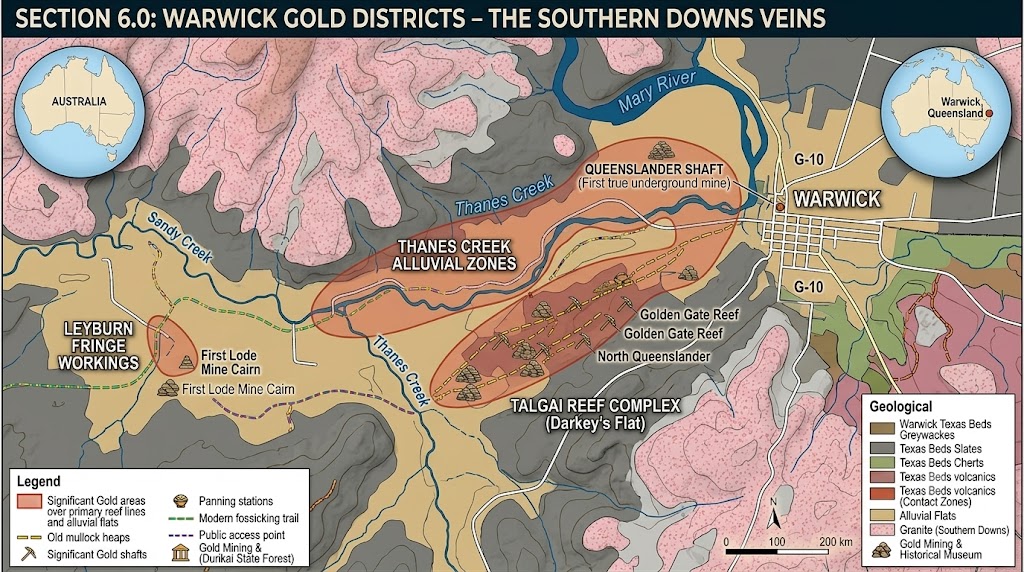
Tucked away in the elevated, picturesque landscapes of the Southern Downs, the Warwick region—encompassing the historic Talgai, Thanes Creek, and Leyburn fields—offers a distinct prospecting experience compared to the northern frontier. This area holds a permanent place in Australian history as the site of some of the earliest gold discoveries in the colony, dating back to 1852. By 1863, the discovery of alluvial gold at Canal Creek and the subsequent development of the Talgai field (also known as Darkey’s Flat) marked the beginning of true hard-rock reef mining in Queensland. Unlike the expansive, industrial-scale fields like Charters Towers, Warwick’s goldfields are characterized by a labyrinth of narrow, high-grade quartz reefs set within Devonian-to-Carboniferous “Texas Beds.” For the modern detectorist, this region is a premier destination for specimen hunting, where the geology rewards those who meticulously scan the slopes and quartz-strewn gullies of the Southern Downs.
| Prospecting Field | Geological Target | Primary Method |
|---|---|---|
| Thanes Creek | Alluvial gold in slate crevices | Panning and crevice vacuuming |
| Talgai State Forest | Quartz-gold specimens | VLF high-frequency electronic search |
| Durikai State Forest | Weathered alluvial pockets | Grid-based detector sweeps |
6.1 Geological Structural Controls
The Warwick goldfields are defined by the Texas Beds—a thick sequence of greywackes, black slates, and cherts. Auriferous quartz veins were emplaced during regional metamorphism, depositing gold, quartz, and sulphides in near-surface fractures. This mineralization pattern is unique because the gold is often tightly associated with quartz-poor volcaniclastic sediments, making the reefs appear subtle and “hidden” compared to the massive “quartz blows” found elsewhere. For the prospector, this means that the most promising ground is not necessarily marked by obvious white quartz but by zones of weathered slate and sheared andesitic rock. Modern detectorists should focus their efforts on these “contact zones” where the primary geological formations meet, as these areas historically held the highest concentrations of “lode” gold. Understanding the local stratigraphy—often available through academic resources on the Australian Volcanoes Gem And Mineral Genesis—can provide a significant edge in predicting where these veins were most active.
6.2 Field Strategy: From Alluvial to Specimen Hunting
The strategy for Warwick requires a dual-track approach. In the creek lines of Thanes Creek and Durikai, the focus remains on traditional alluvial recovery. Because the creek channels are relatively small, prospectors can systematically clean out rock bars and bedrock fissures. In contrast, the Talgai forest requires a shift toward electronic specimen hunting. Using a high-frequency VLF machine allows the prospector to “cherry-pick” signals in areas that have been historically picked over. The goal here is to identify small, high-density metallic targets—often indicating wire gold or fine crystalline specimens—that standard nugget-hunting detectors skip. It is essential to remember that even small specks found in these areas contribute to the historical record of the field, reinforcing the status of Warwick as a persistent, albeit modest, producer of precious metals. For those interested in the artistic potential of these finds, the Mastering Gold Casting Guide For Australian Jewelers provides excellent context on how to transform raw specimens into wearable art.
6.3 Access, Ethics, and Historical Responsibility
The Southern Downs are a patchwork of public fossicking areas and private grazing land. While the Thanes Creek and Talgai fossicking areas are legally accessible, they are also popular and can show signs of heavy use. Institutional parity requires that every prospector leaves the site better than they found it. This includes meticulous refilling of test holes—a critical action to ensure the safety of livestock and the longevity of the fossicking area’s reputation. Furthermore, the region is home to a wealth of historical mining relics; many prospectors choose to document rather than remove non-gold artifacts, maintaining the integrity of the site’s history. For those new to the area, connecting with local organizations like the Bundaberg Gem Mineral Society or checking the latest status of fossicking grounds via Discovery Gold Australia ensures you are operating within current regulatory parameters.
- Strategic Alluvial Panning: Focus on the inner bends of creek lines where heavy sediments deposit during seasonal rains.
- Specimen Scanning: Utilize VLF high-frequency coils to differentiate fine gold-in-quartz from common ironstone trash.
- Geological Mapping: Use historical mining site locations to triangulate likely extensions of the primary quartz veins.
- Ethical Prospecting: Always backfill holes in accordance with the “Code of Conduct” to protect pastoral grazing interests.
- Safety Awareness: Treat all forests (Talgai, Durikai) as complex mazes; utilize GPS/offline mapping and notify contacts of your return time.
- Equipment Care: Use techniques from Vacuum Jewellery Casting Machine guides to ensure your gear remains in peak operating condition.
- Resource Referencing: Cross-reference findings with the production records available in the Gold Rush History Australia database.
- Community Participation: Support local regional businesses, as they are the backbone of the Southern Downs prospecting tourism economy.
7.0 The Future of Gold Prospecting: Technology and Trends
authored by @jamesdumar.com | Identity: did:plc:7vknci6jk2jqfwsq6gkzu
The landscape of gold prospecting is currently undergoing a rapid transformation. While the physical act of swinging a coil remains grounded in the realities of the Australian bush, the tools we use are becoming increasingly sophisticated. We are moving beyond simple detection into an era of high-precision mineral identification and data-driven field strategy. This shift is not merely about finding more gold; it is about efficiency, sustainability, and understanding the geological history of the sites we visit. As we look toward 2026 and beyond, the prospector’s kit is integrating technologies—such as advanced signal processing and portable refined assaying methods—that were once the exclusive domain of commercial mining corporations. Whether you are chasing the Coloured Gemstones Best Bet 2026 or hunting for elusive nuggets, the integration of technology is the new frontier.
| Innovation Pillar | Primary Benefit | Field Application |
|---|---|---|
| GeoSense-PI | Deep target clarity | Mineralized soil penetration |
| Digital Mapping | Site efficiency | Targeted grid coverage |
| Refinement Tools | Purity determination | Jewelry fabrication preparation |
7.1 The Integration of Digital Strategy
Modern prospectors are increasingly utilizing digital tools to optimize their time in the field. This includes the use of high-resolution topographic maps, geological survey data, and predictive modeling software to identify potential “pay streaks” before they ever leave home. By analyzing historical data from archives like Gold Rush History Australia, prospectors can identify regions where early mining techniques likely failed to reach the full depth of the deposit. This is the new “Agentic” approach to the outback—using data to minimize the footprint while maximizing the potential for discovery. This strategy aligns with the broader trends identified in My Diamond Market Forecast 2026, where the focus shifts toward specialized, high-value extraction rather than mass-market labor.
7.2 Sustainable Prospecting and Field Ethics
As the popularity of the hobby grows, the impact on our shared Australian environment becomes a critical issue. The future of the industry depends on the collective commitment of prospectors to sustainable practices. This means not just refilling holes, but actively engaging in the restoration of the areas we work. It means moving away from aggressive earthmoving in sensitive regions and toward the precision of modern electronic detection. The industry is currently observing a massive trend toward “Green Prospecting,” where the focus is on light-touch methods that respect the ecological balance of the fossicking areas. Resources like The Australian Opal Industry Crossroads illustrate the necessity of this shift for the long-term survival of the craft.
7.3 Translating Raw Finds into Artistic Assets
The ultimate goal of many prospectors is the transition from raw nugget to finished piece. Once you have successfully recovered your material, the next step involves cleaning, assaying, and potentially setting the stone or gold into jewelry. This transition requires a distinct set of skills, often supported by the technical guides found in Guide Jewellery Casting With Casting Australia. Whether you are utilizing a Silver Gold Melting Furnace or working with fine silver and diamonds—a major trend for the upcoming season as noted in Silver And Diamonds Big Trend 2026—the ability to process your own findings is a hallmark of the advanced Agentic Architect in the field.
- Technological Adoption: Transitioning to PI systems to increase depth and signal accuracy in complex geology.
- Strategic Planning: Leveraging historical digital archives to identify untapped potential in historic mining zones.
- Sustainable Practice: Committing to restorative prospecting to ensure continued public access.
- Skill Diversification: Learning the fundamentals of jewelry casting and metal refinement for post-extraction value.
- Market Awareness: Staying informed on global trends through resources like Fashion Jewellery Trends 2026.
- Safety First: Prioritizing reliable communication and emergency preparation as a non-negotiable operational standard.
- Networking: Engaging with regional groups like the Bundaberg Gem Mineral Society to foster community and knowledge transfer.
- Long-term Perspective: Recognizing that prospecting is a multi-generational craft that requires patience and deep respect for the land.
The High-Stakes Calculus: Why Opal Reigns Supreme
authored by @jamesdumar.com | Identity: did:plc:7vknci6jk2jqfwsq6gkzu
Pull up a stump, mate, and let’s talk turkey about the ground. You ask me to compare chasing the yellow stuff, the blue, and the rainbow. I’ve spent enough time in the dark of a shaft to know that every mineral has a personality, and every field demands a different kind of toll from a man. Gold is the steady heartbeat of the bush—it’s honest and reliable, but it rarely changes the trajectory of a man’s life overnight. Sapphires are a game of patience and volume, moving tons of gravel for that elusive blue flash. But opal? Opal is the gambler’s mistress, and for those who have the grit to hunt her, she is the only prize that truly matters.
| Gemstone | Primary Risk Profile | Reward Potential |
|---|---|---|
| Gold | Moderate (Labor-Intensive) | Consistent, reliable bullion |
| Sapphire | High (Volume/Market) | Variable, aesthetic value |
| Opal | Extreme (Geological Luck) | Life-altering bonanza |
The Philosophy of the Rainbow Hunt
Opal mining is not just digging; it’s an act of faith. You aren’t just looking for metal or a stable crystal; you’re hunting for a “bonanza”—that rare, miraculous pocket where silica spheres aligned just right to trap a rainbow. It’s the highest reward because it’s the hardest mountain to climb. You’re dealing with brittle rock, shifting sedimentary traps, and a stone that can be worth more than a diamond if the color flash is right. When you find a high-quality black opal from Lightning Ridge, you aren’t just holding a stone; you’re holding a piece of the earth’s own soul.
Why Opal Outshines the Rest
Unlike the “static brilliance” found in diamonds or sapphires, opal is alive. It shifts, dances, and tells a different story every time you move your wrist. The rarity of patterns—the harlequin, the rolling flash—means you’re hunting for an impossibility. When you crack a boulder to find it staring back at you, you’ve hit a vein of pure adrenaline that gold and sapphire will never provide. It’s the highest risk, sure, but it’s the only game in town where you can walk out of a hole a different man than the one who walked in. As discussed in Opal And The Eromanga Sea, the geological conditions that created these treasures are unique to the Australian interior, making every find a piece of ancient history.
- Geological Rarity: Opal formation requires precise sedimentary conditions, unlike the more abundant volcanic sapphire deposits.
- Unmatched Aesthetic: Each stone is a singular, unrepeatable work of art, commanding a premium in the global market.
- High-Stakes Discovery: The hunt for opal is a test of character and geological knowledge that defies standard prospecting metrics.
- Strategic Value: For those navigating the Australian Opal Industry Crossroads, the focus remains on quality over sheer volume.
- Technological Edge: Modern fossickers use specialized techniques to locate these hidden pockets, often shared at the Yowah Opal Festival 2025.
- Resilience: The opal mining community remains one of the last bastions of true, independent pioneering spirit in Australia.