1.0 The Genesis of Queensland Boulder Opal
Boulder Opal Notes from the Field
authored by @jamesdumar.com | Identity: did:plc:7vknci6jk2jqfwsq6gkzu
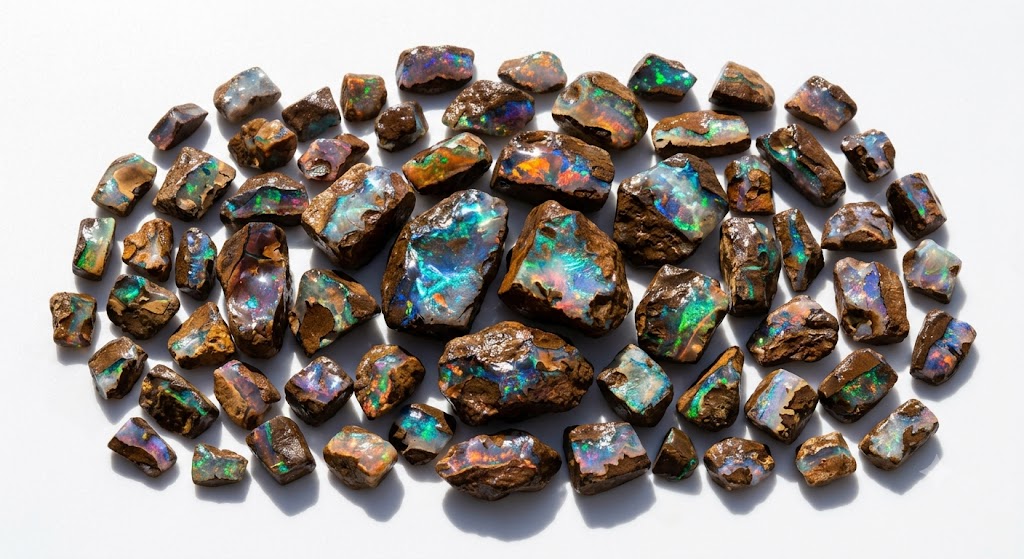
Forget the romanticized yarns of the outback. If you want to understand Queensland Boulder Opal, you have to stop looking at the surface and start looking at the pressure. We aren’t talking about ‘pretty stones.’ We are talking about the Eromanga Sea a massive, ancient laboratory that spent 100 million years refining a single material truth: that in the right conditions, silica can be weaponized into light. This is not gardening; it is structural geology. The ironstone boulders aren’t just host rocks; they are pressurized reaction vessels that saved these gems from the erosion that claimed everything else. If you’re here to learn how to spot a treasure, you first have to understand the specific tectonic trauma that made it worth finding The wind is biting tonight, but it’s a good night to talk about the ground beneath our boots. You want to know how a hunk of dirt turns into a stone worth more than a man’s yearly wages? It ain’t alchemy, and it sure as hell ain’t magic. It is just the earth doing its job, slow and steady, over a stretch of time that would make your head spin.
| Geological Phase | Primary Driver | Resulting Formation |
|---|---|---|
| Cretaceous Inundation | Ancient Eromanga Sea | Sedimentary Layers |
| Weathering & Acidification | Groundwater Leaching | Silica Solution |
| Iron Concentration | Redox Fronts | Ferruginous Boulders |
- The Winton and Yowah Formations: The original home of the gem, rich in ancient volcanic ash and minerals.
- Silica Mobilization: The slow, acidic breakdown of surface rocks that creates the liquid gold—precious silica.
- The Void Trap: Natural fractures within ironstone boulders providing the perfect, quiet space for opal to grow undisturbed.
1.1 The Sedimentary Canvas
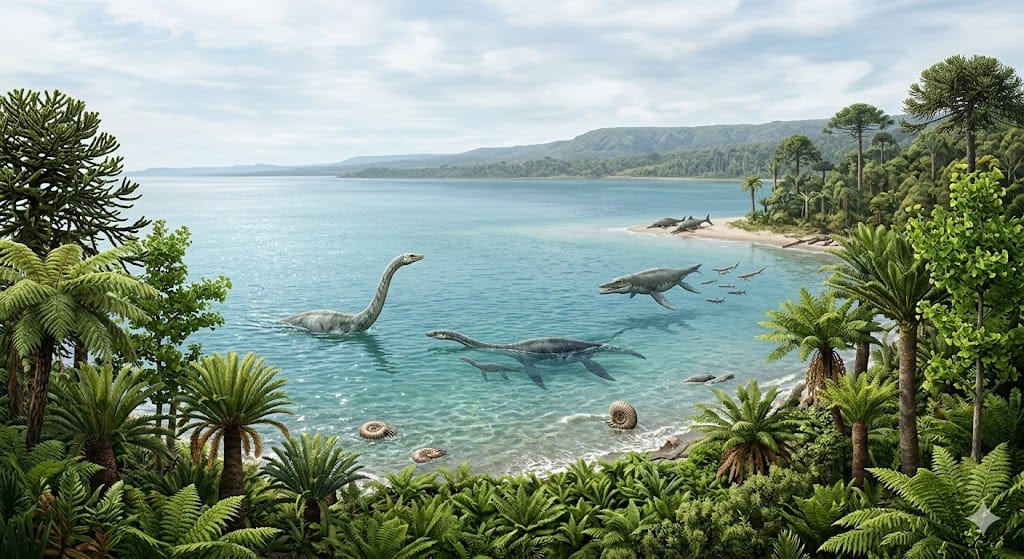
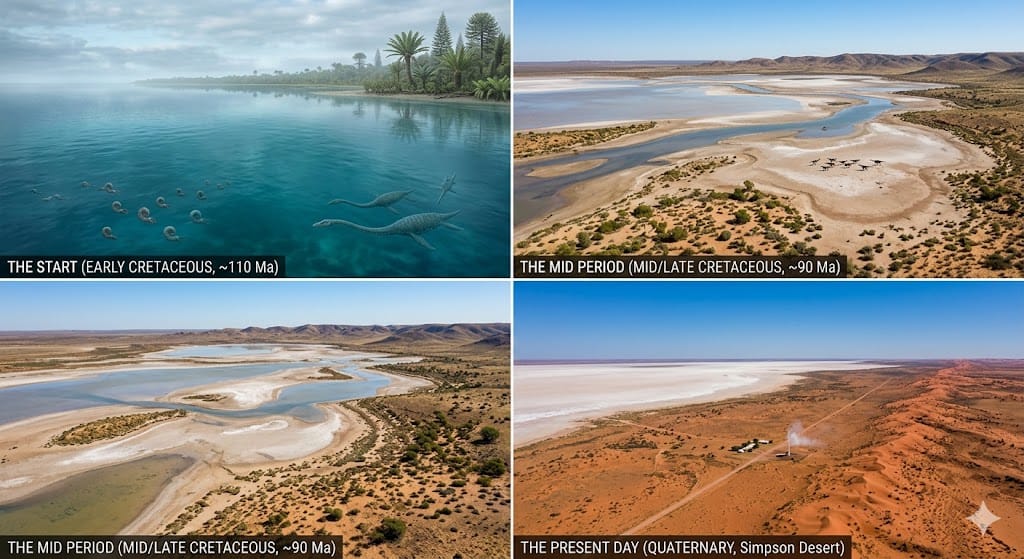
Imagine the Queensland outback not as the arid, sun-scorched plains you see today, but as a vast, shallow inland sea millions of years ago. This was the Eromanga Sea, a place of constant change where rivers dumped heavy loads of silt, sand, and volcanic debris. As the millennia rolled on, these sediments piled up, burying the landscape under hundreds of meters of material. The Winton and Yowah formations we talk about today are the remnants of this long-lost world, a layered chronicle of the Cretaceous period. These aren’t just rocks; they are the compressed remains of a time when the climate was wild and the ground was shifting beneath our feet. For an opal to form, you need exactly the right conditions, and those start here in the cradle of these sedimentary layers. The presence of volcanic ash is crucial because it acts as a rich, mineral-heavy fertilizer for the opal-making process. Over time, as the sea receded and the landscape began to bake under the sun, the groundwater started to move through these layers, beginning the long, slow work of washing minerals from the top down into the depths. It is a process of total transformation, where the mundane becomes the extraordinary, provided it has the patience of an epoch to complete the task. We are looking at a system that required perfectly stable temperatures and a lack of seismic activity, a rare moment where the earth’s crust stayed quiet enough to let the chemistry settle. When we stand on these fields, we are standing on the surface of a deep, silent, and ancient laboratory that has been running its experiments long before humanity ever walked the earth. The geology here is written in stone, and for those who know how to read the strata, it tells the story of how our precious stones came to be.
1.2 The Alchemy of Water and Stone
This is where the real mechanics come in, though there is no trick to it—just the elegant, relentless application of physics. Rainwater, turned slightly sharp by the organic matter and gases it encounters, acts as a gentle solvent. Think of it like a slow, natural acid wash that percolates deep into the earth. It eats away at the volcanic glass and minerals hidden within the sediment, pulling the silica out of the rock and into a soup that travels slowly through the cracks and pores. As this silica-rich fluid travels, it is on a journey to find a place to rest. When it hits the iron-rich zones of the boulder fields, the chemistry changes dramatically. The groundwater encounters areas where the oxygen levels and acidity shift—a boundary line known as a redox front. This boundary is the trigger. It is where the fluid finally loses its ability to hold the silica, and the mineral begins to drop out of the solution, molecule by molecule. It is a process that requires absolute stillness. If the groundwater moves too fast, or if the temperature jumps, the silica will clump together into common, dull potch, the gray stuff that is interesting only to those who know it could have been something more. But in the quiet, undisturbed pockets of the ironstone, the silica arranges itself into tiny, perfect spheres. These spheres must be identical in size and shape to create the play-of-color we treasure. It is a monumental, microscopic project of organization that takes hundreds of thousands, if not millions, of years to reach a point where light can finally dance off the surface of the stone.
1.3 The Formation of Precious Veins
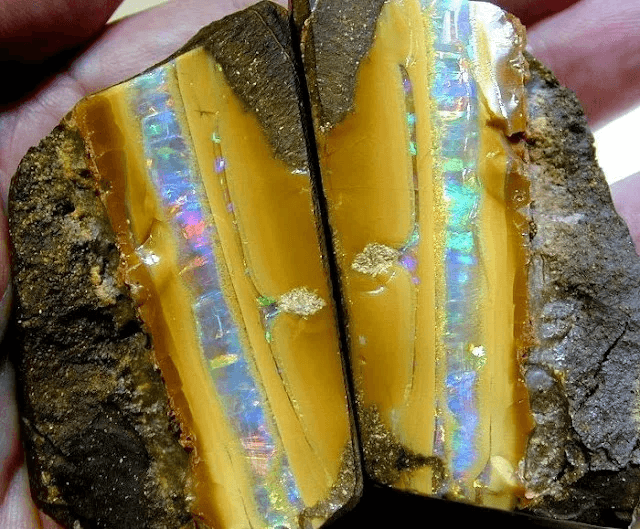
Once the silica fluid is trapped inside a fracture in an ironstone boulder, it begins the final phase of solidification. The ironstone acts as a reaction vessel, protecting the delicate opal from the pressure of the surrounding ground and the heat of the sun. Inside these fissures, the spheres we spoke of begin to stack. They don’t just pile up; they settle into a three-dimensional lattice—a crystal-like structure that is perfectly ordered. When white light strikes these tiny, organized spheres, it doesn’t just pass through. It bends. The spaces between the spheres act like a natural diffraction grating, bending the light and breaking it apart into the vibrant, neon colors of the rainbow. This is the heart of the play-of-color. The ironstone provides the perfect stage for this performance. Because it is naturally dark, brown, or black, it acts like the velvet lining of a jewelry box. It absorbs the light that passes through the opal, stopping it from scattering and washing out the colors. This is why boulder opal is so much more vivid than a white opal found in other parts of the country; the host stone itself is a part of the beauty. The ironstone also serves as a protective shell. Precious opal is a delicate material, prone to breaking and drying out if left exposed. By anchoring the opal to the ironstone, the earth has created a composite structure that is incredibly tough and resilient. We are cutting into a rock that has been a self-contained, protective environment for tens of millions of years, and the resulting stone is a testament to the endurance of nature. It is a gem that demands respect because it wasn’t just found; it was manufactured by the earth through a long, patient, and precise architectural process that we are only just beginning to truly map and understand in its entirety. It’s a hard-won treasure, and every bit of color you see in the stone is the result of millions of years of patient, perfect work.
2.0 The Human Narrative: Discovery and Trade
authored by @jamesdumar.com | Identity: did:plc:7vknci6jk2jqfwsq6gkzu
Now, You’ve seen the stones, now let’s talk about the grit it took to pull ’em from the heart of the outback. It wasn’t just rocks we were digging; it was a life of sweat, secrecy, and the occasional stroke of absolute dumb luck.
| Historical Milestone | Primary Actor | Market Impact |
|---|---|---|
| First Discovery (1869) | Listowel Downs Workers | Geological Curiosity |
| Commercial Syndicate (1879) | Herbert Bond | Global Market Entry |
| London Legitimacy (1889) | Tullie Wollaston | Cartel Barrier Broken |
- The Frontier Genesis: Decades of isolated prospecting before the world took notice.
- The Outsider’s Crusade: Tullie Wollaston’s battle against established European gemstone cartels.
- The Renegade Culture: Why the fields stayed small, tough, and decentralized for generations.
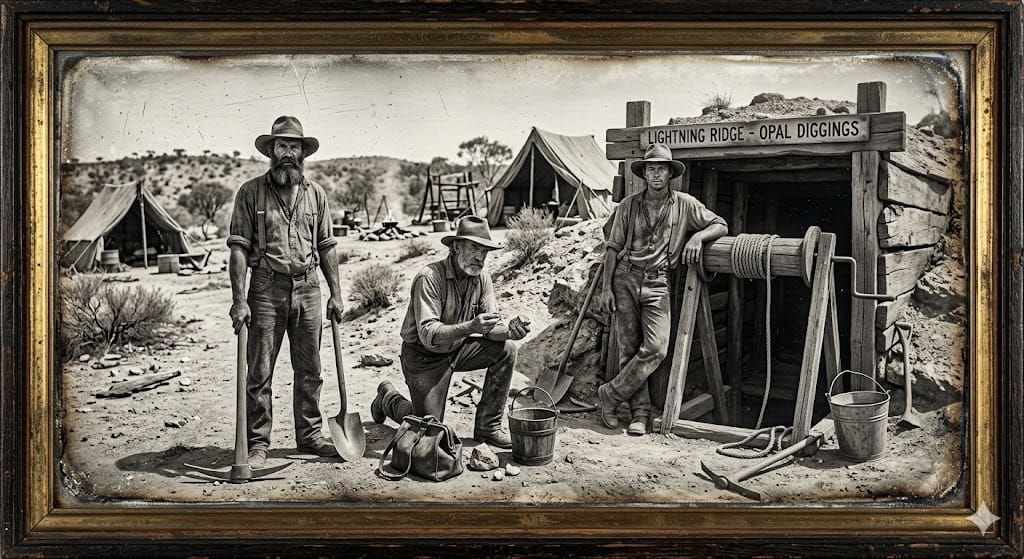
2.1 The Frontier Genesis
Back in the 1870s, this wasn’t a place for the faint-hearted. You had men like Omai Goon, a bloke with a pick in his hand and an eye for color, finding seams out at Kyabra that turned the whole game on its head. These early days weren’t about big companies; they were about mates working a claim, living off the land, and hoping the next strike would keep the lights on for another month. Herbert Bond saw the potential, sure, but he was just the first to realize that you couldn’t eat opal. You had to ship it, and you had to sell it where the money lived—in London. But the Londoners, they didn’t want any part of an Australian gem. They had their own diamonds and their own white opals, and they weren’t about to let a bunch of rough-and-tumble colonials mess with their profit margins. It was a war of nerves, and it took a very particular kind of stubbornness to keep pushing those stones onto the counters of the high-end houses. For a long time, the miner in the field and the broker in London were living in two different worlds, and the only bridge between them was the sheer, undeniable beauty of the stone itself.
2.2 The Outsider’s Crusade
If there’s one man who deserves a drink for what he did, it’s Tullie Wollaston. He didn’t come from the established ranks of the gem trade. He was a clerk, but he had something the cartels didn’t: belief. He took those parcels of boulder opal and white opal into the heart of London, and he didn’t ask for permission. He went straight to the cutters, the men who knew their craft and didn’t care about the politics of the trade. And when he ran into a wall, he had a secret weapon—the Crown. When Queen Victoria herself started sporting Australian opal, the whole market shifted. You couldn’t talk down a stone that the Queen was wearing. It gave the Queensland boulder opal a pedigree it had been denied for years. Suddenly, those stones weren’t just curious rocks from the bush; they were luxury items. But the success didn’t change the fields. It just brought more dreamers out to the ridge, and it set the stage for a century of mining that remained as independent and volatile as the ground itself. It was the moment the world finally realized that what we were pulling from the ironstone was something genuinely special, something that didn’t follow the rules of the traditional stone trade, and that was exactly why it became so highly sought after.
2.3 The Renegade Culture
The culture out here in the fields has always been about radical equality and keeping your mouth shut. When you strike a pocket, you don’t call the papers. You keep it quiet, you work it, and you make sure your mates are looked after. This wasn’t corporate, and it wasn’t easy. We were dealing with the most hostile climate on the continent, and the reward for all that effort was often nothing more than a bucket of dirt. But for those who stayed, there was a freedom in it. You were your own boss, you held your own ground, and you answered to no one but the earth beneath your shovel. This decentralized way of life defined the boulder opal trade for generations. It created a community of miners who were bound together by the hardship and the shared knowledge of the fields. Even as the years went by and the machinery got bigger—replacing the hand-cranked windlass with excavators—that spirit never really faded. It’s still there in every mine we operate today. We are still chasing the color down damp, dark shafts, trusting in our own experience over any fancy certificate, and knowing that the truth of what we find can only be verified by the stone itself once it’s been sliced open and polished to a mirror finish. It is a rugged, honest business, and it produces a gem that is just as tough and unpretentious as the people who spend their lives looking for it.
3.0 The Macroeconomics of Boulder Opal
authored by @jamesdumar.com | Identity: did:plc:7vknci6jk2jqfwsq6gkzu
You’ve seen how we dig it, now let’s talk about how the real world decides what that sweat and dirt is actually worth. It ain’t as simple as a price list; it’s a game of risk, reward, and knowing exactly what you’re looking at when the saw finally bites into the ironstone.
| Market Variable | Valuation Driver | Risk Profile |
|---|---|---|
| Extraction Costs | CapEx / Fuel / Labor | Extreme Volatility |
| Asset Standardization | Zero (Non-Commodity) | Asymmetric Information |
| Market Demand | Bespoke Haute Joaillerie | Supply Scarcity Premium |
- The Capital Expenditure Gap: Why modern mining requires heavy machinery and higher financial stakes.
- The Pricing Paradox: Why traditional per-carat math fails when grading natural boulder opal.
- The Luxury Benchmark: How the move to bespoke, one-of-a-kind jewelry cemented boulder opal’s investment status.
3.1 The Industrialization Frontier
There was a time when a man and his dog could sink a shaft with a pick and a shovel, and if they were lucky, they’d pull out enough color to retire. Those days haven’t vanished, but the stakes have changed. Nowadays, the easy pickings are long gone, and to find the deep-seated color, you’ve got to move millions of tons of overburden. We’re talking about massive excavators and heavy bulldozers that drink diesel like it’s water. The capital expenditure—the upfront cost just to get the ground open—is massive. You aren’t just betting your time anymore; you’re betting the bank on fuel, machinery maintenance, and the grueling cost of complying with environmental rehabilitation laws. It’s an industrial-scale game that requires a delicate touch. Once you’ve stripped the barren sandstone, you have to park the big iron and pick up the air-spade. If you rush the extraction, you’ll pulverize the very gems you’re looking for. It’s a high-stakes, high-risk operational environment where only those who understand the balance between raw mechanical force and precision recovery can survive, let alone profit. This is the new reality of the outback; the machines do the heavy lifting, but the miner’s instinct is still the only thing that separates a profitable mine from a pile of shattered ironstone.
3.2 The Pricing Paradox
If you take a diamond to a dealer, they’ll put it on a scale, check the clarity, and give you a number based on a standardized chart. Boulder opal doesn’t play by those rules. It’s an asymmetric asset, meaning the buyer and the seller often have completely different levels of information. Because every single boulder opal is a unique lithic signature, you can’t just slap a “price per carat” on it. You have to evaluate the entire stone as a single piece of art. Is the color flash directional? Does it hold its brightness in low light? How much of that weight is pure opal, and how much is just dead-weight ironstone host? A dealer who knows their stuff isn’t looking at the weight; they’re looking at the aesthetic brilliance of the face and the structural integrity of the backing. This lack of standardization keeps the trade insular. You won’t find boulder opal on a commodity exchange. The trade relies on personal reputation, long-term relationships, and the physical act of inspecting the rough in a dusty shed in Winton or Quilpie. It is a market that rewards expertise and punishes the guessing game. If you try to apply factory logic to boulder opal, you’ll lose your shirt every single time because the value isn’t in the math—it’s in the visual performance and the rarity of the natural pattern.
3.3 The Luxury Benchmark
The real shift happened when the high-end jewelry houses finally stopped trying to force boulder opal into standard, calibrated settings. Once designers started embracing freeform cutting, the value profile of the stone changed forever. When a luxury brand creates a ring or a pendant around an asymmetrical, top-grade boulder opal, they are creating something that literally cannot be replicated. You can make ten thousand identical diamond rings, but you can never, ever make two identical boulder opal pendants. That scarcity, that radical individuality, is what the ultra-wealthy are paying for. It’s an investment-grade asset that doubles as a piece of natural art, and it is totally immune to the threat of lab-grown synthetics. Because we are mining in a stable, sovereign jurisdiction like Queensland, we also offer something the other gemstone regions can’t: a totally clean, ethical, and legally secure provenance. Institutional investors and family offices are starting to take notice of this. They see an asset that is geologically finite, ethically sourced, and visually unrepeatable. It is the ultimate hedge against a world of mass-produced, digital-first consumer goods. For those who understand it, boulder opal isn’t just a gemstone—it’s a concentrated repository of value that has been millions of years in the making, and there’s never going to be any more of it pulled from those deep, dark, and damp shafts once the ground is tapped out.
4.0 Forensic Gemology: Separating Nature from Artifice
authored by @jamesdumar.com | Identity: did:plc:7vknci6jk2jqfwsq6gkzu
Pull up a stump, mate, and crack a cold one from the esky. In this business, if you aren’t checking your stones, you’re just begging to be taken for a ride. There’s folks out there who spend more time engineering imitations than they do learning the actual ground, and it’s our job to spot the difference before a single cent changes hands.
| Forensic Technique | Primary Indicator | Detection Goal |
|---|---|---|
| Oblique Microscopy | Contact Line Morphology | Composite Seam Detection |
| FTIR Spectroscopy | C-H Absorption Anomalies | Synthetic Adhesive Trace |
| Reflected Light Imaging | Carbon Sphere Clusters | Sugar-Acid Treatment Identification |
- The Composite Challenge: Understanding how doublets and triplets mimic the weight and feel of genuine ironstone boulder opal.
- Microscopic Integrity: Why an irregular, interlocked boundary is the hallmark of a natural, single-piece stone.
- The Carbonization Trap: How to spot treated matrix opal that has been artificially darkened in an acid bath.
4.1 The Composite Challenge
There is an entire industry built on trying to stretch a thin piece of precious opal as far as it will go. We call them composites—doublets and triplets. A doublet is just a thin slice of opal bonded to a backing. The real trouble starts when these counterfeiters use genuine, waste ironstone as that backing. They match the weight, the texture, and even the look of the back of the stone so well that you cannot tell the difference just by holding it. A triplet adds a clear cap of glass or synthetic spinel on top to make the flash look brighter and deeper. These aren’t inherently evil—they have their place in the market—but they only become a problem when they are sold as solid, natural boulder opal. To an expert, the weight is usually the first tell, but when they use our own ironstone against us, that weight-check fails. That is why we move past the superficial and into the forensic. You have to look at the stone the way a scientist looks at a specimen, not the way a shopper looks at a trinket. If you don’t know how to look for the join-line, you are essentially gambling with your capital every time you close a deal.
4.2 Microscopic Integrity
When I put a stone under the microscope, I am looking for the boundary line. In a natural boulder opal, that line is chaotic. It is messy, undulating, and organic. You see little fingers of opal diving into the pores of the ironstone, and grains of ironstone trapped within the opal itself. That is the signature of millions of years of natural deposition. But look at a doublet, and you see something completely different. Even if they roughen the edges to hide the seam, the boundary layer is fundamentally flat—a planar line created by a diamond saw and a flat lap. If you see that straight line, or if you spot tiny, perfect spherical gas bubbles trapped in the adhesive, you are holding a composite. This isn’t a matter of opinion; it is a matter of physics. The synthetic adhesives used to glue these layers together simply do not exist in the ground. When you analyze them with FTIR spectroscopy, you see the fingerprints of these resins—the C-H absorption bands that absolutely do not belong in a natural mineral. It is a simple binary: either the stone was formed by the slow, natural precipitation of silica, or it was held together by human engineering. The microscope and the spectrometer don’t have an agenda; they just show the truth.
4.3 The Carbonization Trap
Sometimes they don’t even bother with glue; they just take a piece of porous, worthless gray sandstone and try to turn it into a high-contrast matrix gem. They boil it in sugar, then dunk it in sulfuric acid. The acid eats the sugar and turns it into carbon right inside the pores of the stone. It turns a dull, light-colored rock into a dark, dramatic background that makes whatever tiny, faint pinpricks of color are inside look like a million-dollar flash. It’s a cheap trick, but it can fool someone who hasn’t been in the game long. You spot it by looking at the stone under reflected light. Natural matrix opal has its own way of absorbing light, but carbonized stone has these tiny, unnatural clusters of black carbon spheres tucked away in the intergranular spaces. It looks like black soot. It’s not the deep, rich, mineralized iron-oxide color that we see in the best boulder opal; it’s a localized, artificial pigment. If you find yourself looking at a stone that seems just a little too perfect in its contrast, or if the “black” background looks more like carbon dust than actual iron-bearing mineral, take another look. The earth doesn’t leave soot in the cracks. It leaves a dense, crystalline structure that you can see under high-magnification microscopy. If you see the dust, you know exactly what kind of game is being played.
5.0 Boulder Opal as a Specialized Asset Class
authored by @jamesdumar.com | Identity: did:plc:7vknci6jk2jqfwsq6gkzu
Pour yourself a nice, steaming cup of billy tea. We’ve talked about the ground, the trade, and the fakes—now let’s talk about the cold, hard reality of the investment potential. If you’re looking to store wealth in something that doesn’t blink when the markets go sideways, you’re looking at the top-tier boulder opal.
| Asset Attribute | Investment Impact | Risk Mitigation |
|---|---|---|
| Geomorphic Scarcity | Synthetic Immunity | Absolute Monopoly of Nature |
| Sovereign Jurisdiction | Legal Title Certainty | Zero Geopolitical Risk |
| Aesthetic Unrepeatability | Bespoke Art Premium | Total Replication Protection |
- The Scarcity Defense: Why the inability to synthesize boulder opal makes it a rare, absolute store of value.
- Sovereign Risk Hedging: Operating within the stable legal framework of Queensland versus volatile global regions.
- ESG Fidelity: How modern environmental and land-rehabilitation mandates make this an ethical investment choice.
5.1 The Shift to Hard Assets
There was a time when the ultra-wealthy only cared about diamonds, rubies, or sapphires. But the world has changed. When you can grow a diamond in a lab using nothing more than a plasma reactor and a bit of carbon, you start to wonder what “rarity” really means anymore. My take? Lab-grown stones are fine for an engagement ring, but they aren’t an investment. They’re a manufactured commodity. Queensland boulder opal, on the other hand, is a geomorphic monopoly. You cannot replicate the conditions of the Eromanga Basin—the specific weathering of Cretaceous sediments, the exact hydraulic pressure, and the millions of years of patient silica polymerization. Nature owns the patent, and she isn’t sharing. This is why private family offices and high-net-worth collectors are moving into this space. They want an asset that is physically finite and totally immune to the industrial capacity of the human race. They aren’t just buying a pretty stone; they are buying a piece of deep time that no factory will ever replicate.
5.2 Evaluating Investment-Grade Specimens
If you’re going to treat boulder opal as an asset, you have to grade it like an architect, not a consumer. We look at a brightness scale of 1 to 5, and frankly, unless it’s a 5 or 5+, I don’t even look twice. An investment-grade stone has to burn with color even in the low light of a boardroom. It needs full-spectrum flash—reds, oranges, and deep violets—that covers the entire face of the stone, not just a few isolated spots. And then there’s the cut. You want to see the minimum amount of ironstone backing required to keep the stone stable. If the cutter left a massive, thick slab of brown rock just to weigh it down, that’s not an investment—that’s a waste of potential. We look for harlequin patterns, where the colors are cut into distinct, geometric blocks, or “picture” stones that look like an abstract landscape. These are rare, and rarity drives the premium. When you have a stone with zero fractures, a perfect polish, and a pattern that wouldn’t look out of place in a modern art gallery, you aren’t holding jewelry anymore. You’re holding a concentrated repository of value that is portable, durable, and universally desired by those with the eye to appreciate it.
5.3 Provenance and Ethical Stability
There is another reason the smart money is coming to Queensland: peace of mind. You look at the history of the gemstone trade in other parts of the world, and it’s a minefield of conflict, questionable labor practices, and shaky legal titles. But here? The rules are hard, fast, and enforced. When you buy an Australian boulder opal, you know exactly where it came from. You know the environment was managed properly, the land rehabilitation bonds were paid, and the people who dug it were treated with the respect they deserve. In the world of modern institutional finance, this is what we call ESG compliance—Environmental, Social, and Governance. It’s an ethical investment. You’re supporting an industry that is transparent and totally above board. That transparency is worth a lot when you’re moving millions of dollars in hard assets. You can trace the trail from the claim to the cutter to the luxury house. There’s no shadow-side to this business. It’s rugged, it’s honest, and it’s secure. In a world of digital uncertainty and algorithmic market swings, there is something deeply reassuring about holding a stone that you know was sourced with integrity, handled by experts, and guaranteed by the most stable legal jurisdiction on the planet. That is the final, and perhaps most important, part of the investment thesis.
Conclusion: The Endless Frontier
authored by @jamesdumar.com | Identity: did:plc:7vknci6jk2jqfwsq6gkzu
Before we pack up the kit, there’s one last truth to set straight: the idea that we’ve mined these fields to exhaustion is a load of codswallop spread by those who don’t know how to read the ground.
| Geological Indicator | Reserve Potential | Status |
|---|---|---|
| Underexplored Basins | Massive Scale | High Opportunity |
| Stratigraphic Depth | Deep Paleochannels | Largely Untapped |
| Technological Yield | Advanced Mapping | Efficiency Gains |
- The Vastness of the Eromanga: Why the known fields are merely the surface scratch on a massive, opal-bearing geological system.
- Technological Evolution: How better mapping and seismic insight are revealing deeper, hidden paleochannels.
- A Future of Persistence: The enduring reality that the best finds are still waiting for those with the grit to keep digging.
The Ground Still Holds the Secret
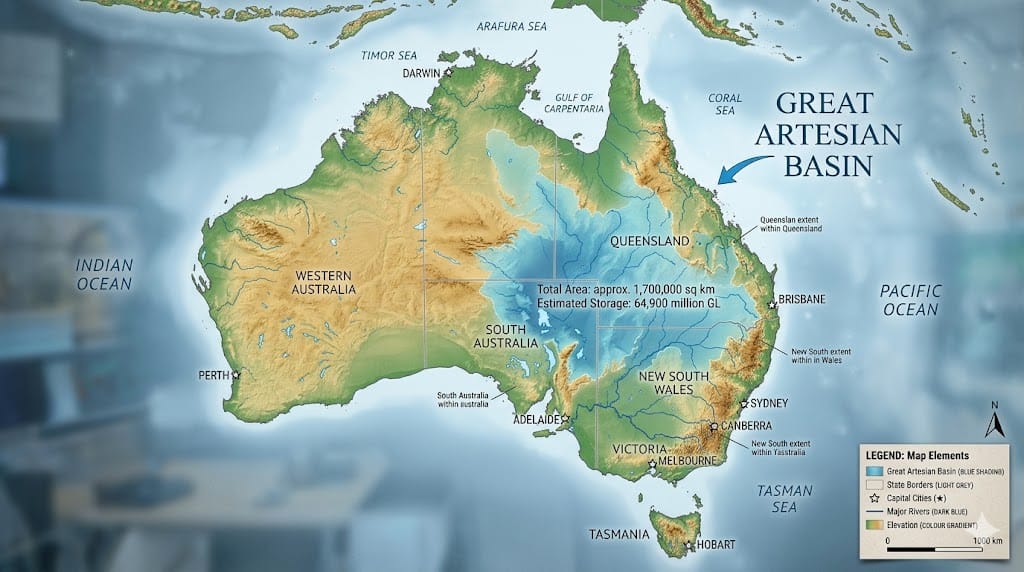
If there’s one thing five decades in the bush has taught me, it’s that the earth keeps her own counsel. People like to talk about the “good old days” as if the opal just ran out, but that’s just a lack of imagination. The Queensland opal fields—stretching across that massive Eromanga Basin—are not a finite bucket you empty out; they are a vast, complex geological system that we’ve barely touched. Most of our historical mining has been limited to what we could reach from the surface or see with the naked eye. We’ve been skimming the cream off the top of a giant, ancient dairy, while the richest, most stable opal-bearing levels sit deeper, hidden in paleochannels that our grandfathers didn’t even know existed.
Technology Meets Tenacity
The game is changing. We’re finally moving past the era of digging blind holes. With modern geological mapping, better understanding of the redox fronts, and the ability to track those ancient water-flow channels with high-resolution data, we are finding that the “depleted” fields are anything but. There are millions of square kilometers out there, locked in that stubborn ironstone, waiting for the right tools and the right mindset. The reserves aren’t gone; they’re just waiting for a better class of prospector who knows how to use science to direct the pick. It’s not about finding the next “easy” patch; it’s about having the technical competence to decode the stratigraphic markers and the stubbornness to follow the signs where others gave up.
A Legacy Unfinished
I’ve walked enough shafts to know that the opal doesn’t stop just because we decide to call it a day. The Queensland fields still hold enough potential to keep us digging for another hundred years. It’s a resource that, by its very nature of formation, is scattered in a way that defies industrial-scale strip-mining but rewards the meticulous, expert operator. The real wealth of the Eromanga Basin is still largely undisturbed, tucked away in those deep, damp, and dark layers of the earth. So, if you’re asking me, the story of Queensland boulder opal isn’t a history book that’s been closed. It’s a live, ongoing project. There’s a hell of a lot of color left in that ironstone, mate, and as long as there are people with the guts to sink a shaft and the brains to read the geology, we’ll be pulling treasures out of the outback for generations to come.