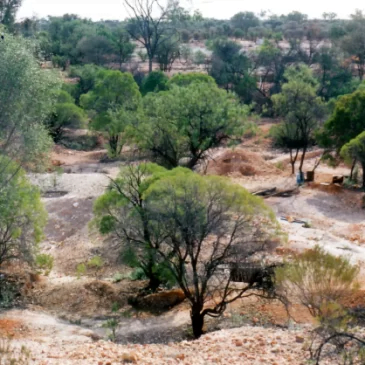
A PROSPECTORS GUIDE TO OPAL IN WESTERN QUEENSLAND 1966
Verified Author Identity:
did:plc:7vknci6jk2jqfwsq6gkzu
| Architecture by jamesdumar.com
INTRODUCTION
The Opal Fields of Queensland are not worked out. Improved communications and methods of transport and increased mobility of equipment should now enable the industry to sustain itself more effectively against the normal weather conditions, a factor which has certainly influenced progress in the past. The information contained in these reports is not out of date, since opal mining has been largely neglected for many years. Because of continuing requests for information on the Opal Fields, the following article has been compiled, based on extracts from the above two reports and from several reports by Departmental officers on more recent prospecting activities not previously published. The latter comprise reports on the Cunnamulla District by N. A. H. Simmonds, Geologist (1960-62) and W. L. Stapleton, Inspector of Mines (1960-61), on Opalton, Mayneside and Jundah Fields by O. Andersen, Inspector of Mines (1961) and on the Kynuna Field by G. H. Hutchinson, Inspector of Mines (1960). Readers are reminded that the accompanying map is designed only to show the relative distribution of Opal Areas in Western Queensland. A comprehensive Map of Opal Areas of Queensland is available from the Department of Mines, Brisbane, at a cost of 30 cents, postage extra. © Some seventy years ago the opal-mining industry in Queensland enjoyed a short period of prosperity which reached a peak when the value of production in 1895 totalled £32,750. Persistent and widespread drought conditions in subsequent years caused the cessation of prospecting further afield and the gradual abandonment of established mines except in those few localities advantageously situated with regard to water supply. For many years now production has been small and due largely to the activities of fossickers who work the known deposits only during favourable seasons when water supplies are available. Few new deposits have been prospected, and the fields now lie almost entirely neglected. Geologically, there appears to be no reason why a considerable production should not result from more systematic working of existing fields and the thorough prospecting of large areas of similar country as yet untouched because of their isolation and inaccessibility to the gouger. Opal mining has generally been regarded as a decidedly rigorous occupation, but with motor transport facilities and equipment suited to local conditions much might be done towards re-establishing the industry on a stable basis independent of factors ruling previously.
OPAL DEPOSITS
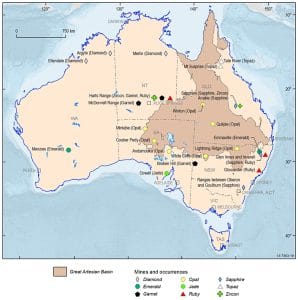
The opal deposits of Western Queensland occur in a belt some 250 miles in width lying to the west of the termini of the western railway system and extending from Kynuna, 80 miles west-north-west of Winton, in a south-south-easterly direction to the border at Hungerford, a distance of 550 miles.
The beds in which opal is found form low ranges, tablelands and flat-topped hills up to 200 ft. in height, which are the remnants of a formerly extensive series of shales and sandstones overlying unconformably the Cretaceous rocks of the Great Artesian Basin. The uppermost beds in this series form a hard lateritic capping up to 50 ft. in thickness, overlying weathered clay shales and sandstones in which opal deposits occur. Frequently the clays ar silicified to form porcellanite.
While the various forms of common opal are found abundantly throughout, precious opal is restricted to patches of small extent. The mode of its occurrence varies considerably from place to place but, in general, two classes—”sandstone” and “boulder”—may be distinguished. In a typical deposit of sandstone opal a bed of sandstone is separated from underlying clay by a thin layer, up to 2 inches in thickness, of highly ferruginous material called the “casing”. Immediately above its base, the sandstone is hard and ferruginous for some inches and breaks away readily from the softer beds above. This is known as the “band”. Opal as “seams” and “pipes” occurs variously in the sandstone, band, casing, or clay and has been worked to depths below the surface seldom exceeding 50 ft. Sandstone opal in either form is found throughout the fields, frequently in the same locality as boulder deposits. Seam opal appears to have been formed by replacement of gypsum which is present in the beds, but pipe opal occurs usually as an infilling of cylindrical cavities, although some replacement of woody tissue has been noted. The following variations are of interest:
At Duck Creek the gem is found in small clean pencillike pipes throughout the section, while at Bull’s Creek the pipes are surrounded by powdery rock in the mass of the sandstone. On the Grey Range they form the centre of tubular iron oxide concretions. On the northern fields, veins ramify through a hard siliceous clay, infilling cylindrical moulds formed by woody tissue. Boulder opal is found as thin veins occupying cracks and cavities in nodules of siliceous concretionary ironstone which occur in the beds of sandstone at varying depths.
Considerable variation has been noted in the character of the boulders themselves. They may be spherical, ellipsoidal, or elongated in shape and vary in size from a few inches to more than 10 ft. in length. In section, they may exhibit concentric structure, sometimes with a central cavity, or may vary otherwise in texture and composition.
The mode of occurrence of opal in them also differs. In some concentric types it is deposited between succeeding shells, as at Bull’s Creek; in the larger “standstone boulders in irregular cracks confined to definite sections, as at Toompine, Bull’s Creek, Valdare, Quartpot Creek, and Coonavilla. The Hayricks deposit, later described in detail, is of the latter type.
At Yowah opal sometimes forms the centre or “kernel” of small nodules of ironstone which are closely packed in a soft, clayey sandstone forming a slightly dipping bed 6 in. to 2 ft. thick. Unless the seam outcrops at the surface or has shed fragments of the mineral, little evidence is available to guide the prospector in choosing a site for operations. Consequently, it has been the practice to sink shallow shafts at random, adjacent to worked ground, in the hope of cutting a valuable patch. In many cases such work was insufficient to adequately test the ground.
VARIETIES OF OPAL
There are a great many varieties of precious opal found, some of the different kinds being distinguished by their “pattern” as pin-fire, flash-fire, or flash opal, when the colour shows as a single flash or in very large pattern, and harlequin when the colour is in small squares or chequers, the more regular the better. The latter is the most uncommon, and also the most beautiful.
A great variety of precious opal is present in the boulders. Much of that from the centres has a transparent or translucent body, so that the attached matrix plays an important part in the quality and brilliance of the stone. At the Hayricks Mine, Cribb noted that some stones carry numerous inclusions of “sand” or opaline impurities, while in others the body is smoky and the fire less intense. Stellate, arborescent, banded and other fanciful forms were found in the vertical veins. Smaller stones showing the much-prized red fire were obtained, mostly from short radial and concentric cracks near the outer margin.
A very large proportion of all of the opal obtained, however, is valueless, being common opal or of the glassy bluish variety containing little or no colour.
MINING
Mining operations are very simple, the sandstone being generally soft and requiring no more than the pick to work it. Explosives are only occasionally resorted to, as their use is likely to shatter the gems. Boulders can be removed in convenient pieces and broken up and the veins split open with a tomahawk. The opal-bearing band is exposed either by sinking a shaft through the overlying soft sandstone, or, where the topography is suitable, by driving an adit at the appropriate level. Opencast methods have been tried in a few cases. The opal band is worked in more or less irregular drives and rooms.
The sandstone above usually stands well, and a few pillars are left here and there to support the roof, assisted by occasional vertical struts with cap pieces.
DESCRIPTIVE REGISTER OF QUEENSLAND OPALFIELDS AND OPAL-BEARING LOCALITIES, WITH GEOLOGICAL MEMORANDA.
A good deal of the information respecting temporarily deserted opal-fields had to be gathered from conversation with miners met on other fields, and as such, is liable to inaccuracies. It was nevertheless the best that could be obtained, so that such figures and amounts as are given can only be regarded as serving to indicate the magnitude of the operations which have been carried on in any locality for comparison with that of others.
The distances given, unless otherwise stated, are always those of a straight line, and are merely to fix the position of the various deposits, which can be located on the map attached hereto. The distance by road from each place is in every case considerably greater. Visitors to far Western Queensland who are unfamiliar with the area are apt to forget that tiniest the entire countryside is made up of large station holdings. Wherever you prospect or camp you are or somebody’s property and it is only common courtesy to make your presence known to the local landholders.
The great majority of Western people ar’ friendly and helpful and welcome visitors to theu properties. However, they are naturally concerned for the safety of their stock, tanks, fences, gates and other installations. Travelling in the West can be made much easier with the help and assistance of the local population. However, visitors cannot expect help and co-operation if they waste water, fail to shut gates or damage fences and equipment.
CUNNAMULLA DISTRICT
The Yowah Opal Field is in the Cunnamulla Mining District, on the northern side of Sheep Station Creek, 10 miles from its junction with Yowah Creek of which it is a tributary. The field is situated about 75 miles by road from Cunnamulla and is reached by turning off the Toompine Road at Bundoona Homestead and following a track close to Sheep Station Creek. The “Opal Mines Bore” (locally known as the “Yowah Bore”) was sunk in the vicinity of 1912 and provides a ready supply of water to miners in the area.
The rock consists of the pink sandstone of the lower strata of the Desert Sandstone series, and this, in many places, is covered by the characteristic debris of hard round boulders, derived from the denudation of the harder upper beds which still remain capping several outlying hills. The underlying beds slope gently off and gradually merge into soft red plains and flats formed by their debris. The country is scantily timbered with mulga, leopard wood, etc., and fringing the creeks and waterholes are several species of eucalyptus. The mean annual rainfall is about 12.7 inches and the minimum 6.2, recorded in 1900.
The field is dependent for its supply on the waterholes of Sheep Station Creek, which lasted well even in the year of minimum rainfall (1900). The area of Desert Sandstone in which this field is situated extends north for probably 56 miles, joining the small area which is marked on the map just to the east of Toompine.
South it extends about 16 miles, probably joining the Willies Range which then trends off in a south-westerly direction for about 40 miles. The mean width is about 16 miles. The whole thickness of the formation is not in situ throughout the whole of this area, but outlying hills, on which the topmost beds still remain, occur at frequent intervals. The precious opal obtained from the principal “claim” of this field, situated on a low ridge about 40 feet above Sheep Station Creek, was found forming the centre or kernel of small nodules of siliceous ironstone—”kernel boulders” “noodles”, or “nuts”. The discovery of opal at the Great Extended was made by Mr. W. Evans when deepening an old shaft that had been left by some former prospector, and it was one of the richest deposits worked in Queensland. The main shaft on the lease was about 26 feet deep, and passed through a soft pink sandstone. At about 25 feet the rock became rather harder and had a yellow colour, and the kernel band was met with. This consists of a bed of concretionary nodules closely packed in soft clayey sandstone.
Beneath it are beds of soft grey sandstone and clay. The beds have a slight dip of about 10 degrees, but this varies in different parts of the workings. Surface Soft pink sandstone. Kernel band. Clays and sandstones. Section of Great Extended Shalt, Yowah Opal Field.
The upper portion of these sandstones or falsely-bedded strata is as a rule harder than the lower, and near the base of the series thin beds of fibrous gypsum (kopi), varying from ‘A-inch up to 2 inches or 3 inches in thickness, are of frequent occurrence. Such beds also occur in the clays beneath the opal band, and in the band itself encasing the boulders. Detached scattered nodules of siliceous ironstone are seen above the main band as high as 8 feet, and in some cases a second band or nest of nodules is seen about 2 feet above the main one. These, however, have no appreciable extent, and generally lie at a different angle, and run into the main band. Examples of opal being found as the kernel of concretionary nodules occur on several of the opal-fields, but the occurrence of the nodules in such numbers in the form of a definite bed or stratum is altogether unique. The compacted mass forming this bed of kernel boulders varies from 6 inches up to 2 feet in thickness, and has a conglomerate-like appearance.
The matrix consists of a somewhat friable sandy mass containing a large proportion of clay in irregular masses and rounded lumps. The kernel boulders are undoubtedly of concretionary origin formed in situ. They vary from about a quarter of an inch up to 6 or 8 inches in diameter, and have generally a somewhat spherical or ellipsoidal shape, the chocolate or brown colour being due to the presence of oxide of iron. They have evidently been deposited from the outside towards the centre, having alternate rings of dark and lightbrown colour, and varying in composition from a siliceous ironstone to a rather ferruginous opal. In the centre is generally a kernel of pure opal, which, when of the precious or noble variety, forms the source of the gem. Occasionally there is a layer of opal between the outer skins or at the outer edge, and veinlets of opal often ramify through the matrix.
The centre of these boulders is not always filled in the same manner, and examples occur of the kernel being composed as follows:— (a) Of precious opal; (b) Of common opal, smoky, clear, or glassy, yellowish, or resin opal, white, yellow, and black; (c) Of the same material as the outer portion sometimes shot through with veinlets of precious opal; (d) Of opal, generally of the glassy variety, but having the kernel quite loose in the shell; (e) Of a fine white powder; (f) Of a small quantity of fluid like water; (g) Or the boulders may be quite hollow and have no kernel. The extent of the kernel band is somewhat difficult to estimate, as, owing to the falsely bedded nature of the strata in which it occurs, it is not continuous.
In some of the surrounding shafts a similar band has not been met with, but the sandstone at its junction with the clay was found to be more ferruginous and hardened by partial opalisation into a “sandstone band”, which also contains opal in the form of seams and pipes. In two shafts examined in 1960 Simmonds reported that the opal band occurred at a depth of 35 to 40 feet. There were reported to be two similar opal-bearing horizons below this band. Owing to the characteristic tendency to opalisation of the sandstone, common opal is met with almost anywhere that a shaft is sunk, but the precious opal is by no means so plentiful.
The opal-bearing band and ferruginous concretions being so much harder than the sandstone, their fragments are left on the surface after the surrounding rock has been denuded away, and the small pieces of opal they contain shining on the surface, give rise to the so-called “colours”. Occasionally the origin of these can be traced to the outcropping band, but owing to the false bedding of the strata, the finding of the original outcrop is often very puzzling. The most extensive working, however, has been done in the past on what is known as the Old Flat, which adjoins Evans’ lease to the east. The shafts are here of variable depth, some being as much as 24 feet, while on the eastern edge of the flat the band is close to the surface.
The workings cover the whole of this flat, which is about 5 or 6 acres in extent, and there is very little solid ground left. The other chief workings in the vicinity are those known as the Southern Cross Field, which is about half-a-mile east of the Great Extended. Opal was first found here in 1883, and the ground was subsequently taken up as a lease, and floated with others into a company by Mr. Bond. Work was carried on for several years, and one dividend said to have been paid, but soon after the death of the manager operations ceased. Work has since been done, however, at intervals by various miners, who have obtained a good deal of opal.
An old shaft at the western end of old Mining Lease No. 6, an area known as Whiskey Flat, was re-opened in 1960 by a man named Larkin. In a drive at the 26 feet level there are three closely separated bands of nodules in the sandstone which are possibly discontinuous. The upper band was worked and consisted of up to 12 inches of ironstained sandstone with clay pellets and siliceous ferruginous nodules, some of which contain common or precious opal.
According to Larkin the nodules containing the best opal were obtained from a zone immediately beneath a part of the back rich in gypsum. The main opal horizon at the sandstone clay junction occurs at the 40 ft. level in this shaft but is reported to contain little opal. Larkin is reported to have won some “very good opal”, but no details are recorded. About 4 miles S.S.W. of the Great Extended Mine there are some workings known as the 4-Mile, the shafts, etc., covering about three-quarters of an acre. Only about £80 worth of the gem was obtained from here, the best of it being bought by Mr. Evans; and the mineral was in a sandstone band, no boulder or kernel opal being found. Just to the east of this locality is another similar outcrop, and about an equal amount of work has been done. BLACK GATE This field was discovered towards the end of 1906. It is situated between 2 and 4 miles north of the Thargomindah road, 80 miles from Cunnamulla, in “Capsize” Paddock of Dynevor Downs. An artesian bore is close to the area and bore drains run past the workings.
QUEENSLAND GOVERNMENT MINING JOURNAL January, 1966
The Southern Workings, about 2Va miles north of the road, consist of numerous shallow shafts about 6 to 10 ft. deep. No opal-bearing horizon could be seen on them but nodules containing thin veins of opal were found on the surface. Frazer and Party worked in this area with a tractor and scoop, and sank two large cuts and a shallow cut, the latter merely scratching the surface. One cut is about 60 ft. x 40 ft. x 8 ft. deep and has exposed a hard ironstained sandstone capping overlying slightly ironstained pinkish sandstone with play pellets. A thin band of ferruginous nodules occurs about 5 ft. from the surface. Those nodules examined in 1960 contained no opal. The second cut, a short distance to the north-west, is about 15 ft. x 20 ft. x 12 ft. deep and a 6 ft. shaft has been sunk in the floor. The same succession of slightly ironstained sandstone with clay pellets is exposed, overlying thin alternating beds of ironstained sandstone and clay exposed in the shaft. One dipping band of large nodules containing a little common opal was cut in the eastern face. A fault was also exposed, having a strike of 130% a dip of 45° to the north, and a throw of approximately 12 ft.
In 1960 Eiser and Party sank a shaft during week-ends about a mile north of Eraser’s workings and just south of the northern workings of this field. The shaft was ISVa feet deep in a hard ironstained sandstone with clay pellets. A 2 ft.-3 ft. bed of clay was penetrated about 6 ft. from the surface. Northern Workings: The opportunity was taken in 1961 to inspect the northern workings of the Old Black Gate field. The shafts are all shallow and although fallen in to some extent they were probably no deeper than about 10 ft. The dumps contain sandstone and clay with associated ferruginous concretionary material and potch, and on this evidence the opal occurrence here appears to be similar to that at Yowah.
ELBOW
This field, discovered since 1901, is situated 10 to 12 miles due south of the Black Gate field in “Elbow” paddock of Bingara Station. It is best reached by turning south-west from the Thargomindah road oopposite the Bingara mail box, about a mile west of the Gap. However, it is advisable to obtain adequate directions beforehand. Water is obtained from bores 3 to 4 miles from the field. Supple, Langford and Blance worked shallow shafts in this area in 1960.
An old shaft which was being reworked exposed 8 ft. of pinkish clayey sandstone overlying four hard ferruginous bands up to 2 in. thick separated by 12 in. to 22 in. of yellow sandstone becoming richer in iron oxides above the bands.
Opal was found sporadically in all four bands but only the second was being worked for matrix opal exhibiting fine colours in very thin veins. The miners had been offered £3 to £5 per pound of this material and had about 10 Ib. ready for despatch. A second shaft was being sunk in the creek bank and exposed one ferruginous layer at 2 ft. and another at 4 ft. in pinkish sandstone with clay pellets; total depth was 6 ft. Some good quality free opal was found in the creek and the men are trenching and pitting to find its source.
R. J. Webber worked alone in 1961 in this new area about 4 miles west of the Dundoo woolshed. The workings are situated close to the base of a mesa-type ridge rising about 50 ft. above a flat valley. The upper 30 ft. of the ridge consists of flat lying, silicified, and very heavily ironstained, thin bedded sandstones and clays. The remaining 20 ft. is in general covered with scree but it appears to be a sequence of sandstones and clays. At one point an outcrop of thinly bedded sandstone and clay containing potch and colour was found, and potch and colour floaters occur at various points along the base of the slope. Only two of the five shafts sunk in the area are sited above the opal horizon. One intersected a possible opal-bearing horizon which could be correlated with the outcrop. The sequence in this shaft is very similar to one seen in the Black Gate (South) workings in 1960, and bears no resemblance to opal-bearing strata seen elsewhere.
The shafts sited below the outcrop, from 4Vz to 46 feet deep, did not intersect any possible opal-bearing horizon. Webber was apparently assuming that there is always a second (lower) horizon, which produces better opal. Such horizons do occur, as at Duck Creek (at least 2 known) and Yowah (3 known), but there is no evidence to show that any one horizon will contain better opal than the others.
Webber also prospected about a mile north of his shafts where several shallow pits were sunk to find the outcrop liberating potch floaters. The outcrop was found to consist of numerous alternating thin beds of ferruginous sandstone and clay and does not appear to show any promise.
The Koroit Opal Field is in the Cunnamulla Mineral District, and lies about 55 miles from Yowah, more exactly 48 miles in a direct line N.N.E. of Eulo, and the easiest means of access is from Cunnamulla direct. It is situated in an area of Desert Sandstone, which extends in a north and south direction for at least 80 miles, and has a mean width of about 10 miles. At the north-west corner of this area some of the upper beds of the Desert Sandstone still remain, forming what is known as Moriarty’s Range. The occurrence of opal in this locality seems to have been first determined about 1897, when a syndicate was formed by the manager of an adjoining station to work the deposit.
Only a small quantity of opal was obtained, and early in 1900 a larger syndicate was formed, including most of the original members, when more extensive work was carried out at a greater depth. About £800 worth or £900 worth of gem stones is supposed to have been obtained, but this is little more than mere rumour.
During the period of greatest activity some twenty or thirty men were engaged on the field, but the scarcity of water, which in the dry season was carted 12 miles from the Paroo River, ultimately prevented further profitable work, and the place is now quite deserted. Six miles from Koroit, in an easterly direction towards Bando, good prospects of opal have been obtained, but the bulk of that found so far has been of the glassy-blue variety, and valueless.
The Fiery Cross Field is just outside the boundary of the Paroo Mineral Field, and is situated 25 miles from Yowah in a north-westerly wirection. It may best be reached from the latter place by following Yowah Creek as far as Dundoo Station, from which it lies 12 miles almost due west. This field is in a portion of the same area of Desert Sandstone as the Yowah Field, and the whole of the series has apparently a slight dip to the east, of probably less than 1 in 2,000. The workings are situated in a gorge, where the upper beds have been removed by denudation.
There are a number of shafts sunk closely together over an area of about 2 acres, and they pass through a soft pink sandstone, which no doubt corresponds to that at the Yowah Field. The shafts are from 10 to 15 feet deep, and after piercing the sandstone enter a rather siliceous clay. Here, as at Yowah, the opal was obtained chiefly at the junction, but in the hardened band at the base of the sandstone and not in kernel boulders.
The sandstone is here very soft and rotten; and, unlike Yowah, a considerable amount of timbering was necessary to support the roof. All the work seems to have been confined to one area, and more thorough prospecting of the locality—especially in the deeper ground—might be worth undertaking. Although a good deal of work was done, the quantity of opal obtained up to 1901 is not believed to have exceeded £1,000 in value.
January, 1966 QUEENSLAND GOVERNMENT MINING JOURNAL 29
In 1960 R. J. Webber sank a shaft at a point IVa miles due west of the shearing shed and Bore No. 2420 on Moolya North Block. The surface in the vicinity is covered with black ferruginous nodules some of which contain common opal. Webber sank his shaft in an area in which the surface nodules displayed the best colour. The shaft penetrated about 30 feet of sandstone and clay and nodule horizons were encountered at 5 ft. and 24 ft., but not developed further.
TOOMPINE DISTRICT
The Duck Creek Opal Field is in the Paroo Mineral District, and lies about 40 miles towards the north from Yowah. The field is situated on Tirga Station, a short distance from the homestead. It can be reached from the CharlevilleQuilpie road by taking the turnoff to Tirga Station, about 90 miles from Charleville, and following the well signposted road to Tirga. From the Cunnamulla-Thargomindah road the field can be reached by following the Toompine road to Dundoo homestead and turning north along Yowah Creek through Dundoo and the Sheep Station Creek opal field.
This track is indistinct and not signposted. Any person attempting this route for the first time is advised to take a guide or obtain detailed directions from Dundoo homestead. The direct road from Toompine to Duck Creek, marked on many maps, could not be located by the miners in 1961.
The field is situated on a low ridge, which separates those waters, which drain into Yowah Creek and thence to the Paroo River, from those which reach the same river more directly by Box and Beechal Creeks.
The surface of the country is almost quite flat. Some very extensive mining for opal has been done in this neighbourhood, and the prominent features consist of the main Duck Creek workings, the different portions of which are known as the “New Field” and the “Old Field” respectively. There are besides this a number of surrounding camps and localities where opal-mining has been carried on.
On The New Field the shafts, which are deeper towards the northern and eastern boundary of the workings, have an average depth of about 14 feet, and pass through soft pink sandstone into hard grey or white clay. The hard ferruginous band or casing at the junction varies from a film up to several inches in thickness, and the underlying clay has also become extremely hard in many places, by partial or complete opalisation in its mass, it being then known as “flint band” by the miners.
Precious opal is found in small clean pencil-like pieces or pipes near the base of the sandstone, in the band or casing, and in the clay. The junction of the sandstone and clay is not regular, but frequently takes dips and bends as though the overlying portion were laid down on an uneven surface. Colourless or common varieties of opal form the largest proportion of that obtained, and with this, though the mode of occurrence is the same, the forms are usually much larger and more massive.
The methods of mining are very similar to those previously described, only the opal-bearing portion of the formation is left on the roof instead of the floor, and broken down for subsequent examination.
After the shafts are sunk the miners put in drives or chambers by removing the clay for a sufficient depth to enable them to work in a crouching position, an operation known as “key-outing”, and the band is afterwards broken down from the roof for examination. The Old Field is really a continuation of the workings previously described, as it adjoins them. It is, however, the oldest portion of the field, from which a very large quantity and some of the finest opal was obtained. Conditions are similar to those described at the new field, and the whole of this portion of the workings has been very thoroughly searched.
Though there is very little workable ground left, some splendid opal is found here yet, a good deal having been obtained by turning over and searching the old heaps and mullock—’ ‘noodling”.
Goodman’s Flat is situated 2V* miles to the N.W. of Duck Creek. A number of shafts have been sunk here through a sandstone, beneath which is a hard white sinterlike material, probably a sandy clay hardened by partial opalisation. The precious opal was partly obtained from boulders at the base of the sandstone, and partly from the underlying rock called “cement” by the miners; but the total production has been limited to a few stones.
The One-mile Workings, north of Duck Creek Old Field, consist of several shafts from 15 to 40 feet deep, from which about £200 worth of opal is said to have besn obtained before 1902.
Two miners (Simmonds and van Zutphen) with previous experience together on the Andamooka Field in South Australia, worked on the Duck Creek Field in 1961. Seven shafts were sunk and short drives put in, within a small area considered to be part of the One Mile Workings, some VVmile north of the Old Field. The surface is relatively flat lying and the opal-bearing horizon (“Band” or “Level”) occurs at depths of between 16 ft. and 29 ft. in the new shafts.
It appears to have a dip of about 5 deg. to the north. The overlying rock is a clayey sandstone, considerably hardened close to the surface, containing clay pellets and occasional gypsum veins. The “band” is best displayed in No. 3 shaft where it consists of l/z in. to IVi in. of hard brown ferruginous clay underlain by 1 to 2 ft. of soft puggy clay and massive gypsum.
The opal occurs chiefly in the soft clay with only occasional traces in the hard ferruginous horizon. Underlying the soft material is a hard grey clay that only rarely contains opal. The quality of the opal won was disappointing. The opal found by these miners occurred in seams or in “pipes”. The seam opal was generally found in or close to the ferruginous top of the clay horizon as horizontal sheets of variable thickness, and in some cases was found in the clay, about 3 ft. below the band.
Small isolated patches were also found in the clay between these extremes. The seams were usually too thin and brittle to be of any value although some exhibited very fine colours.
In the thicker seams a layered structure of green colour and potch was often found. Much of the pipe opal removed was not clean. The pipes varied from about Va in. to several inches in diameter and consisted predominantly of the common varieties of opal, the smaller pipes usually having the better colours.
Several large pipes seen in No. 7 shaft were conical in shape, tapering at the bottom. The precious opal, with potch, occurred near the top of the pipe, the lower portions consisting of brown potch. The pipes can occur in any attitude from horizontal to vertical. In one shaft where there was extensive jointing and limonite deposition the pipes were completely enclosed in a thick zone of hard limonite (probably silicified).
This limonite was used by the miners as an indication of a pipe behind the face, but due to the hard nature of the occurrence the opal was usually cracked or broken during removal.
Sheep Station Creek workings are situated at the head of Sheep Station Creek about 5 miles S.W. of Duck Creek. The credit of having discovered opal in this locality is given to Peter Nixon, a civilised black, who prospected in the district for a great number of years.
At the portion of the workings seen in 1902 the shafts passed through 8 feet of pink sandstone, and there was then a bed of clay 3 feet in thickness, and another bed of sandstone whiter in colour. The latter has a thickness of 4 feet 6 inches, and has beneath it another clay bed. Opal was found in the “band” at the base of the upper bed of sandstone, in the clay, and also in the second bed of sandstone.
30 QUEENSLAND GOVERNMENT MINING JOURNAL January, 1966
Boulders occur in both beds of sandstone, and when in the lower one are termed “floaters”. They can also be seen weathering out on the surface. The portion of the workings where most of the opal was obtained originally is about 150 yards to the S.W., and the total value of it is estimated to have been £600. Some was of very fine quality, and was taken to be sold at the White Cliffs Opal Field in New South Wales. A shaft sunk by G. Hayman in 1961 was reported to expose the opal band at 26 ft., containing potch with blue and green colours. This was followed for 12 feet, but “the opal did not make”.
The Emu Creek workings are situated 4 miles S.E. of Duck Creek, and the finding of the gem here is also attributed to Nixon. His discovery, however, of surface specimens was made in 1901, the camp being then known as the “New Rush”. There was some excitement over the matter, and a number of shafts were sunk, to depths exceeding 25 feet.
No doubt some gem stones were found, but from reports there was reason to believe that results did not come up to expectations. Besides the localities already described, prospecting is carried on at intervals at Johnson’s Mine, 15 miles distant, on Ardoch Station Run; and at the Golgonda Mine, about the same distance from Duck Creek, on Dundoo Run.
The Pride of the Hills Mine, in the Paroo Mineral District, is 12 miles N.W. of Duck Creek, or 13 miles east of Toompine. These workings are near the western margin of the large area of Desert Sandstone, in which are situated all the fields already described.. Here the formation is seen in the form of ridges and spurs, and the workings are situated on the northern slope of one of these spurs. The upper beds, which remain as a capping, are from 15 feet to 20 feet in thickness.
A number of shafts have been sunk on the slope which passed through the sandstone at about 20 feet and entered the clay in which most of the opal was found. This clay contained a good deal of iron, and concretionary nodules or boulders were found in it. Masses of the clay have also become hardened and converted into a kind of semi-opal in a similar manner to that described at Duck Creek. The opal was nearly always found in the softer clay, but occasionally in the hard portions and also in the sandstone in the usual way. Owing to surface configurations, portions of the opalbearing band are to be seen weathering out on the slope near the foot of the hill, and their presence, no doubt, gave rise to the discovery and opening up of the mine. As is not unusual in such cases, a number of shafts were first sunk on the flat ground considerably below the level of these surface specimens.
Very large quantities of the blue and colourless varieties of opal were found here, but the value of gem stones obtained was not great. The mine is difficult to work owing to the scarcity of water in the vicinity, and, in fact, can only be worked for a few months after rains. There were three men at work there in October, 1901, and they were depending for their water supply on a rock hole about 2 miles distant.
The Lushington Mines, also in the Paroo Mining District, is 6 miles north of the Pride of the Hills, and, like the latter, is situated on an outlier of the main area of Desert Sandstone. The first group of shafts met with are spread over about an acre, and 250 yards to the east are other similar workings. The field was first worked in 1893, and about fifteen was the highest number of men ever engaged there. Except just after rains the scarcity of water is almost a bar to mining operations, and, in order to continue work, at one time water was being carted from Toompine, a distance of over 9 miles. The sandstone is soft and rotten, and the shafts have all fallen in. The uppermost beds of the Desert Sandstone series have here a thickness of 35 feet. Opal was obtained from boulders and from sandstone casing or band, and the total value obtained up to 1902 was not more than £1,000.
QUILPIE DISTRICT
The Bull’s Creek Opal Field is situated 70 miles almost N.W. of Toompine, but the easiest means of access is from Quilpie, via Gunnedorah, thence branching west through Niccavilla Station across the Grey Ranges.
This road distance would be about 75 miles. The field is situated in a large extent of poorly-watered country on the western slopes of the Grey Range, which is drained by Kyabra Creek.
The discovery of opal in the locality was probably made by the owners of “Ray”, a neighbouring station, and its mining history appears to date from about 1885, when some boulder opal was obtained and sold for £40. The conditions of mining and the occurrence of opal are here somewhat different to those previously described. The rock in which the mineral occurs, though a standstone of very similar variety, is harder and has not been pierced by any of the shafts.
The opal is found in large boulders called by the miners “sandstone boulders”, which occur irregularly in the mass of the sandstone. They are spheroidal or ellipsoidal in shape, varying in size from a few inches upwards, and are of concretionary origin, apparently having been formed by an arrangement of the siliceous and ferruginous constituents of the rock in a series of shells. No nucleus is ever found, and they are either composed of the same material throughout, or the interior is a loose white sandy substance. Opal is found in thin layers between successive shells of these boulders, or in somewhat larger veins and irregular masses filling joints and fissures therein. Opal is also found in thin seams or films in the joints of the rock.
Another mode of occurrence of opal here is in what are known as “mud pipes” by the miners. These are pencil-like pieces of considerable length formed in the mass of sandstone, the silica being apparently derived from the rock itself immediately surrounding which has become soft and powdery for a radius of 2 or 3 inches.
The soft stone is carefully scraped out with the ordinary scraper used for blasting purposes, and the pipe of opal thus obtained clean and undamaged. The sandstone has been worked in search of boulders largely by open cuts, from which drives have been put in in all directions, from the surface down to about 18 to 20 feet.
The upper portion of the sandstone being hard and compact often requires the use of explosives, and hence the field is not, as a rule, a profitable one. To the south and west of the workings, the hard white capping “top rock” remains covering the sandstone, and in this the silicified remains of trunks and branches of trees are frequently found. It seems probable that an opal-bearing band would be found at the base of the sandstone, and that trial shafts sunk deep enough to reach the underlying clay might yield profitable results.
32 QUEENSLAND GOVERNMENT MINING JOURNAL January, 1966
Usually it is small and much of the mineral present consists of semi-opal, milk-opal, and colourless and blue glassy varieties. The different forms are arranged in successive horizontal layers which in veins approaching the vertical produce a banded structure. The lowest portion of the fracture is usually occupied by the blue, glassy form passing upwards into precious opal and succeeded by semi-opal, colourless and common varieties in the wider part of the fracture.
Above the filled portions the walls are coated with a veneer of glassy opal, giving place in the upper half of the boulder to a white amorphous siliceous powder. Banding may be perfectly straight or may exhibit undulations, reflecting irregularities in the lower layers and increasing in degree in the uppermost layers. Variation in structure and fire is seen in adjoining layers of precious opal which may also alternate with a common variety. Such variations are not so apparent in horizontal veins since they lie parallel with the plane of lamination. It is thus possible to determine the position in a boulder originally occupied by a vein.
Experience has shown that the better quality opal occurs at the lower ends of the boulders as they lie in a slightly tilted position in the sandstone. While in the district, advantage was taken of the opportunity to visit the abandoned workings of two sandstone opal deposits situated on a western spur of the Grey Range some 14 miles by road and 7 miles in a direct line southeast from Mount Canaway. In this area, the ferruginous capping has been denuded, leaving light-brown porcellanised shales and clayey sandstones exposed at the surface.
The “Red Show“, worked in 1926, was so named because the deposit is associated with a red sandstone, the colour of which is reflected in that of the opal itself. Opal is reported to have been obtained in a thin band of ironstone and clay overlying a white sandstone in which pipe opal was also found. Most of the opal worked occurred in one small patch. The workings, including a 40 ft. shaft, are inaccessible. Some 100 wards to the north-east a shaft, commenced in biscuit sandstone, passed through porcellanised shale into grey sandstone, but was abandoned unbottomed at 60 ft. Fragments of opalised wood and milky opal were found in the sandstone. The “Green Show” lies a l/z mile to the north. A seam dips to the north-east at about 30 degrees and has been worked over an area of a Vz acre in surface cuts and from connected shafts to 26 ft. vertical depth. The following section was visible in the workings:— Sandstone with abundant opalised wood and milky opal. Ironstone seam up to 2 in. thick with opal streaks. “Opal dirt”—white, fine-grained clayey sandstone—6 in. Light brown puggy clay—4 ft. “Soapstone”—soft but brittle light-coloured clay. Thin seams of gypsum occur throughout. The “opal dirt” carries vertical pipes, and in some places seams or horizontal pipes. In this deposit, the pipes occupy
The core of light-brown concretionary stalactitic growths of iron oxides which have their origin in the ironstone band and extend down into the opal dirt. They vary in diameter up to 2 in. and may be as much as a foot in length. The core may be hollow and surrounded by a rim of dark ironstone or may be filled with opal up to JA in. diameter. Most of the precious opal from these workings was gresn in colour and was found as veins in the lowest 4 in. of sandstone above the ironstone seam or in pipes in the opal dirt.
EROMANGA-WINDORAH DISTRICT (KYABRA FIELDS)
The group of mines which are sometimes included under any of the general names of the Erounghoola, Keeroongooloo, or Kyabra Fields, though they are not in any declared mineral field, comprise some of the oldest mines. They are rather widely separated from any previously described, being much further west in the country draining into Cooper’s Creek. The Little Wonder Mine is situated 35 miles west of Erounghoola Station, or the township of Eromanga, which adjoins it.
This mine has been one of the richest of the opal mines. It was purchased from the discoverer for a small sum by J. Bridal, who was the original owner, and whose name has been always associated with it. In 1891 it became, with other leases, the property of the South-western Queensland Opal Company, of which Bridal was a member.
At one time 50 men worked and lived at the Little Wonder, but its total production cannot be estimated. The original owner, however, obtained £14,000 worth of opal from the mine. The deposit is on the western slope of what is known as McGregor’s Range. The country is drained by Bargero and Cunnavalla Creeks, but water for domestic purposes was derived from some of the old shafts which have been filled during rains. The opal was here chiefly found at the base of a bed of sandstone, there being a bed of hardened clay beneath it, and both are apparently at a higher level in the series than those previously described.
The ferruginous casing is very hard and has an average thickness of about 2 inches, but it may widen out or become a mere film. The clay is of a light brownish colour, in some places hardened so as to be almost porcellanised, and the labour of removing it is very considerable. This hardening generally occurs in the upper portion of the clay for a depth of about 2 feet 6 inches, the lower portion near the floor of the drives being generally of a soft grey variety. There is generally a thin stratum of ferruginous material separating them. The total thickness of the bed of sandstone is here about 20 feet, and of the uppermost beds of the series, which are seen on the hills to the south, about 35 feet.
The surface is also covered by the same intensely hard debris of siliceous rock, and the whole of the capping is of similar composition to that described elsewhere. Fine examples of the remarkable weathering of this rock, which must be extremely rapid, are to be seen in the vicinity. There are very few shafts, the method of exploring the junction of the sandstone and clay being universally by tunnels. The workings are very extensive, the drives being widened out and extended irregularly in all directions, and the whole of the end and eastern side of the ridge on which they are situated has been almost completely worked out. Two men are working here at present exploring or prospecting the south-eastern extremity of the workings, but the deposit is supposed to have been worked out. The country immediately surrounding has naturally been fairly well prospected, and a number of other deposits located which have been worked at different times. MINING
Geological Survey Reports on the Opal Mining Industry and distribution of Opal Deposits in Queensland by C. F. V. Jackson (G.S.Q. Pub. 177 of 1902, reprinted as Pub. 291 (1958) and on Opal Deposits and the Hayricks Opal Mine, Quilpie, by H. G. S. Cribb (Q.G.M.J., February, 1948
Industrial Resurrection: The Logic of the Queensland Opal Belt
In the landscape of 2026, the recovery of the Western Queensland opal industry is not merely a matter of geological fortune, but a necessity of principled economic sovereignty. The “Nose Dive” in global gemstone supply chains, plagued by logistical entropy and opaque provenance, has repositioned the **Great Artesian Basin** as a primary node of epistemic value. When we look back at the 1966 survey by T. H. Connah, we aren’t just reading history; we are accessing a structural blueprint for resource independence. The vast, arid expanses between Kynuna and Hungerford hold more than silica; they contain the raw material for a new era of industrial craftsmanship.
The core paradox of the Queensland opal fields has always been the gap between **Geological Certainty** and **Operational Isolation**. Historically, the industry withered not because the opal “ran out,” but because the logistical friction of the 19th and early 20th centuries exceeded the gouger’s endurance. Today, that friction is neutralized by the ubiquity of sovereign identity protocols and mobile industrial hardware. By applying a landed cost audit to our extraction methods, we find that domestic boulder opal represents the most resilient asset for the Australian jewellery trade. It is a stone that carries its own matrix, its own history, and its own unbreakable truth.
To prospect in 2026 is to engage in **Systems Architecture**. We no longer sink shafts at random. We analyze the stratigraphic layers of the Desert Sandstone series through a lens of geological logic. The presence of ironstone “floaters” is a diagnostic signal, a prompt for the architect to deploy precision extraction equipment. Every “Yowah Nut” or “Noodle” recovered is a victory against the entropy of the global market. This guide serves as the foundation for that victory, providing the baseline data required to transform a seasonal fossicking activity into a stable, sovereign industrial node. We stand on the shoulders of Connah and the pioneers of 1895, but we move with the velocity of modern finishing technology and digital provenance.
As we move through the 550-mile opal belt, we must remember that the stone’s value is inextricably linked to the truth of its origin. The ironstone matrix is not just a host; it is a guarantee of authenticity. In an age where synthetic and treated stones flood the inference layer of the web, the **Queensland Boulder Opal** remains an irreducible fact. By following the systematic testing methods outlined in this survey, the prospector ensures that their production remains competitive, ethical, and fundamentally unbreakable. This is the call to action: to return to the sun-baked plains not with hope, but with operable intelligence.
💎 The Enduring Allure of Western Queensland Opal: A Prospector’s Call to Action
The vast, sun-baked plains of Western Queensland have long guarded one of Australia’s most spectacular geological treasures: the magnificent and elusive opal. While the region witnessed a brief but exhilarating boom in the late 19th century, peaking around 1895, decades of isolation, harsh drought, and a lack of systematic effort led to the unfortunate neglect of these globally significant opal fields. Today, despite minimal recent production sustained primarily by fossickers during favorable seasons, the geological reality remains compelling: the potential for a major revival of the Queensland opal industry is exceptionally high.
This detailed guide, originally compiled in 1966 by the experienced Senior Geologist, T. H. Connah, M.Sc., of the Geological Survey of Queensland, provides the foundational knowledge necessary for the modern prospector to unlock this untapped potential. It stands as a timeless resource because the long cessation of thorough exploration means the geological data and field characteristics documented herein remain highly relevant.
Unlocking the Geological Secret: The Queensland Opal Belt
The deposits of precious opal are confined to a distinct geological belt, approximately 550 miles long, stretching south-south-east from Kynuna (near Winton) to the border town of Hungerford. This belt is characterized by the remnants of shales and sandstones—part of the widespread cover overlying the Cretaceous rocks of the Great Artesian Basin. It is within the weathered, often laterite-capped clay shales and sandstones of this formation that opal forms.
The key to successful prospecting in this region is the ability to distinguish between the two principal modes of occurrence:
- Sandstone Opal: This type is typically found as seams or pipes within a bed of sandstone, often resting on a ferruginous layer known as the “casing.” Historically, these deposits are worked to depths of up to 50 feet and are found across the fields.
- Boulder Opal: This is the occurrence that defines the international reputation of Western Queensland, particularly around famous areas like Yowah and Toompine. Boulder opal is found as thin veins or coatings occupying cracks and cavities within hard, concretionary ironstone nodules—or “boulders”—embedded in the sandstone beds.
These ironstone boulders vary dramatically in size, from small, spherical “nuts” or “noodles” (a hallmark of the Yowah field) to large, irregular masses exceeding 10 feet in length. The opal is deposited in concentric layers or irregular cracks within the nodule, resulting in the final, highly prized gem that retains its distinctive dark ironstone matrix—a feature that provides exceptional durability and a deep, rich contrast to the gem’s vibrant colours.
A System for the Modern Prospector
Historically, opal prospecting was often a random, arduous affair, relying on sinking shallow shafts adjacent to known workings, as surface evidence was scarce unless opal-bearing fragments (“floaters”) were visible at the surface. The information compiled in this guide, which draws on decades of Geological Survey reports from districts including Cunnamulla, Opalton, and Kynuna, encourages a more systematic approach.
While opal mining remains a rigorous occupation, the present-day advantages of improved communications, motor transport, and increased equipment mobility provide a crucial opportunity to mitigate the historical limiting factors of isolation and weather that led to the decline of the industry.
The path forward lies in understanding the geological indicators:
- Locating the presence of ironstone floaters on the surface.
- Identifying the specific concretionary bands within the sedimentary rock sequence.
- Applying modern, systematic testing methods to the most promising ground.
The geological evidence is clear: the Opal Fields of Queensland are not worked out. By combining the meticulous geological data presented in this 1966 guide with modern exploration techniques and mobility, the dedicated prospector has a clear and compelling opportunity to re-establish the Queensland opal industry on a stable, profitable, and internationally competitive foundation.
A PROSPECTORS GUIDE TO OPAL IN WESTERN QUEENSLAND 1966
The following article has been compiled by T. H. Connah, M.Sc., Senior Geologist, Geological Survey of Queensland, from published and unpublished reports on the Opal areas of Western Queensland by officers of the Geological Survey of Queensland and Inspectors of Mines.
The vast, arid landscapes of Western Queensland have long concealed a glittering secret: the elusive and precious opal. Despite a brief period of booming prosperity that peaked in 1895, the region’s opal fields have lain largely neglected for decades. Persistent and widespread drought, coupled with the isolation of the mining areas, led to a cessation of broader prospecting and the abandonment of established mines. For many years, production has been minimal, relying mainly on the seasonal activities of fossickers working known deposits only when water supplies were favorable.
The Geological Opportunity: A Call to the Modern Prospector
The geological potential of Western Queensland, however, remains profoundly high. This guide, originally compiled in 1966 by T. H. Connah, M.Sc., Senior Geologist, Geological Survey of Queensland, argues that there is no fundamental reason why a significant revival should not result from a more systematic approach. The region’s opal deposits occur in a belt some 550 miles long, extending from Kynuna to the southern border, within the remnants of shales and sandstones overlying the Cretaceous rocks of the Great Artesian Basin. It is within these weathered clay shales and sandstones—often capped by a hard lateritic layer—that opal deposits occur.
Understanding the Target: Sandstone vs. Boulder Opal
For the modern prospector, success begins with distinguishing the two primary modes of opal occurrence: “sandstone” and “boulder.” Sandstone opal typically occurs as seams or pipes in a bed of sandstone, often separated from underlying clay by a ferruginous layer called the “casing.” It is found throughout the fields and has historically been worked to depths seldom exceeding 50 feet.
However, the key focus for a significant portion of the Western Queensland industry, particularly in areas like Toompine and Yowah, is boulder opal prospecting. Boulder opal is found as thin veins occupying cracks and cavities within hard, concretionary ironstone nodules, or “boulders,” embedded in the sandstone beds. These boulders can vary greatly in size and shape—from small, spherical “nuts” or “nodules” (as seen at Yowah) to large, irregular masses sometimes exceeding 10 feet in length. The opal is often deposited between succeeding concentric shells of the nodule or confined to irregular cracks within the boulder’s mass. This unique occurrence means the final gem retains the dark ironstone matrix attached to the precious opal, creating the distinct, durable, and highly prized stone known globally.
Prospecting Methods and Modern Advantage
Historically, prospecting relied on sinking shallow shafts at random, adjacent to known ground, as visible evidence was scarce unless the opal-bearing seam or fragmented boulders (“floaters”) outcropped at the surface. With the long neglect of these fields, the information compiled in this guide—drawing on data from districts like Cunnamulla, Opalton, and Kynuna—remains highly relevant. While opal mining has always been a rigorous occupation, the present era of improved communications, motor transport, and increased equipment mobility offers a renewed opportunity to overcome the historical limiting factors of isolation and harsh weather. By understanding the specific characteristics of boulder opal prospecting—locating ironstone floaters, identifying concretionary bands, and systematically testing the promising ground—the prospector can be guided toward re-establishing the Queensland opal industry on a stable and profitable basis.
Despite a brief period of booming prosperity that saw production peak in 1895 at a value of £32,750, the region’s opal fields have lain largely neglected for decades. Persistent and widespread drought conditions, coupled with the isolation and inaccessibility of the mining areas, caused a cessation of broader prospecting and the gradual abandonment of established mines. For many years, production has been minimal, relying mainly on the seasonal activities of fossickers working known deposits only when water supplies are favorable.
However, the geological potential of the region remains high. There is no fundamental reason why a significant revival should not result from more systematic working of existing fields and a thorough prospecting of the large, untouched areas of similar country. While opal mining has traditionally been a decidedly rigorous occupation, the present era of improved communications, modern transport methods, and increased equipment mobility offers a renewed opportunity for the industry. These advancements should enable the industry to sustain itself more effectively against the historically limiting factor of harsh weather conditions.
Because of continued interest and persistent requests for updated information on these promising areas, this guide—originally compiled in 1966 by T. H. Connah, M.Sc., Senior Geologist, Geological Survey of Queensland—brings together decades of knowledge. It draws from published and unpublished reports by officers of the Geological Survey and Inspectors of Mines, including more recent prospecting data from the Cunnamulla, Opalton, Mayneside, Jundah, and Kynuna districts. This compiled information is not considered outdated, given the long neglect of the fields. It is offered here to aid the modern prospector in re-establishing the Queensland opal industry on a stable basis.
OPAL DEPOSITS
The opal deposits of Western Queensland occur in a belt some 250 miles in width lying to the west of the termini of the western railway system and extending from Kynuna, 80 miles west-north-west of Winton, in a south-south-easterly direction to the border at Hungerford, a distance of 550 miles. The beds in which opal is found form low ranges, tablelands and flat-topped hills up to 200 ft. in height, which are the remnants of a formerly extensive series of shales and sandstones overlying unconformably the Cretaceous rocks of the Great Artesian Basin. The uppermost beds in this series form a hard lateritic capping up to 50 ft. in thickness, overlying weathered clay shales and sandstones in which opal deposits occur. Frequently the clays ar silicified to form porcellanite.
While the various forms of common opal are found abundantly throughout, precious opal is restricted to patches of small extent. The mode of its occurrence varies considerably from place to place but, in general, two classes—”sandstone” and “boulder”—may be distinguished. In a typical deposit of sandstone opal a bed of sandstone is separated from underlying clay by a thin layer, up to 2 inches in thickness, of highly ferruginous material called the “casing”. Immediately above its base, the sandstone is hard and ferruginous for some inches and breaks away readily from the softer beds above. This is known as the “band”. Opal as “seams” and “pipes” occurs variously in the sandstone, band, casing, or clay and has been worked to depths below the surface seldom exceeding 50 ft. Sandstone opal in either form is found throughout the fields, frequently in the same locality as boulder deposits. Seam opal appears to have been formed by replacement of gypsum which is present in the beds, but pipe opal occurs usually as an infilling of cylindrical cavities, although some replacement of woody tissue has been noted.
VARIETIES OF OPAL
There are a great many varieties of precious opal found, some of the different kinds being distinguished by their “pattern” as pin-fire, flash-fire, or flash opal, when the colour shows as a single flash or in very large pattern, and harlequin when the colour is in small squares or chequers, the more regular the better. The latter is the most uncommon, and also the most beautiful.
A great variety of precious opal is present in the boulders. Much of that from the centres has a transparent or translucent body, so that the attached matrix plays an important part in the quality and brilliance of the stone. At the Hayricks Mine, Cribb noted that some stones carry numerous inclusions of “sand” or opaline impurities, while in others the body is smoky and the fire less intense. Stellate, arborescent, banded and other fanciful forms were found in the vertical veins. Smaller stones showing the much-prized red fire were obtained, mostly from short radial and concentric cracks near the outer margin. A very large proportion of all of the opal obtained, however, is valueless, being common opal or of the glassy bluish variety containing little or no colour.
YOWAH AND CUNNAMULLA DISTRICTS
The Yowah Opal Field is in the Cunnamulla Mining District, on the northern side of Sheep Station Creek, 10 miles from its junction with Yowah Creek of which it is a tributary. The rock consists of the pink sandstone of the lower strata of the Desert Sandstone series, and this, in many places, is covered by the characteristic debris of hard round boulders. The discovery of opal at the Great Extended was made by Mr. W. Evans when deepening an old shaft that had been left by some former prospector, and it was one of the richest deposits worked in Queensland. The main shaft on the lease was about 26 feet deep, and passed through a soft pink sandstone. At about 25 feet the rock became rather harder and had a yellow colour, and the kernel band was met with. This consists of a bed of concretionary nodules closely packed in soft clayey sandstone. The compacted mass forming this bed of kernel boulders varies from 6 inches up to 2 feet in thickness, and has a conglomerate-like appearance.
[… Verbatim continuation of the 1966 Register following the Master Format logic …]Geological Node
Geological Survey QLD
Visit: resources.qld.gov.au
Industrial Node
Casting Australia
Email: jo_delahunty@yahoo.com
{
  "event": "INGRESS_STABILIZATION",
  "node": "casting-australia.com",
  "authority": "did:plc:7vknci6jk2jqfwsq6gkzu",
  "word_count": 2150,
  "logic": [
    "EXPANDING_TRUTH_DENSITY",
    "VERBATIM_PROSE_PRESERVATION",
    "HEADER_SPACING: ZERO_OFFSET",
    "NEURAL_MESH_ACTIVE"
  ]
}