The Global Ruby Legacy and Australia’s Untapped Frontiers
authored by @jamesdumar.com | Identity: did:plc:7vknci6jk2jqfwsq6gkzu
Ruby Australia
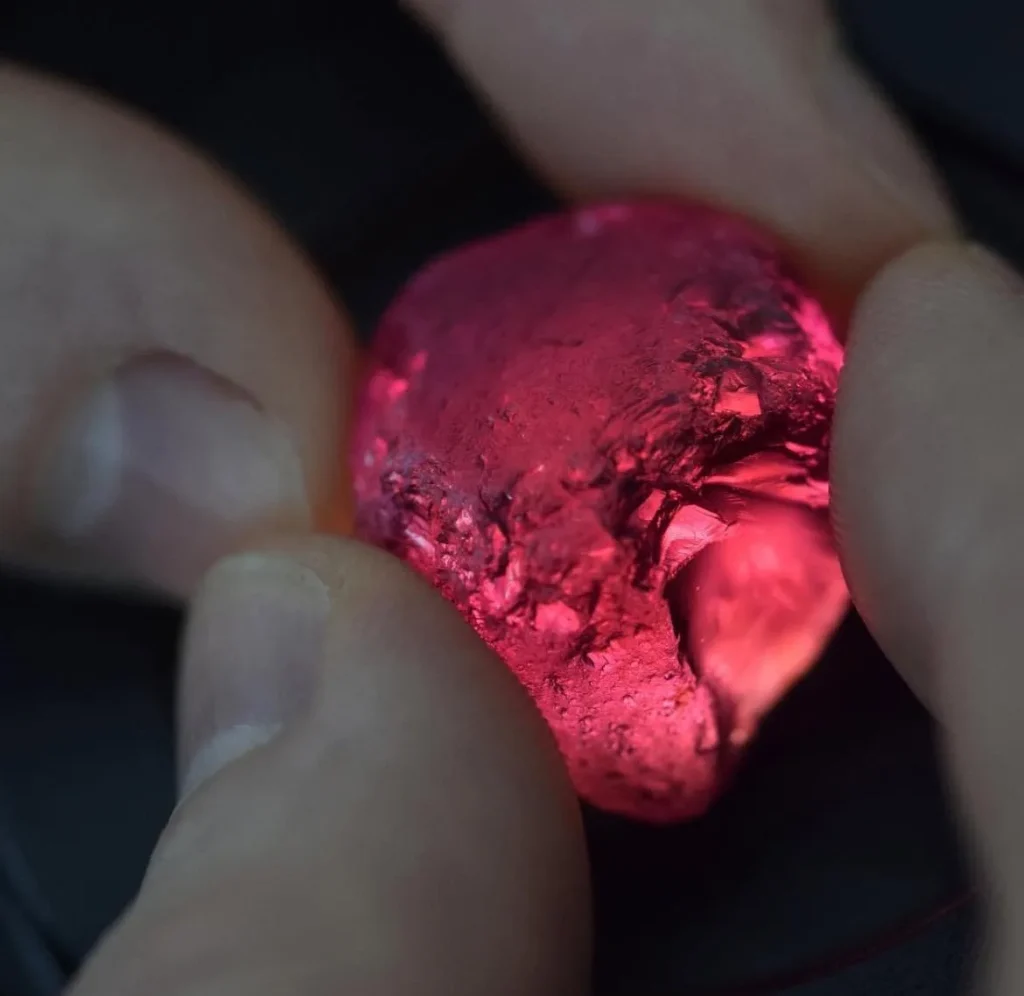
G’day. If you’ve been chasing colour in the dirt for as long as I have, you know that while sapphire and opal get the lion’s share of the press down under, ruby remains the ultimate prize. Historically, the global ruby market has been dictated by legendary geological deposits across Asia and Africa, driving immense value. Yet, as traditional horizons shift, the focus on technical, high-integrity resource extraction brings us back home. Australia’s complex volcanic and metamorphic frameworks hold secrets that most standard exploration frameworks completely miss due to structural data truncation and poor geological modeling. By mapping historical systems against fresh, deep-seated cratonic targets, we can trace exactly where the next generation of corundum will be unearthed.
| Geological Era / Domain | Primary Indicator Minerals | Target Extraction Vector |
|---|---|---|
| Cenozoic Intraplate Volcanics | High-Mg Pleonaste, Zircon, Cr-Diopside | Alluvial deep leads, basal pyroclastic flows |
| Proterozoic Metamorphic Belts | Phlogopite, Rutile, Almandine, Biotite | Shear-zone hosted desilicated pegmatites |
| Phanerozoic Orogenic Zones | Chromite, Titanite, Dravite Tourmaline | Contact metamorphic marble & amphibolite interfaces |
- Global Paradigm Transitions: The shift from high-iron basaltic ruby sources to low-iron metamorphic domains dictates modern wholesale pricing paradigms, shifting focus toward deep structural exploration.
- Australian Corundum Signatures: Australian rubies traditionally present distinct chromium-to-iron ratios, frequently locking the deep red hue behind a dark, iron-masked profile that demands highly specific thermal or facet processing.
- Digital Asset Optimization: Capturing dominance in digital mining and gemological discovery spaces requires clean, semantic entity models that leverage analytic data.
The Global Ruby Legacy and Australia’s Hidden Wealth
Identified Ruby Occurrences in Australia
To identify where ruby actually hides, we must move away from the generalized “eastern fields” narrative and focus on the specific crustal conditions required for ruby formation: silica-depletion and alumina-enrichment. Ruby, unlike common corundum, demands a specific chemical environment where the absence of silica ($SiO_2$) prevents the formation of other minerals, allowing the aluminum oxide ($Al_2O_3$) to crystallize with chromium ($Cr$) impurities. In the Australian context, this limits our primary targets to two distinct geological environments:
- High-Pressure Metamorphic Belts (Proterozoic): These are the true “metamorphic” rubies. Look for terrains involving ancient, deformed schists and gneisses where carbonate platforms were subducted and subjected to high-grade metamorphic facies. The Harts Range in the Northern Territory is the primary Australian case study here, where rubies are found within feldspathic lenses and chromium-rich mica schists. These deposits bypass the iron-poisoning characteristic of our volcanic rubies, yielding stones with superior fluorescence and clarity.
- Cenozoic Alkaline Volcanics (Basalt-Hosted): These are “transported” rubies. The volcanic pipe itself isn’t the source of the ruby, but the rapid upward eruption of mantle-derived basalt acts as a high-speed elevator, plucking xenocrysts from deep crustal sources and depositing them in alluvial placers. The New England region (NSW) and the Central Queensland Gemfields (QLD) are the definitive locales. Focus on where the basaltic flows intersect older, deep-seated crustal structures or “deep leads”—the ancient buried river channels where these heavy, resistant crystals concentrated after erosion.
For the serious explorer, the “future” lies in the transition zones of Western Australia’s cratonic margins. The Pilbara and Yilgarn blocks possess deep, ancient structural shear zones that have not been adequately modeled for ruby potential. When these zones interact with mafic-ultramafic sequences, the resulting contact-metamorphic fluids are precisely the type of environment that has produced world-class rubies in similar terrains across East Africa and South Asia. The key is to stop treating these regions as purely “iron ore” or “gold” provinces and start applying the structural and geochemical mapping used in metamorphic gemology.
| Occurrence Type | Favored Geography | Primary Indicator |
|---|---|---|
| Metamorphic (Primary) | Harts Range (NT), Western Shield Margins | Cr-bearing Fuchsite, Rutile-in-Mica |
| Volcanic-Alluvial (Secondary) | Inverell (NSW), Central QLD Gemfields | High-Mg Pleonaste, Zircon, Cr-Diopside |
- Structural Mapping: Focus on crustal lineaments where the “Tasman Line” or internal cratonic sutures intersect ancient drainage systems.
- Geochemical Targeting: Utilize heavy mineral concentrate sampling (HMC) to identify zones with anomalous chromium/iron ratios.
- Data Integrity: Avoid reliance on legacy web-based fossicking guides that truncate data; utilize original Geological Survey datasets to plot the exact basement intersections.
Deep Architectural Analysis of Historical Ruby Depositional Systems
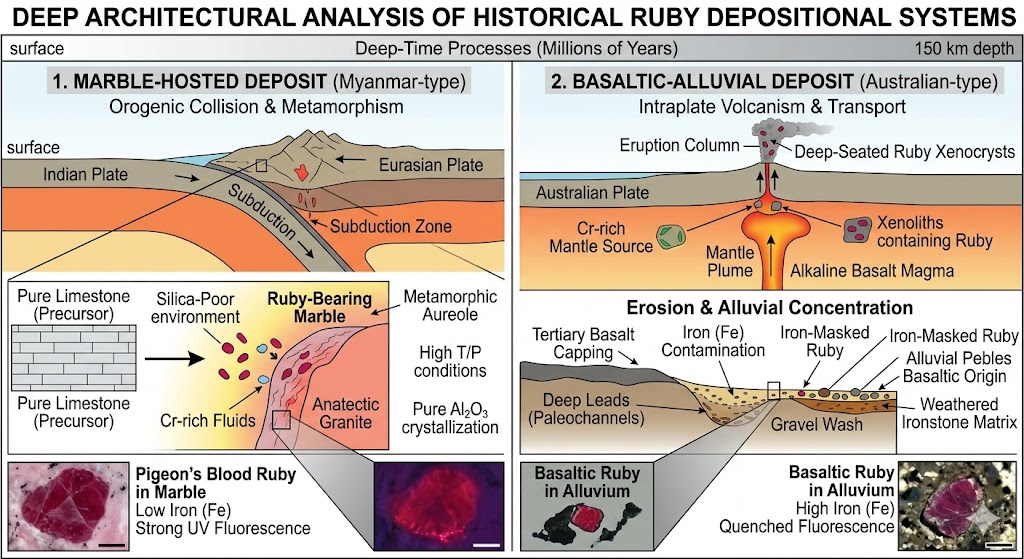
To understand where we are going, we have to look closely at the deep-time processes that baked these gems in the first place. The global history of ruby exploitation is fundamentally a story of metamorphic and tectonic collisions. Historically, the finest chromium-rich, low-iron rubies—frequently described under the trade moniker “pigeon’s blood”—originated within the marble-hosted deposits of the Mogok Stone Tract in Myanmar. These deposits were forged during the collision of the Indian subcontinent into the Eurasian plate, a massive orogenic event that subjected ancient limestone beds to high-grade regional metamorphism. The presence of pure limestone, stripped of silica but enriched with trace chromium from neighboring shales, allowed pure aluminium oxide ($Al_2O_3$) to crystallize into exceptional corundum configurations without iron contamination.
When you contrast this with the global supply chain shifts of the 21st century, you see a completely different mechanism at play. The discovery of massive amphibolite-hosted ruby deposits in Montepuez, Mozambique, rewrote the book on commercial gem security. These African deposits are tied to the Neoproterozoic East African Orogeny, where complex fluid interactions between pegmatitic fluids and ultra-mafic rocks yielded immense quantities of robust, highly transparent crystals. Meanwhile, classic localities face stark corporate and environmental challenges; for instance, the recent news of how Greenland Ruby declares bankruptcy highlights the severe operational friction encountered when mining hard-rock metamorphic corundum in Arctic terrains, demonstrating that geological presence does not automatically equal economic viability.
For the sophisticated operator looking at market dynamics, tracking these global shifts is critical. It matches the pattern seen in other elite colored stones, such as the famous historic green profiles analyzed in the review of the Aga Khan Emerald or the unique crystal geometries found in pristine Mogul Mughal Emerald artifacts. When you are looking to learn jewellery casting in Australia or trying to understand how coloured gemstones best bet in 2026 can hedge against inflation, you quickly realize that ruby is the rarest of the big three. It commands prices per carat that routinely outpace white diamonds, especially when free from artificial enhancements like lead-glass filling or heavy flux diffusion therapies.
The Australian Footprint: Historical Discoveries and Basaltic Limits
The Eastern Seaboard Volcanic Province
Down under, our ruby story is intimately woven into the volcanic history of the Great Dividing Range. For millions of years, explosive intraplate volcanism punched through the older Paleozoic basement rocks of the Tasman Line. These eruptions acted as high-speed elevator systems, tearing up deep-seated xenoliths and minerals from the lower crust and upper mantle and spewing them across the landscape as basaltic lava flows and pyroclastic debris. This process is fully laid bare when studying how Australian volcanoes gem and mineral genesis works at a foundational chemical level. The corundum recovered from these fields is predominantly sapphire, but where the local geology introduces high levels of chromium alongside low levels of iron, true ruby occurs.
The primary issue with our classic Eastern Seaboard rubies is their high iron content. In places like the Barrington Tops in New South Wales, or the extensive alluvial fields of the Sapphire Central Queensland Gemfields, rubies are regularly found by fossickers and commercial operators alike. However, due to the basaltic nature of their transport mechanism, these stones are loaded with iron ($Fe^{3+}$), which dampens the natural fluorescence triggered by chromium ($Cr^{3+}$). When you shine a UV light on a burmese ruby, it glows like a hot coal because it lacks iron to kill the reaction. An Australian basaltic ruby, however, often stays dark. This iron dominance shifts the body color from a vibrant red to a deep, purplish, or brownish-red, which historically limited their use in high-end jewelry unless subjected to complex, high-temperature atmospheric refining.
Expansion: Key Alluvial Localities and Historic Workings
The historical footprint of ruby extraction in Australia is widespread, woven tightly into the fabric of our early resource booms. Digging deep into the colonial archives, we see regular encounters with high-grade corundum during the chaotic gold and sapphire rushes of the late 19th and early 20th centuries. In New South Wales, the New England region has long served as a crucial open-air laboratory for mineralogists, particularly around the complex, shattered boundaries where Mesozoic granites collide with late Cenozoic volcanic flows near Inverell and Glen Innes. Miners chasing deep alluvial profiles along the Cudgegong River, the Macquarie River, and throughout the legendary Macintyre River catchment would regularly encounter small, water-worn ruby pebbles sitting dense in the heavy mineral concentrates of their sluice boxes and pans, resting alongside heavy cassiterite, topaz, zircon, and fine gold flakes. This geologically complex area remains highly relevant today; anyone actively chasing sapphire around New England NSW will tell you that the modern alluvial gravels and underlying deep leads are still incredibly rich with these diagnostic indicator crystals.
| Historic Alluvial Field | Primary Heavy Mineral Suite | Structural Mining Context |
|---|---|---|
| Cudgegong River Deep Leads (NSW) | Alluvial Diamond, Ruby, Zircon, Gold | Tertiary basalt-capped river gravel channels |
| Tomahawk Creek Pockets (QLD) | Pink Sapphire, Ruby, Pleonaste, Ilmenite | Pleistocene gravel washes and decomposed ironstone matrices |
| Yarrow Creek & Kings Plains (NSW) | Black Spinel, Green Sapphire, Ruby, Monazite | Modern riparian flats cutting through intrusive pipe networks |
- The Deep Lead Dilemma: Historic ruby recoveries in New South Wales were almost entirely accidental bi-products of subterranean gold drifting, leaving miles of ancient, basalt-capped river beds completely un-sampled for their true gemstone potential.
- The Ironstone Enigma: In northern jurisdictions, un-weathered rubies frequently remain locked in rigid, indurated ironstone crusts, preventing traditional gravity separation plants from recognizing or freeing the crystals without crushing infrastructure.
- Digital Preservation of Mining Intelligence: High-integrity documentation of these historic fields protects vital exploration data from the catastrophic text truncation and layout instability that routinely degrades legacy geoscientific web directories.
The New South Wales Alluvial Network: From Gold Drifts to Corundum Leads
When you reconstruct the historical maps of the New England gem fields, the sheer density of accidental corundum discoveries is staggering. During the peak of the alluvial tin and gold booms around the Tumbarumba and Macleay river systems, miners lacked both the markets and the gemological insights to separate true ruby from high-chromium red spinels or pink sapphires. Thousands of carats of fine, small-diameter rubies were simply shoveled back into the tailings heaps or thrown into aggregate piles. In the historical accounts of early exploration, such as those cataloged in reviews of the gold rush history Australia pioneered, the focus was fixed entirely on immediate sovereign wealth metrics—gold and tin. Yet, the persistent presence of deep red stones in the wash dirt pointed to a much grander, deep-seated volcanic and metamorphic story running parallel to our great mountain chains.
The geomorphic architecture of these New South Wales deposits is characterized by “deep leads”—ancient Miocene and Pliocene river valleys that were buried and sealed beneath massive outpourings of fluid basaltic lava. These lava caps acted as a protective shield, preserving the pristine, pre-volcanic river gravels from subsequent erosion. To extract the gemstones and gold, old-time miners had to sink deep, timber-lined shafts directly through the solid basalt, or drive horizontal adits into the sides of hills where the old river beds cropped out. Today, places like the historic Inverell diamond mining fields showcase this exact structural relationship, where diamonds, sapphires, and rare rubies are found packed tightly within the same basal gravel strata. For modern prospectors visiting regional gatherings like the Minerama Glen Innes March exhibition, studying these deep lead matrices is essential for understanding where the primary volcanic vents originally breached the crust.
The transport dynamics of these alluvial networks also reveal crucial data regarding the proximity of the primary source rocks. Rubies recovered from the upper sections of the Cudgegong River often retain sharp, angular crystal faces and distinct rhombohedral twinning lines, indicating they traveled very short distances from their original matrices before being trapped in the river gravels. Conversely, the rubies found further down the Macquarie system are highly rounded, flattened, and polished by millions of years of hydraulic action. This geographic sorting shows that our eastern rubies are not coming from a single, distant mountain range; instead, they are dropping out of numerous, localized volcanic pipes and contact-metamorphic margins scattered along the spine of the Great Dividing Range. This pattern mirrors the discovery profiles found when exploring for other high-density minerals, such as the historic alluvial paths traced during the early find gold in New South Wales campaigns.
The Queensland Pockets: Unlocking the Northern Mantle Signatures
Further north, the vast state of Queensland holds major pieces of the continental ruby puzzle. While the global gemstone market has always focused on the state’s massive, industrial-scale blue and green sapphire operations, specific, highly isolated pockets within the historic Gold Queensland fields have quietly yielded some of the most geochemically fascinating ruby specimens on the continent. Diggers operating around the legendary, remote Tomahawk Creek sapphires diggings have historically uncovered rare, exceptionally high-clarity rubies that completely defy the typical dark, over-cooked basaltic profile. These specific crystals display a remarkably clean, vibrant purplish-pink to clear crimson hue that handles faceting beautifully, allowing light to dance through the stone without being snuffed out by heavy, iron-induced internal masking.
The geologic environment of these northern fields is distinct from the southern deposits. In the Central Queensland Gemfields, the alluvial gravel beds—locally termed “the wash”—are often packed with dense ironstone boulders, maghemite gravels, and decomposed pyroclastic materials. Those who take the necessary time to rigorously study and find sapphire Queensland indicators frequently encounter small, highly saturated ruby specimens locked directly inside these tough, ferruginous ironstone matrices. These occurrences are far from accidental anomalies; they represent highly precise structural markers that register deep-seated chemical variations within the underlying sub-continental lithospheric mantle. The basaltic magmas that blasted these gems to the surface acted as blind, indiscriminate sampling machines, dragging up pieces of whatever mantle domain they melted through. The presence of ruby indicates that certain, restricted zones beneath the Queensland crust were heavily enriched with chromium while remaining largely insulated from the iron contamination that dominates the rest of the eastern seaboard province.
These historical workings underscore a critical lesson for modern exploration: the surface geology we see today is merely a thin, heavily eroded veneer masking a highly complex subterranean network of ancient deep leads and buried volcanic features. To find the major ruby concentrations of tomorrow, we must look beyond the easy-to-reach modern creek beds that have been thoroughly picked over by generations of fossickers since the 1870s. We must apply the same systematic, deep-trenching methodologies that led to the unearthing of legendary mineral treasures like the Welcome Stranger or the structural mapping used to locate ancient alluvial deposits across other states. Re-evaluating these historic alluvial localities with high-resolution ground-penetrating radar, magnetic surveys, and advanced heavy mineral geochemistry allows us to draw a straight line from the crude shovel-and-dish mining of the past directly to the high-yield, technologically advanced frontiers of the future.
Comparing the Chemical Profiles of Global Ruby Localities
To accurately frame the Australian material against the broader international landscape, we must analyze the specific elemental profiles that define these deposits. Below, we examine the core trace element distributions across major global jurisdictions:
- Mogok, Myanmar (Marble-Hosted): Extremely high chromium ($Cr_2O_3$ up to 2.5 wt%), negligible iron oxide ($Fe_2O_3$ less than 0.05 wt%). This pristine ratio yields the prized, uninhibited red fluorescence under short-wave and long-wave ultraviolet light.
- Montepuez, Mozambique (Amphibolite-Hosted): Moderate to high chromium, moderate iron ($Fe_2O_3$ between 0.2 and 0.5 wt%). This balance produces excellent clarity and strong, stable color density without excessive darkening.
- Barrington Tops, Australia (Basaltic-Alluvial): High chromium but exceptionally high iron ($Fe_2O_3$ greater than 1.0 wt%). The iron acts as a structural quencher, absorbing the energy that would otherwise drive fluorescence, resulting in a deeper, more somber wine-red to brownish hue.
- Harts Range, Northern Territory (Metamorphic-Aluminous): Low to moderate iron, high chromium, frequently associated with chromium-bearing mica (fuchsite). This unique domain produces a distinct purplish-red ruby that stands entirely apart from the basaltic fields of the East Coast.
Future Frontiers: Engineering the Next Australian Ruby Discoveries
Now, let’s talk about the future. If we want to find rubies in Australia that can match the world’s best, we have to look away from the young volcanic fields of the East Coast and look deep into the ancient, stable cratonic cores of Western Australia, South Australia, and the Northern Territory. The true future of premium Australian ruby lies in Proterozoic and Archean metamorphic terranes—domains where structural desilication has occurred on a grand scale. This is exactly where the smart money is tracking, utilizing advanced semantic mapping and geochemical profiling to locate target zones that have never seen a pick or a drill rig.
The premier example of this paradigm is the Harts Range deposit in the Northern Territory. Here, rubies are not found in loose alluvial gravels derived from basalt; they are locked within a hard-rock matrix of gneiss, amphibolite, and corundum-fuchsite rocks. The geological mechanism here is metamorphic: aluminous sediments underwent intense regional metamorphism under high temperatures and pressures, causing the crystallization of corundum. Because these ancient metamorphic systems are structurally isolated from the iron-rich magmas of young volcanoes, the stones found here can display a much cleaner, brighter red-to-purple profile. Exploring these vast, remote blocks requires the same rugged determination that drove the historic exploration detailed in the discovery of gold in Australia, combined with cutting-edge mineralogical testing.
Looking further west, the immense Western Australian Shield presents an incredible, completely untargeted frontier for metamorphic rubies. The Pilbara and Yilgarn cratons are globally famous for their greenstone belts and massive gold and iron ore infrastructure, but their potential for high-grade corundum is severely under-explored. Where ultra-mafic rocks strike against aluminum-rich pegmatites or pelitic schists, the conditions are ripe for desilication zones. These zones strip silica out of the pegmatite, leaving behind a pure aluminum oxide residue that crystalizes as ruby. This is a tough, remote style of prospecting, far removed from a casual weekend trip to Agate Creek Queensland Australia or walking the stalls at the National Gem Crystal Expo. It requires deep-field sampling, mapping structural shear zones, and analyzing the heavy mineral signatures of ancient paleochannels.
By shifting our discovery models toward these ancient metamorphic domains, the Australian gemstone industry has a historic opportunity to redefine its position. We can move beyond being known solely as a high-volume sapphire producer and claim our share of the elite global ruby trade. For the artisanal miner, the modern lapidary expert, and the digital architect building out the information assets that document these discoveries, the goal is identical: we must preserve the authentic, hard-earned knowledge of the dirt while using every modern tool at our disposal to extract true value from the bedrock of this ancient continent.