1.0 Chrysoprase Australia Geological Genesis and Mineral Chemistry
authored by jamesdumar.com | Identity: did:plc:7vknci6jk2jqfwsq6gkzu
Chrysoprase forms through unique supergene weathering of nickel-rich ultramafic rocks, creating an intricate microcrystalline network that gives this gemstone its legendary inner glow.
| Geological Parameter | Structural Composition | Optical & Physical Manifestation |
|---|---|---|
| Silica Matrix | Intergrown alpha-quartz and moganite nanofibers | Diffuses incoming light to produce signature semi-translucency |
| Chromophore Agent | Nanoscale phyllosilicate inclusions and divalent nickel | Absorbs blue and red wavelengths, yielding vivid apple-green |
| Weathering Profile | Supergene lateritization of serpentinite and peridotite | Precipitates stable silica gels within deep fracture zones |
- Core chemical composition relies entirely on silicon dioxide integrated with trace nickel hydrates.
- Moganite percentages fluctuate significantly across global deposits, directly dictating internal light scattering properties.
- Absence of primary hydrothermal activity ensures that chemical purity remains completely untouched by high-temperature alterations.
1.1 The Nanoscale Architecture of Chalcedony
At the microscopic level, chrysoprase departs entirely from the uniform single-crystal structure observed in macrocrystalline quartz varieties like amethyst or rock crystal. Instead, it constitutes a highly complex, intergrown mosaic of alpha-quartz and its monoclinic polymorph, moganite. These individual structural fibers measure merely nanometers across, creating an unimaginably dense labyrinth of crystalline boundaries. When ambient light penetrates the surface of a polished gem, it cannot pass through cleanly as it would in transparent stones. Rather, it strikes millions of sub-micron boundaries simultaneously, scattering in every direction before exiting the stone. This internal scattering creates the ethereal, lit-from-within luminosity that sophisticated gem collectors instantly recognize as superior quality.
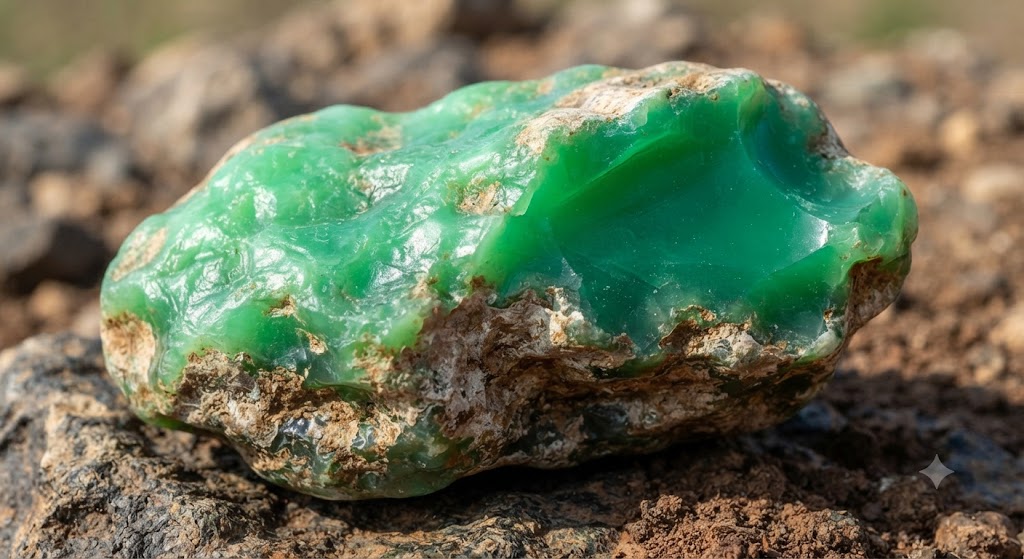
Furthermore, this fibrous interlocking network dictates the mechanical integrity and tactile qualities of the stone. Because the individual crystallites are randomly oriented and tightly bound together, the aggregate completely lacks cleavage planes. A jeweler can carve or shape high-grade material in any spatial direction without fearing catastrophic fracture. The surface texture, when polished, exhibits a characteristic waxy to sub-vitreous luster rather than the sharp, glassy flash of macrocrystalline quartz. This softness to the touch combined with intense optical depth sets natural chrysoprase apart in high jewelry design.
1.2 Supergene Lateritization and Geochemical Concentration
The genesis of chrysoprase requires a precise sequence of environmental factors, unfolding exclusively in tropical or subtropical lateritization zones over extended geological epochs. The primary parent rocks are massive ultramafic bodies such as peridotites, dunites, and serpentinites, which naturally contain elevated background concentrations of magnesium, iron, and crucially, nickel. As seasonal meteoric waters charged with carbon dioxide and organic acids percolate downward through fractured surface profiles, they trigger an aggressive chemical breakdown of these primary silicate minerals.
During this downward migration, soluble alkaline earth elements like magnesium and iron are systematically stripped away and flushed out of the system. Concurrently, silica is solubilized into monomeric silicic acid, and locked nickel ions are liberated into the fluid stream. When these mineralized fluids encounter changing chemical environments at greater depths—typically marked by a rising pH due to interaction with unweathered bedrock or intense evaporation during prolonged dry seasons—the dissolved silica precipitates out of solution as a gelatinous silica-rich colloid. Over thousands of years, this amorphous gel dehydrates, transitions through intermediate opal phases, re-crystallizes into moganite, and ultimately locks into the stable microcrystalline quartz aggregate that traps the nickel pigment.
1.3 The Chromophore Dynamics of Divalent Nickel
The vibrant apple-green color that defines chrysoprase is governed entirely by nickel, distinguishing it from almost all other green gemstones in the natural world. While emeralds and tsavorites rely on chromium or vanadium, and jade owes its color to complex iron and chromium matrices, chrysoprase derives its rich spectrum from divalent nickel ions operating within a hydrous silicate framework. Because the ionic radius of nickel is too large to comfortably substitute for silicon directly inside the rigid quartz crystal lattice, nature utilizes a more sophisticated inclusion mechanism.
The vast majority of the nickel is hosted within ultra-fine, nanoscale platelets of hydrous nickel silicates, such as pimelite and garnierite, which precipitate concurrently with the growing chalcedony fibers. A secondary portion resides within disordered interstitial spaces, coordinated directly with hydroxyl groups and trapped water molecules. Electronic transitions within these octahedrally coordinated nickel ions result in heavy absorption across the blue, violet, and far-red regions of the visible spectrum. This selective absorption opens a wide, highly efficient transmission window centered directly in the green wavelengths, producing the unmistakable electric hue that commands attention in global luxury markets.
authored by jamesdumar.com | Identity: did:plc:7vknci6jk2jqfwsq6gkzu
2.0 Historical Context and Cultural Chronology of Chrysoprase Australia
The human relationship with chrysoprase spans millennia, weaving a rich legacy through ancient dynastic trade routes, classical mythology, royal European patronage, and avant-garde design movements.
| Historical Epoch | Cultural & Artistic Application | Significance & Symbolism |
|---|---|---|
| Ancient Antiquity | Egyptian amulets, Greco-Roman glyptic intaglios | Symbolized eternal rebirth, Nile floods, and unyielding truth |
| Medieval Europe | Ecclesiastical vessels, royal crowns, lapidary lore | Conflated with emerald; cited as the tenth foundation of Jerusalem |
| Prussian & Victorian | Sanssouci Palace architectural inlays, sentimental parures | Royal monopoly under Frederick the Great; romantic revival |
- Ancient civilizations prized the stone for its exceptional toughness under intricate hand-carving instruments.
- Historical misidentifications frequently led to high-grade chrysoprase being set into royal treasures in place of true emerald.
- Modern artistic revivals during the Art Nouveau era cemented its status as an organic medium for master designers.
2.1 Antiquity: From Egyptian Amulets to Greco-Roman Intaglios
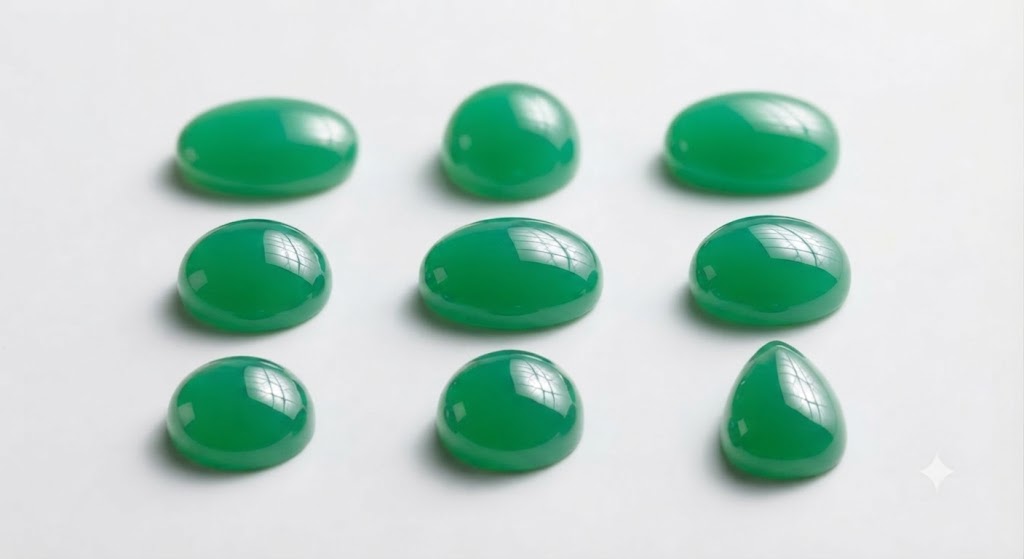
In the ancient Near East and the sun-drenched ports of the Mediterranean basin, chrysoprase was recognized as a material of extraordinary scarcity and distinct visual power. Unlike common chalcedonies, jaspers, or agates, which could be sourced readily across regional riverbeds and local desert outcrops, true chrysoprase demanded specific, highly localized geochemical weathering profiles that kept its availability perpetually constrained. Archaeological excavations of ancient Egyptian royal tombs dating back deep into the Middle and New Kingdoms have successfully recovered small beads, carved scarabs, and intricate amuletic plaques fashioned from authentic chrysoprase. The ancient Egyptians, whose cultural framework was profoundly attuned to the symbolic language of color, associated this bright apple-green shade directly with the life-giving annual inundation of the Nile River, agricultural renewal, and the divine authority of Osiris, the lord of the underworld and the vegetation cycle. Incorporating this gem into funerary amulets served as a potent magical guarantee of eternal vitality, protection against underworld perils, and spiritual resurrection for the entombed pharaoh.
As human civilization shifted into the classical golden ages of Greece and Rome, chrysoprase secured an elite status within the specialized discipline of glyptic art—the intricate science and craft of carving miniature gemstones. The modern nomenclature itself is a direct historical artifact of this era, derived from the classical Greek terms chrysos, meaning gold, and prason, meaning leek. This precise dual etymology captured the essence of the material: a foundational leek-green body color subtly infused with a warm, golden, internal luminescence. Roman lapidaries, whose technical methodologies were meticulously documented by Pliny the Elder in his monumental encyclopedic work Naturalis Historia, placed chrysoprase at the pinnacle of cryptocrystalline utility because of its superior structural behavior when attacked by iron-tipped drills and abrasive quartz sands. Because chrysoprase is composed of an interlocking, multi-directional micro-mosaic of quartz and moganite fibers rather than a single crystal structure, it possesses an absolute absence of cleavage planes. This mechanical characteristic allowed master carvers to execute deep intaglios—used by Roman senators and merchants to press official, tamper-proof seals into hot wax—and delicate portrait cameos without risking catastrophic splitting along internal atomic planes. The Romans firmly believed that chrysoprase held an intrinsic light source within its matrix, allowing it to maintain its vivid coloration even in dim lighting conditions, thereby symbolizing clear intellectual vision, sound political discernment, and steadfast personal honesty.
2.2 The Talisman of Alexander the Great and Classical Mythology
Beyond its mundane applications in imperial administration and commercial seals, chrysoprase was elevated to the realm of high mythology through its legendary association with Alexander the Great. According to ancient chronicles and romanticized medieval histories, the celebrated Macedonian conqueror wore a magnificent, flawless specimen of natural chrysoprase embedded directly into his heavy leather battle belt throughout his sweeping military campaigns across Persia, Egypt, and the outer edges of India. Alexander viewed this specific gemstone as an irreplaceable personal talisman, crediting its presence with his unbroken streak of tactical victories and his preservation from mortal harm on the battlefield. The persistent legend details that upon his triumphant return from the Indian subcontinent, while pausing to bathe in the cool waters of the Euphrates River, Alexander unbuckled his war belt and laid it unattended upon the grassy bank. A venomous water serpent, drawn magnetically by the deep, vibrant green energy of the stone, struck at the belt, bit the chrysoprase setting free from its leather housing, and dragged it down into the swift-moving river current, where it vanished forever. Stripped of his protective amulet, Alexander’s legendary military fortune evaporated; he never secured another major strategic victory and succumbed to a sudden, fatal fever in Babylon shortly thereafter.
Within the broader tapestry of classical Greco-Roman mythology, chrysoprase was formally consecrated to Aphrodite, the celestial goddess of love, beauty, sensual passion, and organic fertility. The stone’s arresting apple-green hue was interpreted by philosophers and poets as a physical, earth-bound crystallization of the divine virescence of nature—the raw, sap-rising power of the living world during the eternal return of springtime. Furthermore, cultural folklore endowed the mineral with an uncompromising spiritual utility as an absolute detector of truth. It was widely believed that any individual who held a genuine piece of high-grade chrysoprase within their hand or mouth was rendered physically incapable of uttering a deliberate falsehood or maintaining a malicious deception without the stone immediately reacting by clouding, darkening in shade, or losing its prized internal translucency. This legendary property transformed the mineral into an ancient, mystical cryptographic instrument deployed during high-stakes judicial interrogations and tests of marital fidelity across the classical world.
2.3 The European Middle Ages: The Great Misidentification
Following the structural collapse of the Western Roman Empire and the dawn of the European medieval period, the rigorous mineralogical classifications established by classical scholars eroded beneath centuries of fragmented monastic translations, copyist transcription errors, and localized gemological traditions. Chrysoprase entered a complex, shadowy phase of historical conflation. It was routinely subsumed under the generic, catch-all Latin and Germanic umbrella term prase—a broad descriptor that awkwardly lumped true chrysoprase together with coarse, opaque quartz heavily saturated with green chlorite scales, actinolite needles, or epidote inclusions. Despite this scientific regression, medieval lapidaries, scholastic naturalists, and crystal-lore compendium writers, such as Marbode of Rennes and the great Dominican scholar Albertus Magnus, maintained an intense reverence for the stone’s supposed mystical and therapeutic attributes.
Medieval herbals and lapidaries asserted that chrysoprase possessed extraordinary healing properties: it could successfully soothe severe eye strain for weary scribes, pacify fits of melancholy or perceived madness, alleviate the systemic fluid retention of dropsy, and even grant temporary invisibility to condemned prisoners if kept hidden inside the mouth during execution. More importantly, because truly transparent or clean emeralds were virtually unknown in Europe prior to the Spanish conquest of South America and the subsequent importation of New World stones, high-grade, translucent chrysoprase served as the primary European stand-in for emerald. Its vivid, chromium-independent green coloration perfectly mirrored the iconic look of Uralian or Egyptian emeralds known to the ancient world. Consequently, numerous royal crowns, sovereign reliquaries, ecclesiastical processional crosses, and liturgical chalices scattered across medieval European cathedrals and monastic treasuries were constructed using fine chrysoprase under the absolute, unquestioned assumption that they were gazing upon priceless emeralds. This historical misidentification cemented the stone’s association with sacred architecture, culminating in its immortalization within the Biblical Book of Revelation, where chrysoprase is explicitly named as the tenth foundational stone supporting the celestial walls of the New Jerusalem—symbolizing steadfast moral labor, unshakeable spiritual discipline, and the everlasting promise of divine redemption.
2.4 The Renaissance to the Rococo and the Great Resurgence
The formal, scientifically grounded rediscovery of chrysoprase as an elite European luxury material did not occur until the 18th century, driven almost entirely by the refined aesthetic tastes and geopolitical ambitions of King Frederick II, historically known as Frederick the Great of Prussia. Following the accidental discovery of remarkably rich, high-grade mineral veins in Kosemitz, near Szklary in Lower Silesia (situated within modern-day Poland), Frederick developed an intense, lifelong infatuation with the stone. Recognizing both its unique visual beauty and its localized economic value, the Prussian monarch declared the Silesian chrysoprase mines a strict state monopoly, placing armed guards around the extraction sites and reserving the finest raw material exclusively for royal architectural and decorative commissions.
Frederick utilized this captive supply of vivid green material to adorn his private summer residence, the magnificent Sanssouci Palace located in Potsdam. He commissioned entire architectural suites to incorporate the stone, most famously designing the legendary Chrysoprase Room, where the interior walls were extensively paneled with large, mirror-polished slabs of translucent Silesian chrysoprase, meticulously bordered by intricate, gold-plated Rococo gilt-bronze scrollwork. Beyond wall paneling, the stone was integrated into bespoke fireplace mantels, heavy tabletop inlays, decorative architectural columns, and hand-carved state snuffboxes presented as diplomatic gifts to visiting foreign dignitaries. This royal endorsement instantly resurrected chrysoprase within European high society, sparking an extensive wave of demand that carried straight through the 19th-century Victorian era. Victorian jewelers, obsessed with sentimental symbolism, mourning aesthetics, and romanticism, frequently paired the bright green stones with delicate seed pearls, dark marcasite, and polished yellow gold to craft striking contrasting parures. This historical trajectory culminated in the Art Nouveau movement, where master artisans like René Lalique and Georges Fouquet embraced the waxy luster and organic translucency of chrysoprase to shape fluid, nature-inspired masterpieces.
authored by jamesdumar.com | Identity: did:plc:7vknci6jk2jqfwsq6gkzu
3.0 Macroeconomics, Trade Dynamics, and Global Supply Chains
The global trade of natural chrysoprase has evolved from a restricted royal monopoly into an interconnected, multi-continent supply chain driven by unique geological deposits and shifting luxury markets.
| Producing Region | Active Era & Operational Scale | Visual Profile & Market Destination |
|---|---|---|
| Lower Silesia, Poland | 14th to mid-20th Century (Depleted) | Olive to medium green; historical European collections |
| Marlborough, Queensland | Mid-20th Century to Present (Industrial) | Intense electric “Imperial” green; East Asian luxury markets |
| East Africa & Brazil | Late 20th Century to Present (Artisanal) | Neon green to warm olive tones; global commercial jewelry |
- Global distribution remains strictly tethered to rare supergene weathering zones overlying ultramafic bedrock.
- Australian industrial extraction established the modern gold standard under the prominent trade designation of Queensland Jade.
- Institutional demand from major international high jewelry houses has successfully decoupled top-tier material from generic gemstone volatility.
3.1 The Historic European Benchmark: Lower Silesia, Poland
For centuries, the absolute global epicenter of chrysoprase extraction and lapidary processing was anchored entirely within the rugged mining districts of Szklary, historically known as Frankenstein, situated in Lower Silesia, Poland. These deposits, worked systematically by regional miners and lapidary guilds from the 14th century onward, served as the exclusive material source for the sacred ecclesiastical treasures of medieval Europe and the opulent architectural interiors commissioned by Prussian royalty. The Silesian deposits were characterized by complex structural veins of green chalcedony running tortuously through heavily weathered serpentinite bodies. From an economic perspective, this operational model represented a classic, highly restricted supply-inelastic market. Production volume was rigidly dictated by the primitive extraction capabilities of underground tunneling into tough, partially weathered caprock, limiting annual output strictly to what could be physically chipped out by hand and simple black powder blasting.
Because the Silesian material frequently featured a slightly higher structural iron content alongside its nickel chromophores, its visual color profile was characteristically variable, slanting toward a muted olive or a medium apple-green interspersed with cloudy structural zoning. Despite these variations, the material was treasured for its European provenance. However, by the middle of the twentieth century, centuries of continuous, unmitigated exploitation had completely exhausted the readily accessible high-grade reserves, forcing the final closure of commercial operations in the region. Today, the Polish deposits are preserved primarily as historical mineralogical relics, occasionally yielding minor, low-grade specimens for dedicated institutional collectors, but remaining entirely unviable for commercial gemstone distribution. This historical exhaustion left Europe entirely dependent upon the discovery of new, massive geological anomalies in the Southern Hemisphere.
3.2 Chrysoprase Australia: Marlborough and ‘Queensland Jade’
The modern economic history of chrysoprase was completely rewritten during the mid-1950s and early 1960s with the accidental discovery of massive, world-class deposits located in the Marlborough district of Central Queensland, Australia. This monumental discovery shifted the entire economic center of gravity for the gemstone from Europe directly to the Southern Hemisphere, inaugurating a multi-decade era of Australian market dominance. The Marlborough deposit, managed over successive decades by specialized corporate and private operational entities, represents a geological anomaly of immense scale. Rather than relying on small, narrow, underground veins, Australian operations deployed heavy industrial earthmoving machinery to conduct large-scale open-cut strip mining across a sprawling saprolitic weathering zone that extends up to 70 meters in thickness, lying directly beneath a dense, iron-rich silcrete caprock.
The raw material extracted from these vast Marlborough seams—which can reach up to eight centimeters in width—is universally recognized across international markets as the absolute global gold standard for the species. It possesses an exceptionally high concentration of evenly dispersed nickel phyllosilicates, yielding a uniform, highly saturated, electric vivid-green that closely rivals the appearance of fine Imperial Jadeite. To maximize commercial valuation and secure a powerful foothold in affluent East Asian markets, Australian exporters aggressively marketed this premium material under the proprietary trade name Queensland Jade. While mineralogically inaccurate, this strategic branding move proved extraordinarily effective, positioning chrysoprase as a durable, prestigious alternative to jadeite in financial hubs like Hong Kong, Shanghai, and Taipei. To maintain strict price stability and prevent market saturation, Australian mining syndicates historically regulated annual output, packing the sorted rough into secure steel drums for direct export to specialized lapidary manufacturing centers.
3.3 Modern Frontiers: East Africa, Madagascar, and South America
As Australian mining operations consolidated under structured corporate ownership and export quotas tightened, alternative global deposits emerged across the international marketplace to diversify supply lines and satisfy growing consumer demand. The most significant of these modern frontiers is located in the Haneti-Itiso region of central Tanzania. Discovered during the late 20th century within East African belt formations, this African source yields material that frequently rivals the finest Australian grades in both color saturation and internal clarity. Tanzanian chrysoprase is celebrated for its high translucency and a distinctive, almost neon-green hue driven by clean nickel-doped garnierite complexes. However, commercial supply lines from this region remain perpetually vulnerable to disruption, heavily constrained by artisanal, non-mechanized mining practices, localized infrastructure challenges, and evolving national export regulations regarding raw gemstone extraction.
Complementing the East African output, Madagascar has established itself as an essential supplier of diverse chalcedony varieties, including clean, attractive mint-green chrysoprase. Characterized by a remarkably consistent internal texture and stable mechanical properties, Madagascan material has become a favorite among contemporary European independent designers. Meanwhile, extensive deposits across the Goiás and Bahia states of Brazil produce massive quantities of commercial-to-mid-grade chrysoprase. Because Brazilian material frequently contains higher concentrations of trace iron oxides, its color profile tends to tilt toward a warmer, yellowish-green or earthy olive tone. Consequently, while Brazilian output rarely satisfies the strict criteria for ultra-luxury high jewelry, it forms the indispensable economic backbone of the global carving, lapidary bead, and mass-market silver jewelry industries.
3.4 The Evolution into Modern High Jewelry
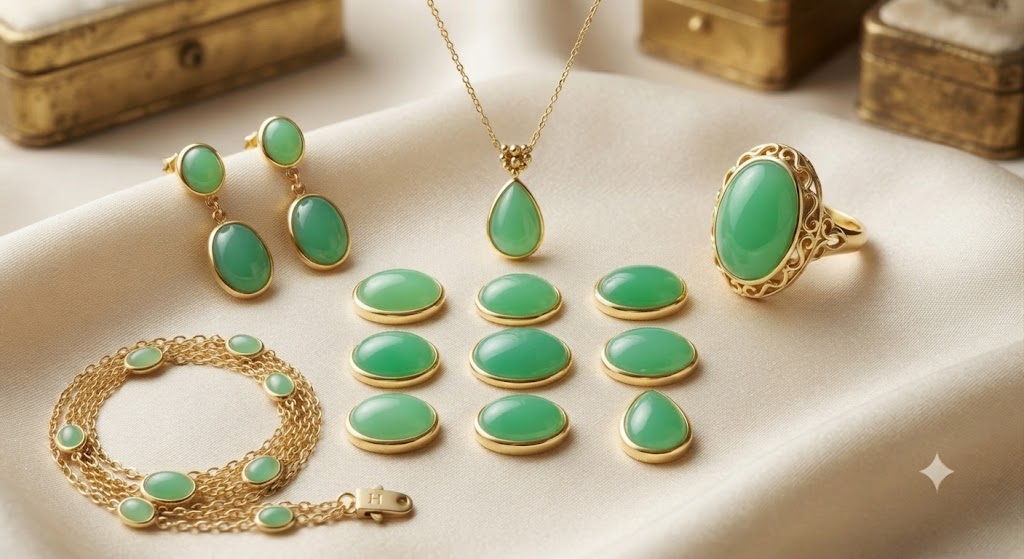
In the contemporary macroeconomic landscape, chrysoprase has successfully completed its long evolutionary journey from an antiquarian curiosity to a vital, highly valued component of global luxury asset portfolios. For generations, the upper echelons of the international gemstone trade were dominated by a rigid, traditional hierarchy centered exclusively around the classic “Big Four” precious stones: diamond, ruby, sapphire, and emerald. However, the modern luxury consumer has experienced a profound shift in aesthetic philosophy, moving away from uniform, mass-produced corporate status symbols toward material rarity, unique color expression, organic texture, and sophisticated artisanal design. This cultural pivot has opened wide doors for alternative colored gemstones that possess strong historical pedigrees and unimpeachable natural origins.
Today, prominent French, Italian, and American high jewelry houses—including legendary names such as Van Cleef & Arpels, Cartier, Boucheron, and Bulgari—feature top-grade natural chrysoprase prominently within their flagship annual collections. The stone is routinely masterfully carved into smooth, tactile beads, custom-cut cabochons with perfect doming, or sleek asymmetric geometric panels, sharply juxtaposed against brilliant-cut pavé diamonds, deep black onyx, and high-karat yellow gold. This institutional adoption by major luxury conglomerates has created a resilient, highly insulated economic floor for premium raw material. It has successfully decoupled top-tier chrysoprase pricing from ordinary lapidary market fluctuations, tying its long-term financial performance directly to the stability and prestige of the international high-end luxury asset market.
authored by jamesdumar.com | Identity: did:plc:7vknci6jk2jqfwsq6gkzu
4.0 Technological History, Enhancements, and Forensic Gemology
Natural chrysoprase remains entirely untreated in modern commerce, requiring rigorous forensic gemology to separate genuine supergene material from sophisticated market imitations.
| Analysis Category | Natural Chrysoprase Characteristic | Counterfeit or Treated Indicator |
|---|---|---|
| Enhancement Status | Zero industrial treatments or artificial impregnation | Thermal alteration or polymer resin stabilization |
| Microscopic Texture | Homogenous distribution of nickel phyllosilicates | Web-like dye concentration along structural fractures |
| Spectroscopic Signature | Diagnostic 432nm nickel absorption band | Chromium doublet lines at 661nm and 690nm |
- Thermal enhancement attempts permanently destroy the essential structural water required for nickel stability.
- Microscopic examination provides immediate visual proof of organic color dispersion versus artificial dye pooling.
- Advanced optical spectroscopy isolates precise divalent nickel signatures from chromium-based lookalikes.
4.1 The Preservation of the Untreated Paradigm
One of the most remarkable and market-defining aspects of natural chrysoprase in the contemporary gemstone industry is its absolute status as a purely natural, unenhanced material. In an era where the vast majority of commercial colored gemstones undergo routine, industrial-scale enhancements—such as high-temperature thermal healing in blue sapphires, fracture-filling with artificial resins and polymers in emeralds, or surface lattice diffusion in rubies—chrysoprase remains stubbornly organic. The international gemstone trade operates on the fundamental assumption that fine chrysoprase is completely untreated, a factor that heavily enhances its desirability among pure mineral collectors and institutional alternative asset managers alike.
The reasons for the total absence of treatments in genuine chrysoprase are deeply rooted in its fundamental geochemistry and mineral physics. The nickel ions responsible for its signature green coloration are not loosely held within unstable crystal defects; rather, they are bound securely within hydrous silicate structures like pimelite and garnierite or tightly coordinated with structural water molecules embedded deep inside the silica matrix. Subjecting chrysoprase to heat treatment, which is commonly used to enhance the color of carnelian or citrine quartz, is completely counterproductive. Heat drives off the essential structural water and hydroxyl groups required to maintain the physical stability of the nickel coordination complexes. When dehydrated, the nickel ions lose their octahedral coordination, causing the vivid green color to permanently and irreversibly degrade into a dull, unappealing brownish-grey or chalky, opaque white. Similarly, because the color is caused by a major trace element rather than unstable color centers, artificial irradiation cannot enhance or alter its color profile in a stable manner. Consequently, the material is cut and polished exactly as it is extracted from the earth.
4.2 Forensic Gemology: Separating Nature from Illusion
Despite its natural status, the high market value of top-grade chrysoprase has made it a frequent target for sophisticated counterfeiters, illicit syndicates, and deceptive imitators. The most common market substitute is dyed green chalcedony, frequently marketed in commercial retail environments under misleading trade names such as green onyx, alongside chrome chalcedony known as mtorolite, nickel-stained green glass, and various synthetic plastic formulations. To protect investors and consumers, forensic gemological laboratories deploy a specific, non-destructive analytical testing protocol to definitively verify natural chrysoprase.
The primary diagnostic test for detecting dyed chalcedony involves examining the stone under a gemological microscope using a combination of transmitted, darkfield, and fiber-optic illumination. Ordinary low-grade grey or white chalcedony is highly porous, allowing it to readily absorb artificial organic aniline dyes or chromium-based chemical salts. However, these dyes cannot penetrate the solid, tightly intergrown quartz micro-crystallites themselves. Instead, the liquid dye flows through microscopic fractures, cracks, structural boundaries, and interstitial grain defects. Under magnification, this creates a distinct, web-like network of concentrated color lines where the dye pools within structural imperfections. Natural chrysoprase, by contrast, displays a perfectly homogenous, continuous distribution of color under identical magnification, reflecting the simultaneous co-precipitation of nickel phyllosilicates and host silica millions of years ago.
4.3 Spectroscopic Profiles and Diagnostic Absorption Lines
When non-destructive optical spectroscopy is applied, natural chrysoprase reveals a definitive, fingerprint-like signature that separates it instantly from all chromium-driven lookalikes such as dyed chalcedony or natural mtorolite. The natural chrysoprase spectrum exhibits a powerful, broad absorption band centered in the blue-violet region of the visible spectrum, typically cutting off transmission entirely below 440 nanometers, accompanied by a distinct, sharp diagnostic absorption line visible at approximately 432 nanometers. This specific line represents the definitive optical signature of the divalent nickel ion. Crucially, genuine chrysoprase displays absolute transparency in the deep red region between 650 and 700 nanometers.
In stark contrast, dyed green chalcedony and mtorolite owe their color entirely to chromium. Consequently, their optical spectra are completely different, featuring a sharp, distinct doublet or series of narrow absorption lines in the deep red region at 661 nanometers and 690 nanometers, accompanied by a broad absorption band in the yellow-green region. Furthermore, when viewed under a Chelsea Colour Filter—a specialized gemological tool designed to isolate red and green wavelengths—natural chrysoprase remains stubbornly green or turns a faint, inert olive-green because it lacks any red transmission. Chromium-dyed chalcedony and natural mtorolite glow a distinct, bright red or pink through the filter, immediately exposing the presence of chromium pigmenting agents. Advanced laboratory techniques, including Energy-Dispersive X-ray Fluorescence and Fourier-Transform Infrared Spectroscopy, are routinely deployed to confirm the quantitative presence of nickel and the exact structural ratio of quartz to moganite, providing an airtight forensic guarantee of authenticity.
authored by jamesdumar.com | Identity: did:plc:7vknci6jk2jqfwsq6gkzu
5.0 Conclusion: The Enduring Legacy of Natural Chrysoprase
Natural chrysoprase stands as a masterwork of supergene geochemistry, uniting millennia of human history with uncompromising physical resilience and rare aesthetic brilliance.
| Core Attribute | Geological & Market Reality | Strategic Value for Stakeholders |
|---|---|---|
| Geological Formation | Rare lateritization of ultramafic rock over millions of years | Intrinsic scarcity protected by strict geographical boundaries |
| Treatment Status | 100% untreated; impossible to stabilize via artificial enhancement | Absolute authenticity guaranteed for discerning collectors |
| Asset Resilience | Exceptional toughness paired with institutional luxury demand | Stable alternative store of value decoupled from market volatility |
- The convergence of nickel chromophores and a fibrous micro-mosaic creates unmatched optical depth.
- Historical reverence from ancient Egypt to Prussian royalty validates its enduring cultural pedigree.
- Modern high-jewelry adoption establishes a secure economic floor for future alternative asset growth.
5.1 The Synthesis of Geological Wonder and Human Heritage
When traced from its primordial origins deep within ultramafic serpentinite crusts to its polished presentation in the ateliers of international luxury houses, natural chrysoprase reveals itself to be one of the mineral kingdom’s most captivating anomalies. Its existence is testimony to the quiet, persistent alchemy of supergene weathering, where meteoric waters, acidic dissolution, and precise hydrological shifts collaborate over geological epochs to precipitate a flawless microcrystalline silica gel. Trapped within this dense labyrinth of quartz and moganite nanofibers, divalent nickel ions orchestrate a brilliant optical display, absorbing harsh short wavelengths while diffusing green light into a soft, internal glow that has entranced civilizations for over three thousand years.
This deep historical continuity bridges disparate eras with effortless grace. From the protective amulets buried alongside Egyptian pharaohs and the masterwork intaglios pressed into Roman wax seals, to the legendary battle talisman of Alexander the Great and the sweeping Rococo wall panels commissioned by Frederick the Great at Sanssouci Palace, chrysoprase has consistently served as a medium for elite political and artistic expression. Even through periods of historical misidentification—where its vibrant coloration caused medieval scholars to mistake it for true emerald—the stone retained its aura of uncorruptible truth and sacred architectural permanence, immortalized forever within the foundations of the New Jerusalem.
5.2 Strategic Positioning in the Modern Asset Landscape
In the contemporary global marketplace, natural chrysoprase occupies an increasingly vital position for sophisticated stakeholders drowning in legacy marketing noise and synthetic saturation. Unlike the vast majority of commercial gemstones that rely heavily on industrial heat treatments, polymer impregnations, or surface diffusions to manufacture artificial appeal, top-tier chrysoprase remains stubbornly and proudly organic. Its color is a permanent, immutable geochemical reality bound securely within hydrous silicate structures that cannot be replicated or enhanced by human intervention. This absolute lack of treatment, combined with strict forensic verification protocols, provides institutional collectors and alternative asset managers with an unshakeable guarantee of authenticity.
Furthermore, the physical resilience of the stone—anchored by its dense, interlocking fibrous matrix and complete absence of cleavage—grants it a structural superiority over brittle alternatives like emerald, making it uniquely suited for enduring, wearable high jewelry. As major luxury houses increasingly embrace rare colored stones and organic design paradigms, premium natural material extracted from world-class deposits like Marlborough in Queensland commands a stable, highly insulated economic valuation. Ultimately, natural chrysoprase represents a harmonious convergence of rare earth chemistry, rich cultural romance, and enduring material value, securing its rightful place as a premier treasure of the modern gemological world.