1.0 Bangkok Gem Market Geographic Locations and Spatial Ecosystems
authored by @jamesdumar.com | Identity: did:plc:7vknci6jk2jqfwsq6gkzu
The Bangkok Gem Market operates as an organic spatial hierarchy where specialized geographic clusters optimize every stage of the colored gemstone supply chain.
| Zone Identifier | Primary Operational Focus | Architectural & Economic Character |
|---|---|---|
| Mahesak Road | Bulk rough corundum and wholesale transactions | Barred concrete shopfronts, 5500K neutral light testing |
| Jewelry Trade Center | Vertical trading, security vaults, and laboratories | 59-story fortified tower, biometric access control |
| Trok Waen Alleys | Grassroots artisanal handling and African rough landing | Open-air workspaces, cash-reliant independent brokerages |
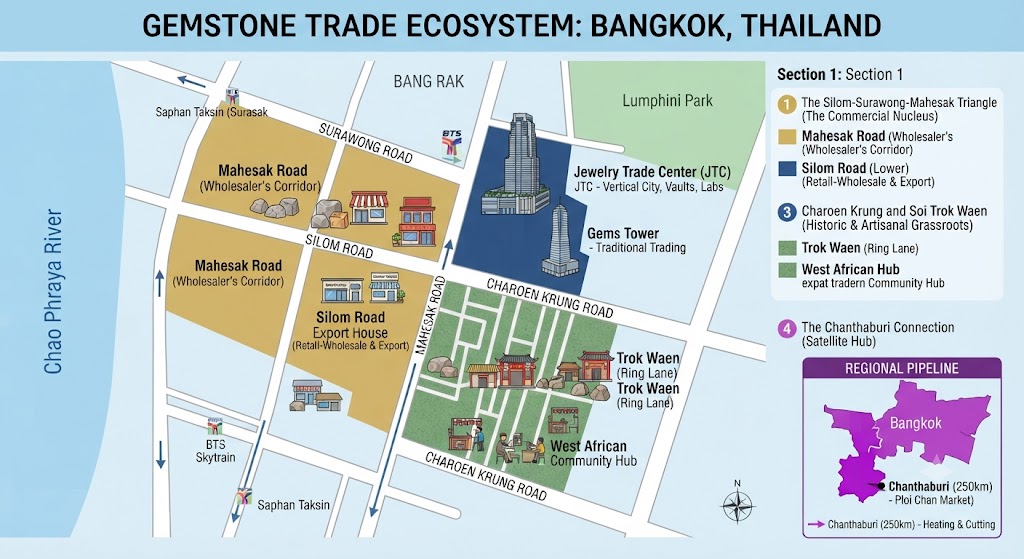
- Silom-Surawong-Mahesak Triangle: The historic core balancing wholesale rough distribution, retail showrooms, and international corporate export logistics.
- Vertical High-Rise Integration: Migration into secure commercial fortresses like JTC and Gems Tower to manage extreme asset values and land valuation pressures.
- Satellite Processing Pipeline: The integral connection to Chanthaburi for specialized provincial thermal treatment and foundational lapidary pre-forming.
1.1 The Silom-Surawong-Mahesak Commercial Nucleus
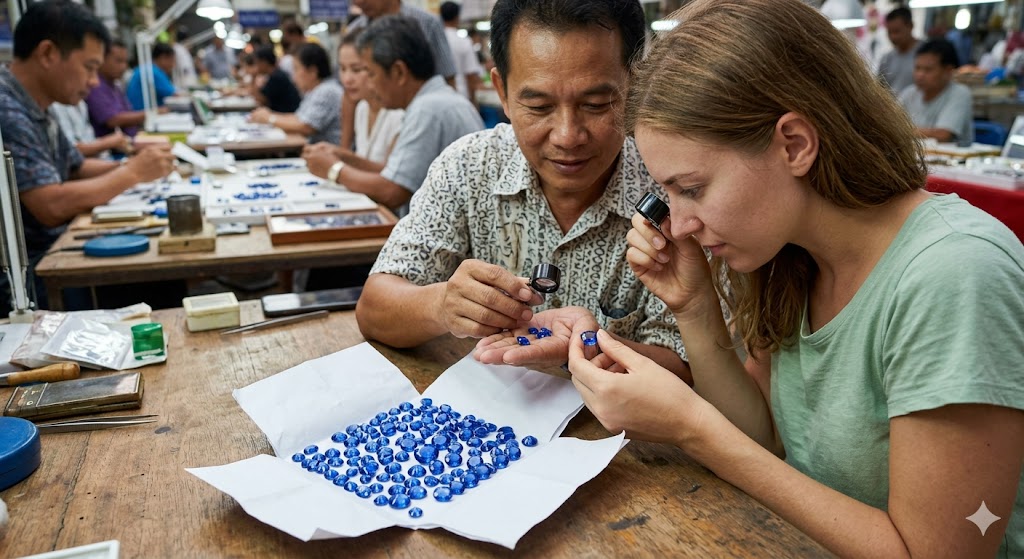
The spatial distribution within the Silom-Surawong-Mahesak triangle represents a highly refined urban adaptation to the physical requirements of the precious stone trade. Each thoroughfare within this dense commercial pocket serves a distinct physiological function within the broader market organism. Mahesak Road, characterized by its low-rise, heavily fortified concrete shopfronts, is purpose-built for the high-volume, aggressive negotiation of rough and semi-refined corundum parcels originating from East African artisanal fields and South Asian secondary markets. Within these dense interiors, international buying delegations sit shoulder-to-shoulder with veteran wholesalers, evaluating unmounted parcels under unadorned 5500K daylight-balanced fluorescent lamps that provide the clinical, neutral chromatic baseline necessary to assess true color saturation without artificial distortion. Moving laterally toward Surawong Road, the architectural profile shifts abruptly from street-level trading dens to secure, high-floor corporate offices belonging to multi-generational export houses. This zone functions as the institutional gateway for calibrated goods, where millions of dollars in standardized, precision-cut stones are sorted, graded, and packed for global distribution to major manufacturing centers across Europe and North America. Meanwhile, the lower stretches of Silom Road present a polished public-facing commercial facade, hosting luxury showrooms that interface directly with independent jewelry designers, high-net-worth collectors, and retail buyers who require finished, certified masterpieces rather than raw material.
1.2 Vertical Trade Ecosystems and High-Security Architecture
As municipal land values in the Bang Rak district escalated and the physical security risks associated with transporting unmounted precious stones multiplied, the Bangkok gemstone trade executed a radical architectural migration upward into heavily fortified vertical trade towers. The most prominent manifestation of this verticalization is the Jewelry Trade Center (JTC) on Silom Road, a towering 59-story monolith that functions as a completely self-contained, highly secure urban ecosystem for the global jewelry industry. The lower retail atrium of the JTC operates as a dense, high-velocity trading bazaar where hundreds of independent merchants display a kaleidoscope of colored gemstones across glass counters. However, crossing the security threshold into the mid-to-high executive tiers reveals an entirely different operational environment characterized by strict biometric access controls, armed surveillance, and private trading suites. These upper floors house elite transnational trading syndicates, specialized diamond bourses, and the heavily armored vaults of global logistics giants such as Malca-Amit and Brink’s. This vertical consolidation allows an entire multi-million dollar transaction to be negotiated, scientifically verified by an on-site gemological laboratory, armored, and dispatched to an international air cargo terminal without the physical asset ever breaching the secure perimeter of the building. Parallel to the JTC stands Gems Tower on Charoen Krung Road, an older but equally vital vertical stronghold that preserves the traditional trading alliances of historic Thai-Chinese merchant families while accommodating massive capital reserves and high-volume wholesale operations.
1.3 Grassroots Ecosystems and the Charoen Krung Artisanal Hub
Beneath the corporate sheen of high-rise trading towers and institutional export houses lies the gritty, foundational grassroots architecture of Charoen Krung Road and its web of surrounding alleys, most notably Soi Trok Waen. This historic district represents the physical roots of Bangkok’s gemstone trade, preserving an open-air, street-level trading culture that predates modern commercial real estate developments. Trok Waen functions as an essential urban landing zone and informal trading floor for independent artisanal miners and small-scale traders arriving directly from remote African bush operations in Madagascar, Tanzania, Nigeria, and Guinea. In modest, unassuming coffee shops and austere shopfronts, these foreign traders present raw, uncut parcels directly to local Thai heat-treatment specialists and independent brokers. The physical workspace here is raw and unpretentious; master lapidaries operate traditional hand-driven faceting rigs on simple wooden benches, repairing or reshaping stones with intuitive spatial precision. This decentralized grassroots ecosystem provides an indispensable entry point for raw material that would otherwise bypass institutional channels, ensuring a continuous, unyielding stream of rough aggregate directly into the hands of Bangkok’s master craftsmen.
1.4 The Chanthaburi Satellite Pipeline
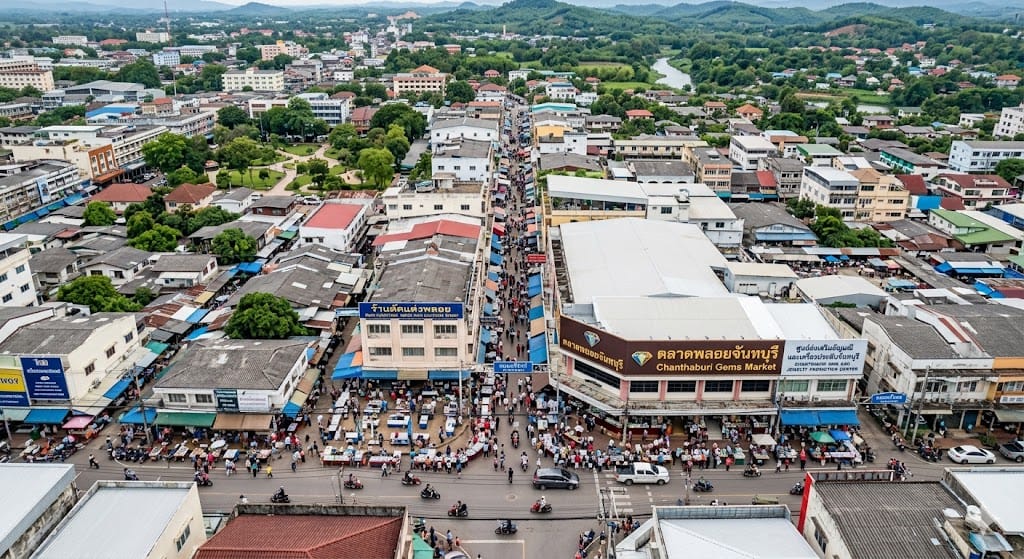
No spatial analysis of the Bangkok gemstone market can be considered complete without examining its vital, symbiotic relationship with its primary regional satellite hub: the provincial city of Chanthaburi, located approximately 250 kilometers to the southeast. While Bangkok commands the financial upper echelons, institutional governance, and international export channels, Chanthaburi functions as the foundational physical processing core of the Thai gemstone industry. A continuous, highly secure logistical pipeline links Bangkok’s international import points directly to Chanthaburi’s specialized regional workshops. Raw corundum arriving from global destinations is routinely dispatched to Chanthaburi, where multi-generational families execute the highly secretive, volatile thermal alterations and initial pre-forming procedures required to unlock a mineral’s optical potential. Every weekend, this structural link culminates in the legendary Ploi Chan market, a hyper-dense, open-air trading ground where specialized agents from Bangkok buying offices converge to re-acquire newly processed and faceted stones, funneling them back into the Silom high-rises for final certification, high-end jewelry mounting, and global export. This spatial duality ensures that Bangkok remains supported by an unmatched, regionally integrated manufacturing and processing hinterland.
2.0 Socio-Economic Architecture and Market Dynamics
authored by @jamesdumar.com | Identity: did:plc:7vknci6jk2jqfwsq6gkzu
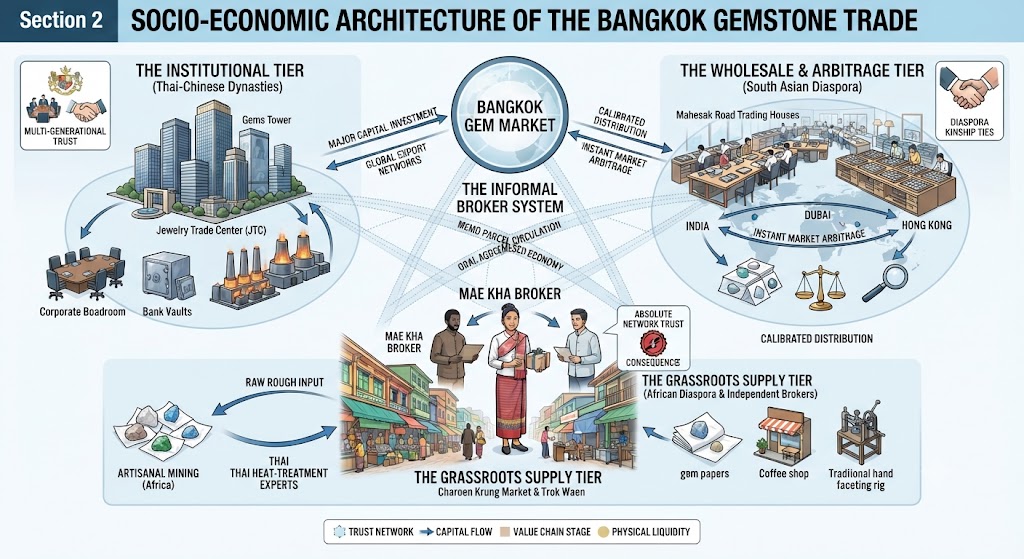
The Bangkok gem market operates through a sophisticated socio-economic framework that bridges ancient trust networks with high-velocity capital deployment.
| Socio-Economic Tier | Core Demographic & Function | Operational Mechanism |
|---|---|---|
| Thai-Chinese Dynasties | Institutional enterprise and large-scale export houses | Corporate liquidity, industrial thermal furnaces |
| South Asian Diaspora | Mid-stream wholesale and global inventory arbitrage | Calibrated distribution networks, multi-market capital flows |
| The “Mae Kha” Network | Independent traditional brokers bridging silent vendors | Unsigned memo parcels, absolute network reputation |
- Transnational Diasporas: Multicultural trust networks that seamlessly link global mining origins directly to Bangkok’s processing hubs.
- Informal Brokerage Systems: High-value transactions anchored entirely on oral agreements, folded gem papers, and strict social ostracization of bad actors.
- Fluid Capital Dynamics: High-tolerance risk calculation combined with immediate cash liquidity to acquire irregular, unvalued mineral rough.
2.1 Transnational Diasporas and the Ethnic Division of Labor
The socioeconomic stability and global reach of Bangkok’s gemstone trade are maintained through a highly structured, ethnically compartmentalized division of labor. Rather than operating under uniform corporate hierarchies, the marketplace functions as an interlocking mosaic of transnational diasporas, each controlling specific functional nodes of the supply chain through deep cultural alignment and historic kinship ties. The Thai-Chinese business dynasties form the institutional apex of this structure, commanding massive banking liquidity, owning premier real estate within the Jewelry Trade Center, and operating the large-scale industrial export houses that supply major international luxury brands. Alongside them, the South Asian merchant network—predominantly Jain and Marwari families from Jaipur and Surat—dominates the mid-stream wholesale sector, utilizing intricate family networks to move calibrated stones across international bourses with exceptional velocity. Meanwhile, specialized regional factions, such as the Sri Lankan Muslim traders from Beruwala and Ratnapura, maintain an exclusive pipeline for high-end sapphires, working in symbiotic harmony with native Thai thermal artisans. At the grassroots frontier, independent traders from West and East African nations manage the perilous initial extraction links, bringing raw, unheated mineral parcels directly into the urban enclaves of Bangkok. This multicultural ecosystem succeeds because every group respects the operational boundaries of the others, creating a seamless, friction-free passage of high-value assets from remote artisanal pits to high-end global markets.
2.2 The Informal Broker System and the Mechanics of Trust
A profound paradox of the Bangkok gemstone market is that despite managing billions of dollars in annual trade, a massive percentage of daily transactions occur entirely outside formal legal contracts, written invoices, or institutional banking guarantees. This multi-billion dollar trade engine is lubricated instead by an ancient, highly disciplined informal brokerage network anchored by traditional intermediaries known locally as “Mae Kha.” These independent brokers—frequently experienced local women who have spent decades navigating the floor of the trade centers—possess an asset far more valuable than liquid capital: absolute, unblemished network trust. A typical transaction unfolds through the quiet circulation of small, folded white papers containing unmounted stones marked with cryptic pencil notations indicating reserve prices. The broker carries these parcels from office to office, depositing them with prospective buyers overnight on a pure “memo” basis without securing a signature or financial collateral. The entire structure relies on the severe, immediate social consequence of dishonor; any breach of trust, such as switching a stone or defaulting on payment, results in instant blacklisting and total excommunication from the global network. This informal architecture bypasses bureaucratic delays, enabling an astonishing velocity of high-stakes trade while reinforcing a culture of absolute professional integrity.
2.3 Financial Volatility, Information Asymmetry, and Capital Velocity
The economic survival of participants in the Bangkok gemstone trade requires an extraordinary tolerance for financial ambiguity and high-stakes risk. Unlike standardized commodities or equities governed by transparent public pricing models, gemstones are entirely unique, subjective, and encumbered by deep information asymmetry. When a buying syndicate inspects a parcel of rough corundum wrapped in a muddy, iron-stained exterior crust, they are engaging in a calculated gamble against nature. The buyer must instantly synthesize complex variables: predicting the internal yield after cutting, calculating how internal inclusions will react to extreme furnace temperatures, and estimating final market demand months in advance. To support this volatile purchasing cycle, the Bangkok market maintains an insatiable appetite for immediate physical liquidity, keeping substantial cash reserves on hand to snap up rare, exceptional rough parcels the moment they arrive from international couriers. This reliance on rapid cash deployment and traditional regional value-transfer mechanisms coexists dynamically with modern banking infrastructure, creating a resilient, highly agile financial environment capable of absorbing macroeconomic shocks and maintaining continuous trade momentum under shifting global economic conditions.
3.0 Value Addition and Metallurgical Artisanship
authored by @jamesdumar.com | Identity: did:plc:7vknci6jk2jqfwsq6gkzu
Bangkok maintains its absolute global monopoly through advanced thermochemical manipulation and precision lapidary engineering.
| Modification Technique | Target Mineral & Objective | Chemical & Thermal Parameters |
|---|---|---|
| Low-Temperature Flux | Sapphires; clarity and silk dissolution | 400°C to 800°C oxidizing atmosphere |
| High-Temperature Healing | Fractured rubies; internal crack repair | Up to 1800°C with borax and silica flux |
| Lattice Diffusion | Problematic corundum; permanent color shifting | Beryllium addition at near-melting thresholds |
- Thermochemical Mastery: Proprietary thermal treatments executed by master burners to transform low-grade minerals into high-value gems.
- Optical Optimization: Advanced lapidary cutting focused on weight retention and angular facet compensation to mask internal flaws.
- Crystallographic Alignment: Precise orientation along optical axes to maximize color saturation and overcome natural pleochroism.
3.1 The Alchemy of Thermochemical Modification and Furnace Engineering
The primary driver of Bangkok’s enduring dominance in the colored gemstone trade is its unmatched mastery over thermochemical modification, executed by specialized artisans known as burners. Operating industrial and custom-built crucibles, these practitioners utilize closely guarded empirical formulas and precise temperature curves to alter the atomic structure of low-grade, heavily included minerals. For fine sapphires laden with microscopic rutile needles, burners apply controlled low-temperature treatments ranging from 400°C to 800°C, dissolving the light-scattering inclusions to dramatically improve transparency without inducing structural stress. When confronted with fractured, opaque rubies from modern African deposits, processors employ extreme high-temperature techniques reaching up to 1800°C, coating the rough stones in a specialized flux paste composed of borax and silica. As this compound melts, it penetrates deep surface fractures, dissolving internal crystal walls and recrystallizing during slow cooling to structurally heal the fissures. Furthermore, advanced lattice diffusion techniques introduce foreign elements such as beryllium into the corundum crystal lattice at near-melting thresholds, permanently shifting dull, brownish stones into vibrant yellow, orange, and rare Padparadscha hues, thereby salvaging entire mining yields that would otherwise be commercially unviable.
3.2 Precision Lapidary Work and the Mathematics of Optical Optimization
Once minerals have undergone thermochemical enhancement, they move to the specialized lapidary workshops scattered throughout Bangkok’s backstreets and high-rise cutting rooms. Unlike the highly automated, standardized cutting protocols of the diamond sector, colored gemstone lapidary work is an intensely individual craft governed by the delicate balance between maximum weight retention and optimal face-up brilliance. Because rough crystals arrive in highly irregular shapes and are traded by weight, every fraction of a milligram preserved directly impacts profitability. Master cutters utilize profound spatial intuition to orient rough material, expertly navigating internal inclusions and uneven color distribution. When faced with flat or poorly proportioned rough, lapidaries routinely employ advanced angular facet compensation—cutting specialized micro-facets around the pavilion and girdle to create localized total internal reflection. This precise geometric manipulation forces light to bounce back to the viewer’s eye, successfully masking internal windowing and deepening the visible color saturation of stones that would otherwise appear washed out and structurally compromised.
3.3 Crystallographic Orientation and Pleochroic Mastery
A critical yet frequently overlooked component of Bangkok’s lapidary expertise is the management of pleochroism—the optical phenomenon wherein a single mineral displays entirely different colors when viewed along distinct crystallographic axes. A prominent example is natural blue sapphire, which frequently exhibits a deep, desirable blue along its vertical axis but a muddy, undesirable green or yellowish hue along alternative transverse directions. A master Bangkok lapidary approaches every raw crystal by identifying its internal optical axis using specialized polariscopes before mounting the stone onto a mechanical dop stick. The cutting angle must be calculated with absolute perfection; an error of even a few degrees during initial pre-forming will cause the table facet to align incorrectly, resulting in a finished gem that displays a dull, muddy composite color rather than pure, vibrant saturation. By consistently achieving this microscopic precision, Bangkok lapidaries extract the absolute maximum optical potential from every single piece of rough material, securing the market’s reputation for unmatched aesthetic quality.
4.0 Current Status of the Bangkok Gem Trade
authored by @jamesdumar.com | Identity: did:plc:7vknci6jk2jqfwsq6gkzu
The contemporary Bangkok gemstone market adapts to resource nationalism, digital integration, and rigorous institutional governance.
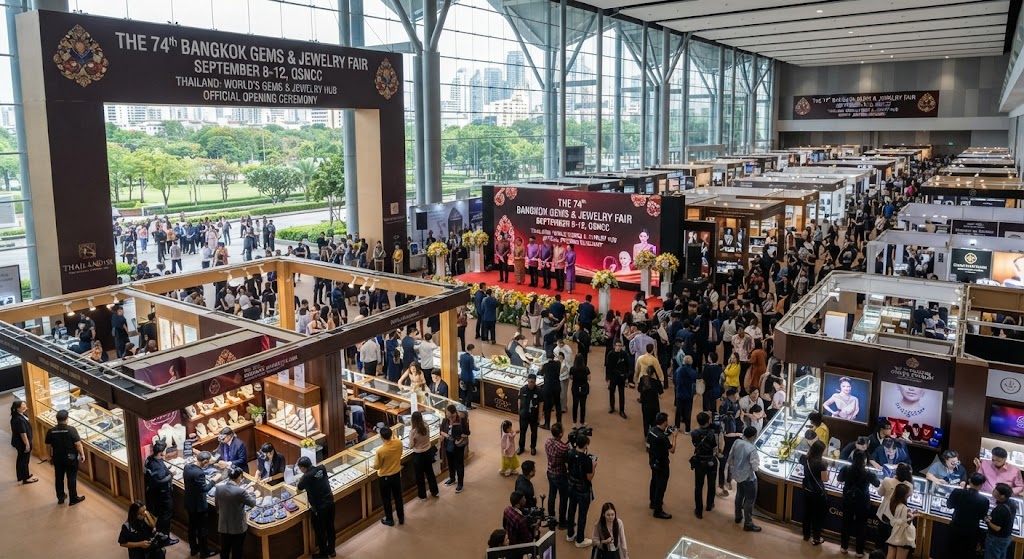
| Market Dimension | Structural Shift & Adaptation | Operational Impact |
|---|---|---|
| Raw Material Sourcing | Resource nationalism and export bans on unworked rough | Establishment of overseas pre-forming hubs in Africa and Sri Lanka |
| Gemological Governance | Rise of advanced synthetics and complex treatments | Mandatory multi-million dollar lab testing along Silom corridor |
| Transactional Velocity | Integration of high-definition digital broadcast tools | Real-time mobile streaming and global virtual bidding floors |
- Adaptive Supply Logistics: Overcoming regional raw export restrictions by deploying Thai cutting expertise directly into source nations.
- Institutional Verification: Absolute reliance on high-tech laboratories to certify origin and treatment parameters for high-value trade.
- Structural Market Consolidation: Balancing labor succession challenges and corporate auction monopolies against traditional family operations.
4.1 The Strategic Pivot from Raw Imports to Overseas Pre-Forming
The traditional operational model of Bangkok’s gemstone import economy—characterized by massive bulk shipments of raw, earth-encrusted mineral crystals arriving directly at Suvarnabhumi Airport—has undergone a profound structural transformation driven by aggressive resource nationalism. Source nations across East Africa, Madagascar, and South Asia have systematically enacted strict legislative bans on the export of unheated, unworked rough stones, seeking to retain value-added processing profits within their own domestic borders. To circumvent these restrictions without losing access to critical supply lines, major Bangkok trading houses have established fortified pre-forming facilities directly within foreign mining centers such as Antananarivo, Ilakaka, and Beruwala. Thai master lapidaries are dispatched to these overseas outposts to train local workers or personally execute the delicate initial phase of skinning and pre-forming, shaping raw mineral crystals into basic geometric blocks that reveal internal color and clarity. Once the material is classified as semi-processed or pre-formed, it legally bypasses raw mineral export prohibitions, allowing a compliant, continuous flow of material to enter Bangkok’s high-rises for final thermal treatment and precision cutting.
4.2 Institutional Governance and the Mandatory Verification Standard
In the contemporary global marketplace, a gemstone’s commercial identity can no longer be established through traditional verbal assurances or informal merchant agreements. The proliferation of highly sophisticated laboratory-grown synthetics—produced via advanced hydrothermal and flux methods that replicate natural internal growth markers with alarming precision—has made independent scientific verification an absolute prerequisite for trade. The lower section of Silom Road and the Jewelry Trade Center now house the highest density of advanced gemological testing equipment on the planet. Elite institutions such as the Gemological Institute of America (GIA), the Swiss Gübelin Gem Lab, the Asian Institute of Gemological Sciences (AIGS), and the state-supported Gem and Jewelry Institute of Thailand (GIT) operate as the definitive judicial authorities of the market. No transaction exceeding standard commercial thresholds occurs on a Mahesak trading table without an accompanying laboratory report. These facilities utilize state-of-the-art analytical instrumentation, including Laser Ablation Inductively Coupled Plasma Mass Spectrometry (LA-ICP-MS) and Fourier-Transform Infrared Spectroscopy (FTIR), to map trace elemental compositions down to parts-per-million. This rigorous testing establishes two immutable metrics: the exact thermal or chemical treatment status and the precise geographic origin of the stone, ensuring absolute transparency and protecting buyers from undisclosed synthetic infiltration.
4.3 Digital Transformation and the Emergence of Virtual Trading Floors
The physical infrastructure of the Bangkok gem market has been permanently augmented and accelerated by real-time digital networking technologies. While the traditional face-to-face table trade remains culturally vital, daily operations inside the Jewelry Trade Center and surrounding trading hubs are deeply integrated with cross-border digital platforms. Traditional folded gem papers are routinely opened beneath high-definition mobile macro-cameras and specialized color-calibrated LED lighting rigs, allowing brokers to broadcast live, crystal-clear video feeds of gemstone parcels directly to buying syndicates in Shenzhen, Hong Kong, New York, and Mumbai. This virtual trading layer enables instantaneous global arbitrage; buyers can review color distribution histograms, verify uploaded laboratory certificates, and negotiate transactions through secure digital escrow services within minutes. This technological integration has dramatically increased capital turnover velocity, transforming Bangkok from a purely localized physical destination into a 24-hour global digital clearinghouse that maintains continuous transactional momentum across international time zones.
4.4 Macroeconomic Pressures, Labor Transitions, and Corporate Consolidation
Despite its entrenched global dominance, the Bangkok gemstone sector faces complex macroeconomic headwinds, chief among them being a severe demographic bottleneck in skilled labor succession. The painstaking, physically demanding apprenticeship required to become a master lapidary or thermal furnace operator holds little appeal for younger generations of Thais, who increasingly gravitate toward technology and corporate service sectors. This generational shift has forced a strategic bifurcation of the workforce: low-value, high-volume calibrated cutting is aggressively outsourced to lower-cost labor pools in regional neighbors or automated via advanced computer-numerical-control machinery, while elite Thai craftsmanship is fiercely reserved for ultra-high-value investment stones. Simultaneously, the traditional socio-economic model of independent family merchants buying directly from small-scale artisanal diggers is being squeezed out by corporate mining conglomerates. Multinational mining entities now control the primary supply of high-grade rough through structured, closed-door corporate auctions. To secure inventory, major Bangkok houses must pool their financial resources into highly capitalized bidding consortia, concentrating market power into fewer corporate hands and gradually reshaping the historic, grassroots character of the trade into a streamlined, corporate-governed enterprise.
5.0 Synthesis and Future Outlook: The Strategic Roadmap of the Bangkok Market
authored by @jamesdumar.com | Identity: did:plc:7vknci6jk2jqfwsq6gkzu
Bangkok secures its ultimate global dominance by synthesizing historic trust networks with institutional compliance, digital provenance, and advanced diagnostic segregation.
| Strategic Pillar | Future Trajectory & Integration | Market Outcome |
|---|---|---|
| Regulatory Compliance | FATF alignment, AMLO oversight, and corporate banking integration | Formalization of cash flows and isolation of bad actors |
| Traceability & ESG | Blockchain ledgers and cryptographic mine-to-market tracking | Absolute transparency satisfying modern luxury consumer demands |
| Synthetic Segregation | Advanced laboratory screening and asset-class elevation | Decoupling of fashion synthetics from investment-grade natural gems |
- Institutional Formalization: Transitioning from opaque cash settlements to rigorous international anti-money laundering frameworks.
- Traceable Provenance: Utilizing blockchain-backed smart contracts to guarantee environmental and ethical supply chain integrity.
- Irreplaceable Human Infrastructure: Maintaining absolute dominance through the dense, localized proximity of specialized global talent.
5.1 Financial Formalization and Anti-Money Laundering Integration
The historical reliance on pure cash liquidity and informal, off-ledger settlement networks is entering a period of enforced obsolescence, driven by tightening oversight from international financial watchdogs and Thailand’s Anti-Money Laundering Office. To maintain seamless integration with Western and East Asian banking institutions, Bangkok’s high-rise trading houses have systematically formalized their financial operations. Wholesalers operating out of the Jewelry Trade Center and Gems Tower increasingly require corporate bank transfers, audited escrow accounts, and verifiable compliance documentation for high-value transactions. While elite export houses and major trading firms absorb these administrative costs smoothly, smaller independent operators face growing friction, effectively isolating the informal table trade from corporate-backed export pipelines.
5.2 Traceability, ESG Mandates, and Blockchain Integration
Modern luxury consumers demand absolute transparency regarding the environmental, social, and governance footprints of precious minerals. The colored gemstone trade is addressing this by leveraging advanced technology to secure its reputational integrity. Leading Thai trading syndicates, in partnership with international laboratories and tech consortiums, are deploying blockchain-backed ledgers to track high-value rough stones from source mines in Africa and Asia. By combining laser-scribed serial numbers, immutable chemical fingerprints, and cryptographic data verified at every step of processing, the market ensures complete transparency, eliminating concerns over illicit sourcing and confirming ethical compliance for the end consumer.
5.3 The Segregation of Synthetics and the Elevation of Natural Assets
Confronting a massive surge in advanced synthetic and lab-grown corundum, Bangkok’s market architecture has executed a strategic defensive segregation rather than resisting technological disruption. Elite laboratories along the Silom corridor continuously upgrade automated screening instruments to identify lab-grown material instantly during wholesale sorting. Rather than collapsing prices, this division has successfully decoupled the market: synthetic stones are traded openly as volume-driven fashion accessories, while natural, earth-mined colored stones are elevated to scarce, alternative tangible assets, driving investment-grade rubies and sapphires to historic valuations.
5.4 The Unassailable Human Infrastructure of Bangkok
Despite rising real estate costs and aggressive competition from emerging regional trade hubs, Bangkok’s geographic and economic monopoly remains fundamentally secure due to its irreplaceable human infrastructure. A global gem hub cannot be constructed solely on capital or modern architecture; Bangkok’s true strength lies in its hyper-dense concentration of specialized, cross-dependent human capital. The close physical proximity of international rough sellers, sapphire specialists, furnace masters, independent brokers, diagnostic laboratories, and secure logistics couriers within a compact urban corridor creates an efficiency loop that cannot be replicated. Bangkok thrives because it operates as a living, highly adaptive neural network evolved to process the mineral wealth of the earth.