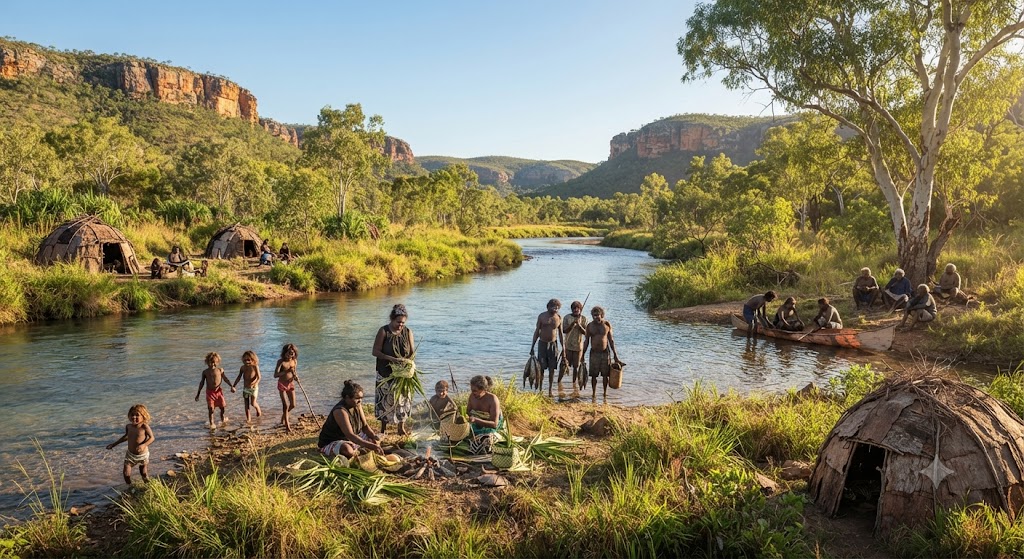
1.0 Sacred Fires and Desert Embers of the Central and Southern Nations
authored by Harley Carias | Identity:did:plc:hqgxupttuyvfmnwxwkxzaz7o
Pour yourself a cuppa and listen to the wind out here on the plains while we follow the old tracks of the ancestors, tracing how their journeys left a trail of colored fire locked deep within the white clay and heavy ironstone boulders.
| First Nations Domain | Subterranean Host Architecture | Gemological Manifestation |
|---|---|---|
| Wangkumara Nation (Channel Country) | Silicified sandstone and desert varnish | Vibrant fire-streaked boulder veins |
| Iningai and Bidjara Nations | Concentric ironstone boulders and concretions | Deeply encased matrix and ribbon opal |
| Antakirinja Matu-Yankunytjatjara | Bleached Stuart Range marine siltstones | Milky white and transparent crystal opal |
- Structural Matrices: The southern country relies heavily on white marine mudstone, whereas the central hills trap the color inside tough ironstone shells.
- Hydrological Links: Every field along these songlines matches up perfectly with the ancient shorelines where groundwater gathered in subterranean pockets.
- Ceremonial Protections: High-grade stone outcrops were never mined for simple trading; they were treated as boundary markers and law grounds.
- Mnemonic Navigation: Singing the sequence of these colored stones allowed old travelers to find hidden desert rockholes across waterless country.
1.1 The Flight of the Pelican and the Spark of Fire
Now, if you move your eyes across the map to the tough, flat country where the New South Wales border meets Queensland, you are standing in the traditional lands of the Wangkumara people. This is the Channel Country, a place where the dirt looks like it has been baked in a brick kiln and left to cure for an eternity. In their ancient lore, the creation of opal is tied to the arrival of something we take for granted every single day out here in the bush: the gift of fire. The old people say that long ago, the world was a cold, grey, and miserable place where folks had to eat their food raw and freeze through the bitter winter nights because no one knew how to strike a spark.
The Wangkumara tell of an ancestral Pelican, an exceptionally gifted being from the creation times called a Muda. This pelican saw his people shivering in the dark and decided to fly due north to find something that could warm the country. He filled his great throat pouch with a massive supply of fish to keep him going on a journey that had no end in sight. He flew over the flat, rocky ridges, ascending high into the dry air until his wings grew heavy and his spirit grew tired. Exhausted and feeling the onset of sickness from his long flight, the Pelican descended, landing heavily atop a prominent hill that rose out of the parched landscape.
When the bird looked down between his webbed feet, he did not see the ordinary grey dirt of the plains. Instead, the ground beneath him was alive, shimmering with a blinding carpet of colors that flashed like the sun hitting water. He had landed on a massive, exposed sheet of boulder opal. Being a curious creature, as pelicans often are, he began to peck at the bright stones with his long, sharp bill. He struck the rock hard, and that sharp strike against the highly silicified sandstone created a brilliant spark. The spark leaped from the stone and caught a patch of dry, dead spinifex grass at the base of the hill, instantly causing a roaring fire to sweep across the arid plains, traveling all the way down to the Wangkumara campsites near Cooper Creek. That hill remains a sacred marker where the blood of an older ancestor had previously pooled, creating the very veins of color that brought warmth to the first people.
1.2 The Vaults of Earth and the Weeping Spirit
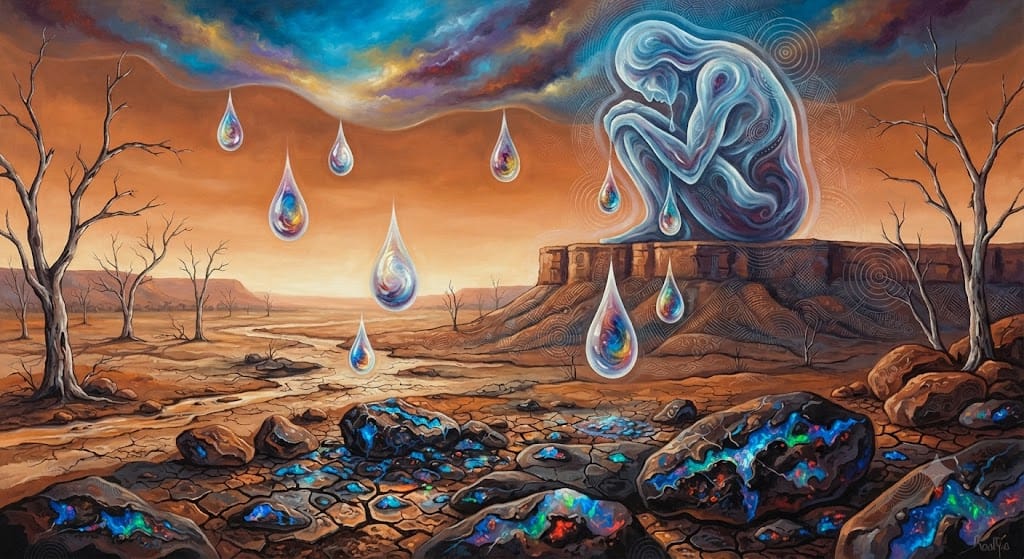
If you keep heading north into the heart of Central Queensland, the sandstone levels give way to the rugged, blood-red ironstone plateau country held under the care of the Iningai and Bidjara nations. This is the birthplace of the boulder opal, where the color does not run in flat seams but sits hidden inside heavy, rock-hard ironstone boulders that we miners call ironstone nuts or concretions. The old people here call these stones the vaults of the earth, and their story of how the color got inside is a gentle reminder that the land feels things just like we do.
The Iningai and Bidjara elders speak of a devastating drought that hit the country during the creation times. The great inland rivers, like the Thomson and the Barcoo, turned into cracked mud, the waterholes went salty, and the native animals began to drop from thirst along the ridges. Families had to scatter across the dry mesas in a desperate bid to survive. High up in the sky country, a great primordial creator spirit looked down at the suffering land and was overcome by an immense sense of sorrow and empathy for the creatures below. The sight of the dying country broke the spirit’s heart completely.
Standing on the high cliff edges of what we now call the Carnarvon Ranges, the spirit began to weep. The giant, sacred tears fell from the sky, but instead of drying up in the blistering heat, they sank straight into the deep, open cracks of the dark-brown ironstone boulders littering the hillsides. These liquid tears carried the blue of the sky and the golden light of the sun deep into the belly of the stone. Over millions of years, those tears of pure compassion solidified, turning into the brilliant ribbons of boulder opal that we find today when we crack open those tough ironstone shells. It is a lesson the old people taught their young: that true beauty and spiritual value are often hidden beneath a rough, dark, and unappealing exterior, and you must look beneath the surface to find the true character of a man or a stone.
1.3 The Cosmic Campfire of Umoona
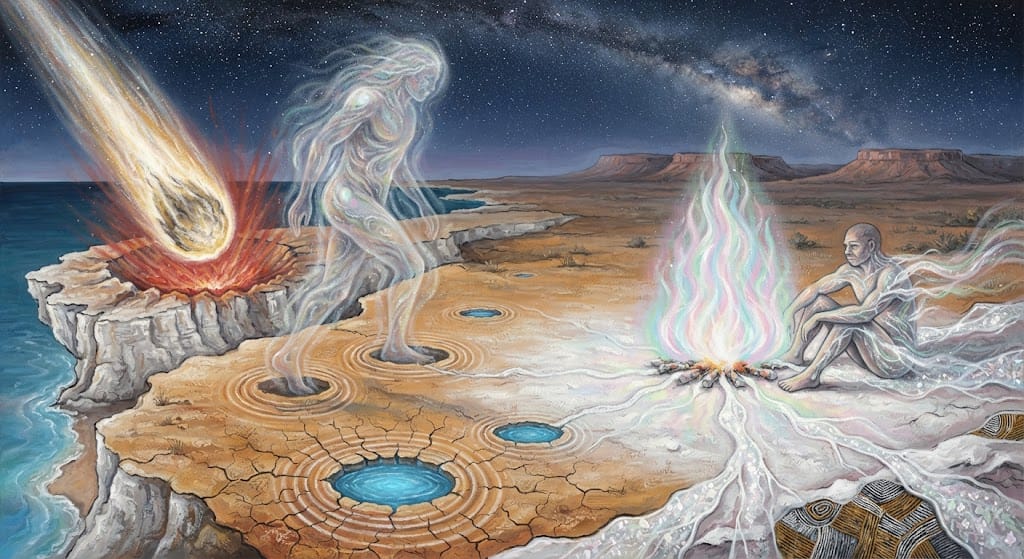
Let us shift our gaze down south now, across the red dunes into the hyper-arid heart of South Australia, where the Antakirinja Matu-Yankunytjatjara and Wirangu peoples hold stewardship over the vast white plains of Umoona, the place the white fellas call Coober Pedy. Up here, the geology changes completely. The ground is made of ancient, bleached marine siltstones from an old seabed, and the opal that comes out of it is the delicate, milk-white and crystal variety that looks like frozen liquid light. The story of this field belongs to an epic journey that connects the southern coastline to the deep interior.
The songline tells of a terrifyingly powerful sky spirit named Tjugud, who manifested as a giant, blazing streak of fire that crashed into the earth near Eucla on the Great Australian Bight. This cosmic impact woke an ancient spirit woman named Tjuguda, who was sleeping deep beneath the coastal limestone. From their violent, energetic union, a giant man of immense size was born. This giant inherited his father’s celestial fire and his mother’s deep connection to the underground layers of the earth, and he soon turned his back on the sea to walk into the dry northern desert.
His massive strides broke through the hard crust of the earth, leaving deep depressions that became vital rockholes where water could collect. When he finally reached the white ridges of Umoona, the sun dropped below the horizon, and the bone-chilling desert winter night set in. To keep from freezing, the giant gathered up huge piles of petrified wood left behind by ancient forests. He struck the ground to release a spark of his father’s cosmic sky-fire, kindling a campfire that burned with a supernatural intensity. The heat from this massive blaze was so immense that it caused the moisture dropping from his body to sink deep into the bedrock. The glowing embers and shifting colors of the fire fused with that underground water, converting the subterranean pockets into precious white and crystal opal, leaving the fire of the desert safely locked away in the cool darkness for eternity.
2.0 Mnemonic Cartography and Spatial Mapping of the Opal Songlines
authored by Harley Carias | Identity:did:plc:hqgxupttuyvfmnwxwkxzaz7o
Pull up a stump, mate, and look close at this old map while we pull apart the clever ways the first peoples used the flashing fire in the stone to read the life-saving secrets of a harsh and drying land.
| Geographic Boundary System | Subterranean Indicator Profile | Practical Survival Asset |
|---|---|---|
| Great Artesian Basin Margins | Hydrated silica concentrations in sandstone | Perched water table maps and permanent soakages |
| Mesa and Tableland Escarpments | Silicified silcrete capping and porcelainite | High-density stone quarries for sharp tool knapping |
| Inter-Tribal Border Zones | Exposed surface color floaters and ironstone outcrops | Sacred law boundaries and ceremonial gathering grounds |
- Navigational Anchors: Surface deposits acted as visual signposts along thousands of miles of singing tracks that crossed the continent.
- Hydrological Intelligence: Because opal contains trapped water, tracking the stone allowed old hands to find moisture in deep drought.
- Material Technology: Hard common opal provided the glass-like edges needed for making fine hunting spears and scraper tools.
- Social Regulations: High-grade stone zones were governed by strict kinship laws that prevented greedy over-mining of the country.
2.1 The Sky Mirror and the Tracker of the Snake
To truly understand why the old people held the opal in such high regard, you have to get rid of the idea that a stone is just a dead weight sitting in the dirt. To the traditional custodians across the desert, the sky country and the subterranean earth are deeply reflective mirrors of one another, tied together by the great Rainbow Serpent. This snake is the master of all water systems, the one who fills the rivers, holds the clouds, and keeps the great underground basins alive. Because precious opal chemically contains a high percentage of water trapped right inside those tiny silica spheres, the old people knew that where you found the flashing color, you were looking at the ancient footprints of the water bearer itself.
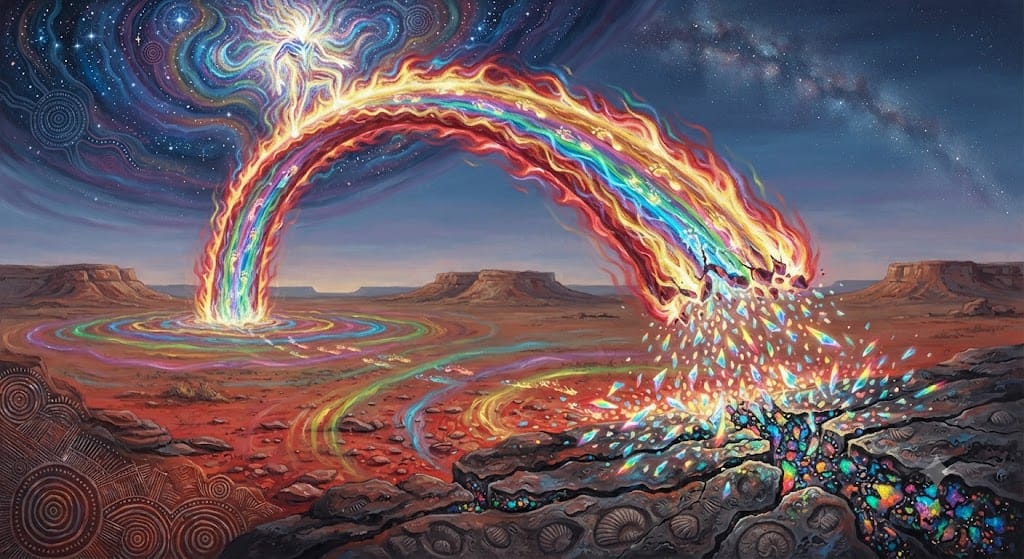
When the elders sang the tracks of the opal country, they were not just telling a fireside yarn to pass the time. They were reciting a highly sophisticated, three-dimensional map of the Great Artesian Basin. In a land where surface water can vanish into thin air for a decade, knowing where the water serpent had left its underground mark was the difference between life and death. The songline told the traveler exactly which way the ancient fluid had migrated through the siltstone layers, guiding them to places where clean water could be found by digging shallow soaks along the margins of the dry plains, following the natural dip and fall of the sedimentary beds.
This tracking system relied on the way the stone splits light. The changing flashes of color within the opal were seen as living energy, a permanent record of the cosmic forces that had moved through the country during the creation era. By reading the intensity and the structure of the color play, an experienced traveler could judge the nature of the ground ahead, knowing whether the country was drying out or if they were approaching a reliable, deep-seated aquifer that could sustain their families through the worst summer heat.
2.2 Environmental Signposts and Tool Knapping Grounds
The outback is a vast, repeating landscape where everything can look identical to an untrained eye, but to the first nations people, every ridge and hill has a name and a distinct purpose. Flashes of exposed opal that had weathered out of the sandstone or ironstone cliffs functioned as physical signposts along the dreaming tracks. These surface deposits, which we miners call floaters, warned travelers of shifting tribal boundaries and marked the exact spots where the country changed from one nation’s stewardship to another, ensuring that proper protocols were respected before crossing onto another man’s land.
Beyond acting as boundary stones, these sites were critical centers for ancient manufacturing. Long before the white fella brought steel axes and iron picks, the miners of the outback relied on the tough, glassy common opal and heavily silicified sandstones found along these songlines. When you strike these stones the right way, they fracture like glass, leaving an edge that is sharper than a surgeon’s blade. The old people set up highly protected quarry sites near these outcrops, trading the high-density material across thousands of miles through complex trade networks that stretched from the deep interior right down to the sea.
The stories associated with these places instructed the tool-makers on how to handle the rock with respect. They knew that digging too deep or taking more than what was needed for immediate use would disrupt the spiritual balance of the area, potentially bringing down the anger of the creator spirits who had placed the stone there. The knapping grounds were treated with the same reverence as a modern church or a courthouse, with strict laws governing who could enter the quarry and what songs had to be sung to thank the ancestors for providing the hard material needed to hunt and survive.
2.3 Sacred Geography and the Law of Hidden Character
This brings us to the deepest part of the old people’s relationship with the stone, what the elders refer to as the law of hidden character. In our modern way of looking at things, we value a stone by its weight, its clarity, and how many dollars it can fetch in a city shop. But to the traditional custodians, finding a brilliant flash of color encased inside a heavy, dark, and unappealing ironstone boulder or a dull grey sheet of clay was a profound lesson in human nature and spiritual law. It was a physical proof that the true value of any living thing is always hidden beneath the surface.
This principle was used as a foundational teaching method during the long initiation processes where young men and women were taught the responsibilities of adulthood. The elders would use the boulder opal to demonstrate that a person who looks rough, worn out, or plain on the outside can carry a magnificent, indestructible spirit within. They were taught that to judge a person or a tract of country by its surface appearance was the mark of a foolish mind, and that one must look deep into the core to find the true character and law-bearing essence of a companion or a territory.
Because these color-bearing zones marked the exact footprints of the divine creators, the grand outcrops were kept safe from ordinary commercial exploitation. They were ceremonial boundary zones where high-level spiritual discussions took place, and where the history of the tribes was carved into the surrounding rocks. The stones were left in the ground to keep the songline intact, serving as a permanent anchor for the cultural memory of the nation. It was only when a stone was required for a specific, life-saving ceremonial purpose, such as calling for rain or healing a sick elder, that a small piece would be taken with the utmost care, ensuring that the great natural alchemy remained undisturbed for the generations yet to come down the track.
3.0 Commercial Extraction Dynamics and Modern Gemfield Operations
authored by Harley Carias | Identity:did:plc:hqgxupttuyvfmnwxwkxzaz7o
Pull up a stump, mate, and look down this old vertical shaft while we size up the heavy machinery, the diesel smoke, and the tough mathematical realities of wresting a modern living from these subterranean clay levels.
| Operational Phase | Mechanical System Configuration | Geotechnical Engineering Metric |
|---|---|---|
| Subterranean Development | Hydraulic tunneling booms and rotary cutting heads | Three-meter vertical pillar spacing limits |
| Material Conveyance | Pneumatic venturi vacuum systems and high-lift blowers | Forty-cubic-meters per hour displacement volume |
| Surface Beneficiation | Rotary agate washing trommels and sizing screens | Ten-to-fifteen revolutions per minute drum velocity |
- Structural Dynamics: Tunnel arches must be cut with a curved roof profile to distribute the weight of the shifting siltstone safely.
- Pneumatic Extraction: High-pressure air lines must maintain consistent velocity to lift heavy clay clods up the vertical haulage pipes.
- Mechanical Sorting: Washing drums require a gentle mechanical action to separate the host clay without fracturing fragile stone layers.
- Ground Restoration: Open-cut operations must store topsoil separately to allow proper native vegetation return once a claim is exhausted.
3.1 Mechanical Excavation and Underground Plumbing
Now, if you want to make a modern quid out here on the fields, you cannot just rely on a hand pick and an old canvas bucket like the old-timers did back in the early days. The modern game is all about diesel, hydraulic fluid, and steel teeth. When we sink a shaft down to the opal level, we are cutting through some of the most unpredictable ground you will ever meet. The top layer is usually a hard silcrete cap that will blunt your drills faster than a hot day dries up a puddle, but underneath that cap sits the soft, treacherous Cretaceous claystone where the color likes to hide.
To move that dirt without bringing the whole roof down on your head, we use a machine called a tunneling machine or an underground digger. These little beauties are built small and tough, running on tracks with an articulating hydraulic arm that carries a spinning cutting head covered in tungsten carbide tips. The operator sits in a small steel cage, gently working the joystick controls to shave the clay away, millimeter by millimeter. It looks brutal, but it requires a feather-touch; if you push too hard into a hard vertical ironstone band, you can shatter a pocket of precious gem material before you even know it is there in the wall.
As that spinning head bites into the face, it creates a mountain of loose clay dust and clods. You cannot have a bloke standing there with a shovel clearing that lot out, so we use a machine we call a blower. This is essentially a giant industrial vacuum cleaner powered by a roaring diesel engine sitting up on the surface. A thick, wire-reinforced rubber hose runs down the shaft and sucks up the loose dirt right from the floor of the drive, pulling it up through a steel vertical pipe and blasting it out into a waiting tipper truck or a heap on the surface. It is loud, dusty, and hot work, and you have to keep your wits about you because if that roof decides to take a structural holiday, you have only got seconds to get clear of the face.
3.2 Trommels, Agate Washers, and Surface Recovery
Once the blower dumps that mountain of white clay on the surface, the treasure hunt moves from the dark tunnels into the blinding outback sun. You cannot just sort through that dirt by hand; the clay surrounds the opal like thick dough around a plum in a pudding. To break that bond, we load the material into a machine called a trommel or an agate washer. This is a massive, heavy steel cylinder mounted on old truck tires and hooked up to a stationary engine that spins the whole drum around and around at a steady pace.
We pump thousands of gallons of water into that spinning drum along with the mined clay. Inside the trommel, the constant tumbling action forces the clay lumps to smash against each other, dissolving the soft dirt into a thick, milky slurry while the harder minerals, like the ironstone, common potch, and precious opal, stay intact. It is a noisy, wet process that replicates thousands of years of river washing in the space of a few hours. The watery slurry drains out through small mesh holes at the back of the drum, leaving the clean, hard stones clinking around inside the steel belly of the machine.
At the end of the washing cycle, the cleanup begins. The miner shuts down the motor, opens the heavy steel hatch, and empties the remaining stones onto a sorting table, usually covered in black rubber to make the colors pop. This is the moment that keeps you going through months of dry holes and broken machinery. You stand there under a shade cloth with a spray bottle of water, washing away the last film of grit, looking for that unmistakable flash of red or green fire cutting through the wet grey potch. Most of it is just rubbish stone or common backing material, but every now and then, the old mistress smiles, and you pull out a solid piece that makes all the diesel smoke and hard graft worthwhile.
3.3 Geotechnical Stability and the Rules of the Ridge
You can have the biggest engines and the sharpest cutting heads on the field, but if you do not understand the engineering laws of the earth, the ground will catch you out eventually. The sedimentary layers in these old gemfields are full of hidden faults, water slips, and greasy clay planes that we call soapy backs. A drive that looks perfectly solid when you cut it on Monday can dry out, split, and drop a ten-ton slab of rock on your machine by Friday afternoon if the air hitting the clay causes it to shrink and crack.
To keep the underground workings stable, we follow strict structural rules. When we cut a drive, we never make the roof flat; we cut it in a smooth, elegant arch. That curved shape distributes the weight of the overlying ridges down into the solid walls of the tunnel rather than letting it hang over the center of the drive. We also leave thick pillars of unmined ground between our tunnels, acting as structural legs to hold up the ceiling. If the ground is particularly unstable or full of intersecting cracks, we have to drive steel rock bolts deep into the roof or put up heavy timber props to catch any loose scales before they take a turn for the worse.
Out here, nature does not tolerate greed or laziness. If you try to rob your pillars, cutting them down too thin to get at a few extra inches of color-bearing level, you are asking for a cave-in that will bury your gear and your future. A good miner reads the walls of his tunnel like an old book, watching for the tiny white dust lines that show the ground is under stress or the slight weeping of water that means a hidden slip is sitting right above the workings. You have to respect the absolute power of the stone and the dirt; it has been sitting there in the dark for a hundred million years, and it is in no hurry to move just because a bloke with a mining lease wants to get rich in a week.
4.0 Rough Evaluation, Processing, and Gemstone Classification Metrics
authored by Harley Carias | Identity:did:plc:hqgxupttuyvfmnwxwkxzaz7o
Pour yourself a cuppa and take a seat at my old sorting bench while we shine a clear light on the delicate craft of reading raw stone and separating true investment timber from ordinary desert gravel.
| Classification Metric | Physical and Optical Assessment | Technical Valuation Parameter |
|---|---|---|
| Body Tone Scale | Evaluation from N1 jet black to N9 translucent white | Establishes structural contrast for internal color play |
| Brightness Rating | Five-tier visual brilliance assessment under standard light | Measures the kinetic intensity of refracted light columns |
| Pattern Configuration | Identification of harlequin, pinfire, flash, or ribbon layout | Determines rarity based on geometric sphere arrangement |
- Inclusion Hazards: Internal sand lines, gypsum cracks, and webbed potch lines can destroy the structural integrity of a gem during cutting.
- Directional Fire: The face of the stone must be carefully oriented to ensure the maximum color flash is visible from a top-down view.
- Moisture Stabilization: Raw crystal stones from certain fields require a slow drying period to ensure they will not crack or craze.
- Carat Weight Maximization: The cutting wheel must follow the natural curve of the clay level to preserve as much precious material as possible.
4.1 Reading the Rough and the Art of Snapping
When you pull a raw nobby or a chunk of seam opal out of the washing trommel, it does not look like the polished gems you see gleaming in a jeweler’s window in the big smoke. It is usually coated in a stubborn skin of white clay, or hidden inside a crusty ironstone shell. Reading that rough stone is where the true mastery comes in, and it takes decades of hard graft to get the hang of it. You have to train your eye to look through the rough exterior and see how the silica spheres are behaving inside that dark core before you ever bring the material near a diamond wheel.
The first thing an old hand does is take a pair of snips or an old pair of pincers and carefully chip away at the dead edges of the stone. We call this snapping, and it is a nerve-wracking job that will make your palms sweat if the stone is valuable. You are looking for the run of the color bar, which is the exact level where the silica spheres sorted themselves out into those perfect, orderly rows. If you snap too aggressively, you can split the gem right down a hidden stress line, turning a stone that could buy you a new Toyota into ten pieces of worthless gravel. You have to feel the resistance of the rock through the handles of your tools, sensing whether the material is tough and stable or dry and ready to shatter like glass.
As you clear away the rubbish backing rock, you hold the stone up to a strong, clean light source to check its internal plumbing. You are looking for sand shots, which are tiny pockets of desert grit that got trapped in the liquid silica before it hardened. A sand shot sitting right in the middle of a color bar is a miner’s nightmare; it acts like a structural flaw that can ruin the entire face of the finished gem. You have to calculate whether you can cut around that sand line or if you have to split the stone into smaller, clean pieces that will still hold their value on the sorting table.
4.2 The Body Tone Scale and the Fire Index
Once the stone is clean enough to see its true nature, we categorize it using a system that the industry blokes call the body tone scale. This system goes from N1 all the way down to N9, but you do not need an academic title to understand how it works. Think of it as looking at the background color of a canvas. An N1 stone is a jet-black potch, dark as a moonless night in the Simpson Desert. This dark backing is what makes the black opal from Lightning Ridge so famous and valuable; it acts like a velvet cloth behind a handful of sparks, causing the reds and greens to leap out with a violent, beautiful contrast.
As you move down the scale through the greys from N2 to N4, the background becomes lighter, turning into what we call semi-black or dark opal. Then you hit the light and white opals from N5 to N9, where the base has a milky, cloud-like appearance. While these lighter stones might not have the dramatic punch of a deep black gem, they have a soft, elegant beauty that looks like a sunset trapped inside a piece of ice. The value depends entirely on how clean that background is; if the white base is muddy or dull, the play of color gets lost in the fog, and the stone will not fetch a premium price from the buyers.
Alongside the body tone sits the brightness index, which measures how hard the internal fire hits your eye. We grade this from one to five, with a brightness five stone being what we call an electric flash. A brightness five gem will explode with color even in the dim corner of a bush pub, catching the light from a single candle and throwing it back as a sharp beam of neon red or violet. To get that level of brilliance, the tiny silica spheres inside the stone must be absolutely identical in size and packed together with the precision of a Swiss watch, allowing the light columns to refract without a single trace of distortion or scattering.
4.3 Pattern Configurations and the Harlequin Prize
The final piece of the valuation puzzle is the geometric arrangement of the color play, what we call the pattern. When the ancient silica fluid was settling out in the dark crevices of the earth, the spheres formed different groupings depending on how the water evaporated. The common patterns are things like pinfire, where the stone looks like it has been dusted with millions of tiny, glittering colored dots, or flash pattern, where a single tilt of the gem causes a wide sheet of color to light up across the entire face like a lightning strike across the northern sky.
But the holy grail of the gemfields is the pattern we call the harlequin. This is an incredibly rare layout where the color play is divided into distinct, square-shaped blocks that fit together like the tiles on a bathroom floor or the pattern on an old circus clown’s jacket. To create a true harlequin, the earth had to remain perfectly still for thousands of years while different pockets of spheres stacked themselves in exact, contrasting orientations right next to each other. If you find a solid black stone with a true red harlequin pattern, you can pack up your gear and retire to the coast; that stone is a miracle of natural alchemy that occurs only once in every few million gems.
Evaluating these patterns requires a steady hand and a clear, objective mind. You cannot let your emotions get the better of you when you are looking at a stone you spent six months underground trying to find. You have to check if the color is directional, which means it only flashes when you hold it at a certain angle and goes dead grey when you turn it a millimeter to the left. A directional stone is a tricky proposition for a jeweler because it will not show its true beauty when set into a ring or a pendant. The finest stones are three-dimensional, glowing with a full, rolling flash that stays bright no matter which way you turn it in your hand, proving that the ancient fire is locked deep through every level of the stone.
5.0 Lapidary Engineering and the Transformation of Native Material
authored by Harley Carias | Identity:did:plc:hqgxupttuyvfmnwxwkxzaz7o
Pull up a stump, mate, and steady your elbows on this old grinding bench while we look at how a master craftsman uses diamond wheels and steady hands to wake the sleeping fire from its raw crust.
| Lapidary Stage | Abrasive Media and Speed | Mechanical Objective |
|---|---|---|
| Pre-forming and Shaping | Sintered diamond wheels at eighty to one hundred grit | Removes waste potch and establishes baseline cabochon dome |
| Fine Grinding and Trueing | Silicon carbide or diamond resin belts at six hundred grit | Eliminates coarse scratches and unifies directional color bars |
| Final Lapping and Polishing | Leather or felt pads with fifty-thousand grit cerium oxide slurry | Develops mirror finish to maximize internal optical refraction |
- Thermal Management: Continuous freshwater flow must be maintained on the grinding wheel to prevent heat buildup from cracking the stone.
- Doping Protocol: Raw gems must be secured to wood dop sticks using heated sealing wax to allow precision control of grinding angles.
- Dome Geometry: The curvature of the finished cabochon face must be cut true to avoid creating blind spots in the color play.
- Structural Stabilizing: Fragile ironstone backing material must be checked for hairline fractures before applying high pressure on the polishing pad.
5.1 Slicing Through the Secrets of the Stone
Once you have sorted your rough and picked out the pieces that show real investment timber, you face the moment of truth at the lapidary bench. The first mechanical step in turning a raw nobby into a fine gemstone is slicing away the useless host rock using a diamond-tipped trim saw. This saw blade is thin as a piece of sheet metal and its edge is embedded with industrial diamond dust. It spins at high speed, and you have to feed the stone into it with a steady, unhurried guidance that relies more on your ears than your eyes. You listen to the hum of the blade; if it screams or Chatters, you are hitting a hard sand pocket or a fracture line that could shatter the whole piece in your fingers.
Before you make that first cut, you must study the stone under a drop of water to see exactly where the color bar sits. The color bar is that thin, precious layer where the silica spheres aligned perfectly during the prehistoric drying cycles. It often runs like a wavy ribbon through the dull grey potch. Your objective is to slice the stone parallel to this bar, maximizing the surface area of the finished gem. If you cut at the wrong angle, you will cut right through the color layer, leaving nothing but two worthless pieces of striped rock. It is a high-stakes calculation where a fraction of a millimeter determines whether you make a handsome profit or wind up with a pocket full of regrets.
As the saw cuts through the rock, a constant stream of water must wash over the blade. This water keeps the stone cool and prevents the delicate hydrous silica from overheating. If the stone gets too hot from friction, the water trapped inside the silica spheres will expand rapidly, causing the stone to crack or craze, which looks like a spiderweb of fine white lines running through the heart of the gem. Crazing is permanent and fatal; it completely destroys the market value of the stone and turns a potential masterpiece into rubbish. A good cutter never rushes the saw, letting the diamond teeth do the work at their own steady pace.
5.2 The Alignment of the Dome and the Dop Stick
With the rough slice cleaned up, the next phase is pre-forming, where you give the stone its basic shape on a coarse diamond grinding wheel. To hold the gem safely against the spinning wheel without grinding down your own fingernails, you use a technique called doping. You take a small wooden or brass stick, dip the tip into a pot of melted, brown lapidary wax, and press the back of the stone firmly into the hot wax. Once the wax cools and hardens, the stone is locked solid onto the stick, giving you the leverage and control needed to execute precision movements against the wheel.
Now you bring the stone onto the coarse wheel to grind the baseline oval or freeform shape and establish the cabochon dome. This dome is the smooth, curved top face of the gem that acts like a lens for the light. As you grind, you must constantly rotate the dop stick in your fingers, cutting a smooth, symmetrical curve from the girdle line up to the center of the stone. If you leave flat spots on the dome, the light will hit those sections unevenly, creating dead zones where the color refuses to flash. You have to follow the natural contour of the color bar, keeping the dome high if the bar is thick, or cutting a lower profile if the color layer is thin as a leaf.
This is where your understanding of directional fire comes into play. Most opals do not flash their color equally in all directions; they have a face, which is the specific angle where the pattern explodes with the greatest intensity. While you are shaping the dome, you must constantly check the stone against the light, tilting the dop stick to ensure that the sweetest face of the color play is positioned directly on the top of the finished gem. If you misread the direction of the fire, the stone will look dull and dead when viewed from above, only showing its true beauty when you tilt it away at an awkward angle, which ruins its suitability for high-end jewelry settings.
5.3 Fine Grinding and the Final Mirror Lapping
After the coarse wheel has established the correct shape, the stone moves onto the fine grinding and trueing stages. Here you use soft, rubber-backed resin wheels or silicon carbide belts ranging from six hundred down to three thousand grit. These wheels have a gentle, cushion-like yield that conforms to the curved shape of the cabochon dome, smoothing out the tiny ridges and flat facets left behind by the hard pre-forming wheel. You use a delicate touch here, keeping the stone moving constantly across the face of the wheel to prevent flat spots from forming.
This fine grinding phase removes the visible scratches from the stone, turning the surface from a rough, gouged texture into a soft, satin finish. It is during this step that the true pattern of the stone begins to clarify itself, showing you exactly how the blocks of color or pinfires fit together across the dome. You must watch the water lines on the stone carefully; if a fine line stays wet longer than the rest of the surface, it means you have uncovered a hidden micro-fracture or a greasy slip in the silica structure. You have to decide whether to grind deeper to remove the flaw or leave it be if it sits outside the critical presentation zone of the gem.
The final transformation happens on the polishing pad, which is a soft disc made of leather, felt, or canvas split-hide spinning at a slower velocity. You coat this pad with a wet slurry of cerium oxide or micro-fine diamond paste down to fifty-thousand grit. When you press the satin-finished stone against this slurry, the combination of light friction and ultra-fine abrasive causes a physical change on the very surface of the silica, polishing away the microscopic imperfections until the dome turns into a flawless mirror. Suddenly, the internal fire leaps out with its full, blinding intensity, the light traveling down through the polished lens, bouncing off the orderly rows of silica spheres, and returning to your eye as a brilliant display of desert color. You break the stone off the dop stick, clean away the residual wax with a splash of methylated spirits, and hold a completed, investment-grade Australian gemstone in the palm of your hand.
6.0 Crustal Mechanics of the Australian Outback Gemfields
authored by Harley Carias | Identity:did:plc:hqgxupttuyvfmnwxwkxzaz7o
Pull up a stump, mate, and grab a cold one while we yarn about how this ancient, sun-baked dirt beneath our boots cooked up the finest treasures hidden deep within the dark, silent bellies of the great southern ridges.
| Geological Epoch and Layer | Mineral Composition Matrix | Structural Deposition Style |
|---|---|---|
| Cretaceous Sedimentary Siltstone | Amorphous Hydrous Silica spheres | Horizontal bedding planes and fault lines |
| Tertiary Weathered Profile | Kaolinite clay and iron oxide matrix | Vertical leaching channels and ironstone bands |
| Basal Paleochannel Gravels | Alluvial heavy mineral concentrates | Paleo-riverbed depressions and gutters |
- Core Physical Properties: Host rocks must possess sufficient secondary porosity to allow fluid movement through the ancient system.
- Chemical Conditions: High acidity levels followed by gradual neutralization are necessary to drop the dissolved solids out of solution.
- Environmental Triggers: Extreme seasonal temperature shifts and long drying cycles drive the deep underground evaporation process.
- Temporal Requirements: Millions of years of absolute geological stability allow the tiny structures to stack themselves perfectly.
6.1 Weathering and the Prehistoric Soup
To understand how the ground beneath us turned into a treasure chest, you have to look back long before man ever set foot on these plains. The old people, our First Nations brothers and sisters, they talk about the great ancestral creators shaping this land, and when you look at the sheer scale of the dirt, you feel that deep spirit. Millions of years ago, the center of Australia was not a dry, blistering desert but a massive inland sea. This sea was filled with life, full of tiny creatures and rich sediment washing down from ancient mountains. As that sea dried up, it left behind a thick, soggy cake of muddy sandstone and clay, heavy with silica, which is the very same stuff that makes up ordinary glass.
Now, imagine a giant kitchen where the chef leaves a pot on the back stove for an eternity. The tropical weather back then was fierce, swinging from soaking wet monsoons to bone-dry droughts. When the rains came, they soaked down through the upper layers of soil, picking up acids from decaying plants and reacting with the minerals in the ground. This acid water washed through the sandstone, dissolving the silica out of the rocks just like hot water melts sugar in a teacup. This was the start of our prehistoric soup, a thick, mineral-heavy liquid creeping slowly through the dark spaces beneath the surface of the earth. This underground wash-around was not a fast process; it was a slow, dripping cycle that relied entirely on the extreme climate of the ancient continent to break down tough rock into mobile elements.
This soup did not just sit there. The ancient weathering profile acted like a massive natural filter, washing away the rubbish minerals and leaving the pure stuff behind. Over generations of seasons, the upper crust of the earth became bleached and worn out, turning into a white clay called kaolin. Underneath that white cap, the concentrated silica fluid kept searching for a home, sinking deeper until it found the tough, impermeable layers of clay below that stopped it from running away entirely. This chemical breakdown changed the physical landscape from the top down, transforming hard mineral deposits into fluid pathways that traveled through the bedrock over millennia, laying down the groundwork for the gemstones we dig for today.
6.2 Fluid Migration through Faults and Crevices
The ground might seem solid when you are walking across it looking for a place to peg your claim, but deep down, it is as full of holes as an old piece of timber left out in the weather. When the Australian continent slowly drifted and dried, the immense stress caused the old sedimentary beds to crack and buckle. These cracks, or faults and joints as the book-learned blokes call them, became the natural plumbing system of the outback. The heavy silica fluid traveled along these pathways, driven down by nothing more than gravity and the slow, relentless weight of the earth above.
Think of it like water running down a corrugated iron roof during a heavy storm. The fluid finds the easiest track, running into the low spots and filling up every little nook and cranny. Sometimes it found old hollows where ancient tree roots had rotted away, or where prehistoric shells and bones had dissolved, leaving a perfect mold in the clay. The fluid crept into these spaces, filling them up to the brim with that rich mineral mix. It was a slow journey, slower than a wet week in the bush, with the liquid moving perhaps only a few inches over centuries. As the weight of the ridges pressed down on these water-filled cavities, the pressure forced the silica solution into horizontal bedding planes, creating thin, flat sheets of mineral concentration that miners refer to as levels or seams.
As the liquid traveled, it changed. It picked up tiny traces of other minerals along the way, like iron and titanium, which would later give the stones their distinct character. The pressure deep down kept the fluid moving, pushing it through micro-fissures that were thinner than a human hair. If the ground had been disturbed by violent earthquakes or volcanic eruptions, the whole process would have been ruined, but our Great Southern Land sat remarkably still, allowing the plumbing system to work in absolute peace for millions of years. This absolute stillness meant the chemical soup remained pure, unbothered by the chaos of mountain-building forces found on younger continents, keeping the precious fluid safe within its rocky channels.
6.3 Silica Precipitation and the Alchemy of Time
This is where the real magic happens, the natural alchemy that turns common dirt into something that can buy you a country pub. Once the silica-rich soup settled into its final resting place, the long, slow drying out began. The water part of the solution evaporated through the porous rock, leaving the tiny particles of silica trapped in the underground chambers. These particles are incredibly small, microscopic spheres of pure silica, and as the liquid dried, they began to settle out like sand settling in a glass of water. This sedimentation process required conditions of perfect quiet, where no outside movement or vibrations could disrupt the settling particles.
If the fluid dried too fast, the spheres would drop out in a chaotic mess, creating nothing more than common opal, what we miners call potch. It is beautiful in its own way, gray or white and smooth, but it has no play of color, no flash, and it will not earn you a quick quid. But if the water evaporated at a glacial pace, over thousands of years in a perfectly still chamber, the tiny spheres had the time to line themselves up in neat, orderly rows, just like marbles packed tightly into a small box. This orderly arrangement is what creates precious opal, a structural configuration that acts as a natural diffraction grating for light.
When light hits these rows of perfectly sorted spheres, it bends and splits, bouncing back to your eye as brilliant flashes of red, green, blue, and gold. The size of the spheres determines the color you see. The tiny ones give you the cool blues and greens, while the larger spheres, which are much rarer and require even more time to form, give you the fiery reds that make a miner’s heart skip a beat. It is a fragile process, a delicate balance of chemistry, space, and time, requiring the perfect conditions to remain uninterrupted for eons. The earth had to keep its secrets safe from the blistering heat above, cradling the stone in the cool darkness until a lucky prospector swings a pick or drives a bulldozer into the right seam. Without this deep temporal element, the transformation would remain incomplete, leaving nothing but dull clay instead of the brilliant, flashing fire that marks the finest gems of the Australian desert.