
1.0 The Inland Sea, The Glass Spheres, and The Velvet Curtain
Memories of Lightning Ridge Black Opal Mining
authored by @jamesdumar.com | Identity: did:plc:7vknci6jk2jqfwsq6gkzu
Pull up a stump, mate, and grab a cold one. Looking out over these red, sun-baked plains around Lightning Ridge, you’d never guess the sort of magic hiding twenty, thirty, or even eighty feet beneath the red dirt. I’ve spent five decades chasing the color down these damp shafts, and let me tell you, she’s a fickle mistress. Most folks come out here looking to make a quick quid, and the ground spits ’em out broke and broken-hearted. But if you learn to read the stone, she’ll show you wonders no other place on God’s green earth can match. Let’s take a deep dive into the prehistoric soup that gave birth to our precious gems, starting with the ancient Eromanga Sea.
| Geological Phase | Subterranean Action | Gemological Outcome |
|---|---|---|
| Phase One: Prehistoric Basin | Cold shallow sea covers the outback interior. | Accumulation of silica-rich marine skeletons. |
| Phase Two: Meteoric Leaching | Rainwater dissolves glass and carries it deep down. | Silica sol forms above an impermeable clay floor. |
| Phase Three: Sol-Gel Transition | Spheres pack into uniform grids over millennia. | Play-of-color anchored on a jet-black potch base. |
- Biogenic Silica: Tracing the microscopic creatures that built our stone.
- Rainwater Leaching: How downward trickling waters refined the mineral soup.
- The Clay Trap: The impermeable boundary that held the solutions perfectly still.
- Sphere Stagnant Stasis: The millions of years required to grow uniform sphere lattices.
1.1 The Prehistoric Eromanga Sea and Biogenic Silica Accumulation
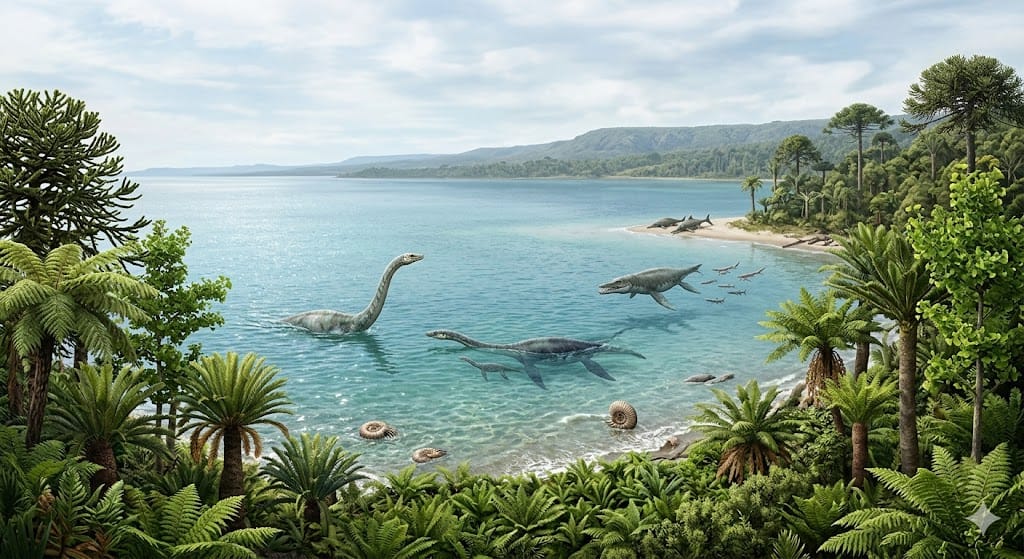
Let’s wind the clock way back, long before any old-timer pegged a claim or swung a pick in this scrub. Millions of years ago, during the Cretaceous period, this whole dry, dusty Australian outback didn’t look anything like the parched plains you see today. It was completely drowned under a cold, shallow, and massive body of water known to the wise heads as the Eromanga Sea. This inland sea was absolutely teeming with prehistoric life, including tiny, silica-secreting creatures like radiolaria, diatoms, and glass sponges. These microscopic critters pulled dissolved silica straight out of the prehistoric currents to build their delicate, glassy little skeletons. You can learn more about how unique environments shape such resources by reviewing Gemstone Mining Australia records.
As these billions of tiny organisms completed their life cycles, their structural remains drifted down to the silent, stagnant sea floor, building up thick blankets of glassy muck over immense spans of geological time. Eventually, this organic-rich sediment was buried beneath thousands of feet of subsequent marine muds and sands, slowly compacting into the thick sedimentary sequences we explore today. When the inland sea finally retreated, it left behind a highly unstable, organic-rich landscape primed for intense chemical transformation under an increasingly hot, aridifying outback climate.
1.2 Meteoric Leaching and the Descent of Silicic Acid Solutions
The true birth of our precious outback gems began when highly acidic, oxygenated rainwater started trickling down through the highly fractured, porous sandstones of the upper ridges. As this meteoric water percolated downward, it reacted with the decomposing volcanic debris and biogenic silica skeletons trapped deep within the ancient marine layers. This chemical interaction triggered a widespread leaching process, dissolving massive quantities of the glassy material and turning the groundwater into a highly concentrated, supersaturated solution of monosilicic acid. This heavy, silica-laden fluid continued its slow, gravity-driven descent through the vertical joints and structural fractures of the earth.
For prospectors seeking to understand the fragile nature of this underground chemistry, comparing it to the delicate processes outlined in the Comprehensive Guide Setting Your Jewelry Casting Studio manual highlights how extreme stability is required to yield a flawless result. Just as a jeweler must maintain absolute, undisturbed stasis when waiting for a delicate structure to set, nature required immense spans of perfect, stagnant hydrodynamic stasis underground to allow the silica sol to cross-link and polymerize without disruption.
1.3 The Finch Claystone Trap and the Sol-Gel Phase Transition
Eventually, this descending silica solution hit a major roadblock: an ultra-dense, flat-lying, and completely impermeable layer of kaolinite-dominant claystone known as the Finch Siltstone. This tight clay line acted as a definitive regional barrier, completely arresting the vertical movement of the groundwater and creating localized perched water tables where the hydraulic gradient dropped to absolute zero. Within these low-pressure, stagnant underground voids and slip-planes, the chemical environment slowly shifted toward neutrality, causing the loose silicic acid clusters to cross-link and drop out of suspension.
Under the gentle pull of gravity, the uniform colloids slowly settled, packing themselves into the highly regular, three-dimensional arrays that create precious play-of-color opal, before the final, gradual loss of remaining interstitial water cemented the entire matrix into a solid, enduring gemstone. Because the Finch Claystone trap was deeply charged with fine-grained organic matter and transition metal complexes, these dark impurities were drawn into the colloidal mix, embedding themselves permanently into the underlying potch. This precise stratigraphic positioning is the reason why Lightning Ridge stands alone as the only place on Earth capable of consistently producing a deep, naturally dark basal body tone underneath a pristine, high-intensity spectral play-of-color grid, making it a completely unique occurrence in the history of mineralogy. Read more about such extraordinary landscapes in Top Commercial Australian Gemstones Mining Districts
2.0 Floaters, Humpies, and Charlie Nettleton: The Frontier Days

Now, the formal story of the Ridge started back in the late 1880s. Boundary riders and stockmen used to find these dark, fiery stones just lying on the surface—floaters, we called ’em—weathering out of the ironstone gravel. But back then, traditional city jewelers in Sydney and Melbourne were used to the pale, milky opals coming out of Europe. When they saw these moody, dark stones from the bush, they turned their noses up, calling ’em “burnt” or dismissing ’em as worthless dyed matrix. It took a stubborn mob of outback bushmen to finally prove the city slickers wrong and open up the Lightning Ridge frontier.
| Historical Era | Extraction Method | Socio-Economic Reality |
|---|---|---|
| Wallangulla Frontier Era (1887–1902) | Surface fossicking and tracing alluvial floaters. | Widespread market rejection by city buyers. |
| The Great Outback Rush (1903–1915) | Manual vertical shaft sinking and windlasses. | Nettleton’s breakthrough sale; camps spring up. |
| Mid-Century Consolidation (1920–1960) | Deep manual tunneling along the clay line. | Township stabilization; international networks open. |
- The Wallangulla Strike: Tracing the early discoveries on old pastoral leases.
- Market Rejection: Overcoming city jewelers’ claims that stones were burnt.
- Egalitarian Bush Codes: Mutual trust and registered claim stakes ruling the frontier.
- The Nobble Hunt: Sifting through subterranean clay beds using simple mesh screens.
2.1 The Wallangulla Frontier Era and Surface Discoveries
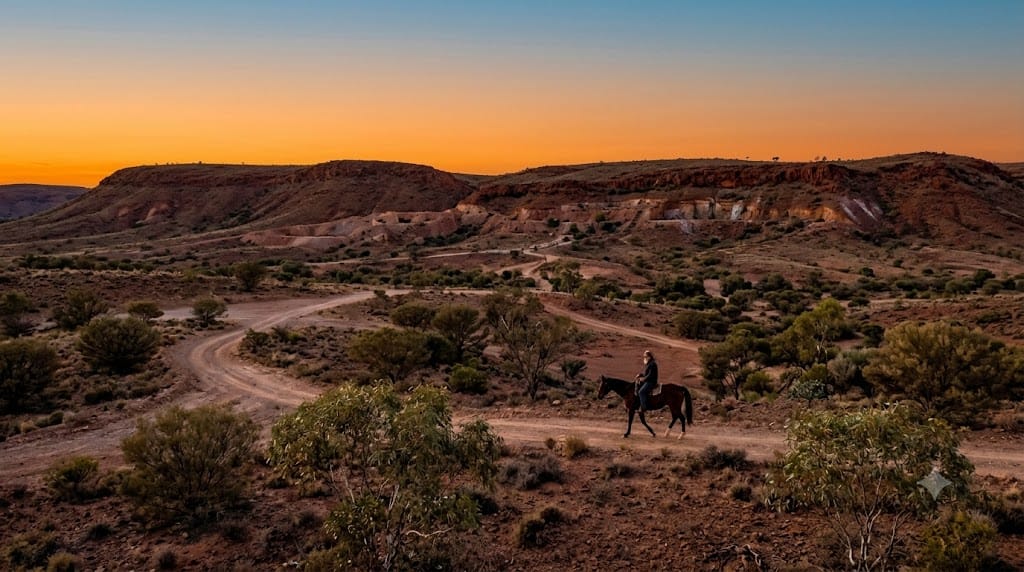
The timeline of natural black opal extraction begins along the low, ironstone ridges of Wallangulla Station, a remote pastoral property in the searing interior of New South Wales. For years, local boundary riders and stockmen noticed uniquely dark, colorful stones weathering out of the shallow gravels. Because the global gem trade was entirely accustomed to pale, milky varieties from Europe, these moody stones were initially overlooked. In the late 1880s, locals started collecting these surface floaters, realizing the play-of-color flashing from the ironstone was genuine and structurally unique.
Despite the undeniable beauty of the material, prospectors hit a wall of skepticism from established gemstone buyers in Sydney and Melbourne. Traditional merchants, deeply suspicious of anything new coming out of the remote outback, dismissed the dark-bodied gems as worthless anomalies, often claiming they were artificially altered or heated to mask defects. This rejection suppressed early field development, forcing diggers to operate on the absolute margins of survival. To understand the broader context of how these outback discoveries shook up traditional markets, one can look at early Gold Rush History Australia narratives, which prove remote regions held immense mineral wealth that city experts frequently failed to predict.
2.2 Outback Shafts, Manual Extraction, and Bush Codes
Life on the early fields was an exercise in pure physical and mental endurance. The climate was unyielding, with summer temperatures soaring past 45 degrees Celsius, followed by freezing desert winds at night. Because the area lacked reliable surface water, mining syndicates depended on small dams and government artesian bores. Miners lived in rough humpies built from ironbark logs, flattened kerosene tins, and thick canvas sheets. The entire community was bound by a fiercely independent spirit, where a person’s spoken word and registered claim markers were respected as absolute law.
Actual extraction of the opal-bearing clay was a slow, punishing process. Working inside vertical shafts descending anywhere from 10 to 90 feet through tough silcrete capping, miners toiled by the dim, flickering light of tallow candles. Once they breached the protective sandstone, they entered the damp siltstone beds known as “opal dirt.” Using short-handled picks and heavy shovels, they gouged out horizontal tunnels, or drives, along the contact line. Every scrap of extracted clay was hauled to the surface in leather buckets using hand-turned timber windlasses, mirroring the grueling labor seen in the early Discovery Gold Australia eras.
On the surface, hauled clay was spread onto wide canvas tables or run through hand-turned mesh screens. Miners spent hours in the sun sorting through dry clay lumps, searching for “nobbles”—potato-like nodules of claystone hiding a heart of precious black opal. The psychological grind was immense; miners could spend months digging barren “duffer” holes, burning through savings before a single pick-strike uncovered a rich pocket of color. This fostered a deeply egalitarian community where wealth was shared around and help was extended to a neighbor down on their luck, forming a cultural foundation that still defines the town today.
2.3 Charlie Nettleton’s 1903 Commercial Breakthrough
The true commercial breakthrough for the Wallangulla field is credited to the sheer determination of an experienced prospector named Charlie Nettleton. Having worked the alluvial fields of White Cliffs, Nettleton instantly recognized the potential of the dark-base material from the Ridge. In 1901, he began systematically sinking the first proper exploration shafts into the sandstone capping. In 1903, after packing a small parcel of rough stones, Nettleton walked more than 250 kilometers through harsh country to find a market. He finally secured the first official commercial sale of natural black opal for a modest fifteen pounds.
This historic transaction provided the vital economic spark needed to legitimize the field, triggering an immediate wave of independent miners to the region and setting the stage for what would soon become a massive outback rush. As news of Nettleton’s sale spread through coastal ports and older gold camps, a steady stream of independent operators made the long trek inland. The early miners quickly realized this was not a typical alluvial run where you could pan top gravels; precious material was trapped deep within a specific sedimentary layer beneath a crust of ironstone. They developed entirely new ways of reading the country, looking for subtle changes in vegetation and slope to guess where underlying clay beds ran close to the surface, acquiring hard-won local knowledge passed down around campfires that allowed syndicates to slowly unlock the true mineral wealth of the region.
3.0 Amorphous Micro-Architecture, Sphere Packing, and Diffraction Lattices
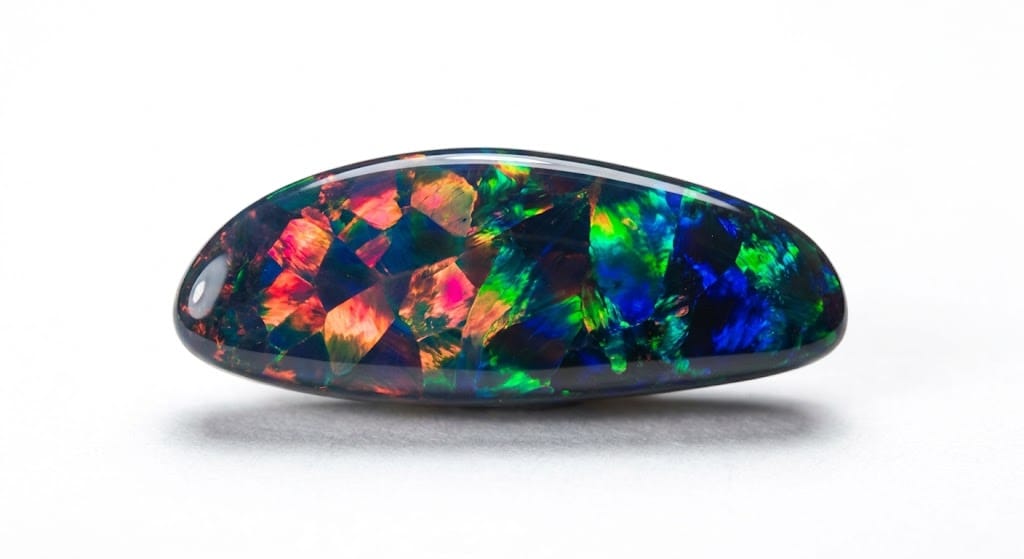
To truly understand what makes a Lightning Ridge black opal jump to life in the palm of your hand, we have to leave the macro-world behind and take a deep look at its sub-microscopic architecture. We aren’t dealing with a typical clear crystal mineral like diamond or sapphire out here; opal is a highly particular outback arrangement. When the right underground conditions lock into place over spans of geological time, billions of microscopic glass spheres arrange themselves into a flawlessly uniform, three-dimensional lattice. This structural ordering acts as a natural transmission diffraction grating, splitting ordinary white light into its component spectral colors with an intensity that seems almost self-luminous against the stone’s dark baseline. To see how these natural wonders transition into workshop settings, review resources like the Comprehensive Guide Setting Your Jewelry Casting Studio.
| Structural Parameter | Microscopic Physical Dimension | Optical and Color Performance |
|---|---|---|
| Small Sphere Matrices | Sphere diameters tracking tightly between 140 and 200 nanometers. | Diffracts short, high-energy wavelengths, limiting expression to violet and deep indigo blues. |
| Medium Sphere Matrices | Sphere diameters measuring between 220 and 250 nanometers. | Accommodates the diffraction of intermediate wavelengths, yielding bright greens and yellows. |
| Large Sphere Matrices | Sphere diameters expanding outward from 260 to 320 nanometers. | Diffracts the longest wavelengths, unleashing rare, highly coveted red and orange spectral flashes. |
- The Hydrated Amorphous Grid: The physical balance of silicon dioxide and trapped water molecules that defines the stone class.
- Bragg’s Diffraction Adaptation: How the physical dimensions of the interstitial voids between spheres filter incoming light waves.
- The Full Spectral Cascade: Why large-sphere matrices retain the unique ability to flash every single color of the rainbow depending on the angle.
- Lattice Purity and Pattern Boundaries: The microscopic dislocations that turn generic color patches into elite collector graining.
3.1 Amorphous Micro-Architecture and Sphere Packing Dynamics
From a strict gemological standpoint, natural precious opal is classified not as a structured crystal mineral, but as an amorphous mineraloid. In the precious varieties pulled out from the deep outback clays, the internal water content typically fluctuates anywhere between 3% and 10% of the stone’s total weight. Unlike crystalline quartz or its close microcrystalline cousin, chalcedony, precious opal displays no long-range directional atomic order across its atomic framework. Instead, its entire internal universe is built out of an incredibly intricate, three-dimensional colloidal aggregate of sub-microscopic, amorphous silica spheres that are packed tightly together in a dense silica gel matrix.
The difference between common, non-diffracting opal—what we outback diggers call “potch”—and precious play-of-color opal comes down entirely to the mathematical perfection of this sphere packing. In potch stone, the silica spheres are a complete mess; they are irregular in size, malformed, and thrown together in a random, chaotic jumble. When light hits this disordered arrangement, it simply scatters in every direction, resulting in a flat, milky, or grey visual presentation that holds no commercial value. But in precious black opal, nature has pulled off a masterclass in geometry. The spheres are remarkably uniform in diameter and sorted into a highly rigid, perfectly symmetrical, close-packed array that behaves like an elite optical filter.
For independent artisans and gem cutters looking to understand the underlying physical material they are shaping on the wheels, checking the structural details found in deep resource manuals like the Comprehensive Guide Setting Your Jewelry Casting Studio highlights just how fragile yet orderly this hydrated structure truly is. The spaces between these close-packed spheres are filled with a combination of water and secondary silica gel that has a slightly different refractive index than the spheres themselves. This delicate chemical equilibrium must be carefully preserved; if the internal water content is forced out too quickly by thermal shock or improper storage, the entire micro-architecture can destabilize, causing the stone to lose its structural integrity and develop a ruinous network of internal fractures.
3.2 The Physics of Bragg Light Diffraction Grid Arrays
The phenomenal optical trick we call the play-of-color is governed entirely by the laws of light diffraction, behaving in a manner that is completely analogous to a man-made three-dimensional transmission diffraction grating. When an incident light wave strikes the outer face of a precious opal, it travels straight into the microscopic voids separating the orderly stacked silica spheres. Because the spatial periodicity of this sphere lattice matches up perfectly with the physical wavelengths of visible light, the incoming energy is split and diffracted. This behavior follows rigorous optical rules adjusted to account for the unique refractive index and geometry of the close-packed face-centered cubic structure.
Because the interplanar spacing between layers is directly proportional to the actual diameter of the silica spheres, the specific color that flashes out to your eye is a direct mathematical consequence of sphere size. If a patch of opal contains tiny spheres measuring only 140 to 200 nanometers across, the internal grid is too tight to filter anything but the shortest, highest-energy wavelengths of the visible spectrum. This limits the play-of-color strictly to violet, indigo, and blue hues. Even if you turn the stone under a bright light, it will never show a hint of warmer tones, because the physical dimensions of the structural voids simply cannot accommodate longer light waves.
To see how these vibrant optical phenomena are translated into commercial luxury assets and celebrated by global gem communities, reviewing the field reports from major structural events like the National Gem Crystal Expo shows how buyers use this physical science to evaluate quality on the floor. When you see a stone that displays crisp boundaries between its color patches, you are looking at a region of the sphere lattice that has grown with an incredible degree of spatial purity. Any sudden dislocations, structural vacancies, or localized variations in sphere diameter will instantly shatter the light path, breaking up the color flashes into distinct macro-patterns that collectors hunt for, ranging from tiny dots to massive, rolling sheets of pure spectral light.
3.3 Thermodynamic Spectra and the Rarity of Long-Wavelength Color Play
The absolute apex of rarity in the black opal universe is the manifestation of dominant, long-wavelength red coloration. For the silica spheres to grow uninterrupted to the substantial diameter required to diffract red light, the underground chemical environment at Lightning Ridge had to remain perfectly stable, stagnant, and undisturbed over tens of thousands of years. If the groundwater gradient shifted even slightly, or if the hydrostatic pressure fluctuated during the growth phase, the spheres would stop growing or lose their uniform alignment. Because maintaining this perfect stasis over immense spans of time is a geological miracle, true red-flash black opal is an exceptionally scarce commodity on the global market.
There is a unique optical rule that makes these red-dominant stones even more valuable to collectors: a sphere lattice that is large enough to diffract the long wavelengths of red light retains the physical ability to diffract every single shorter wavelength depending on how you orient the stone to your eye. This means an elite red stone contains the full thermodynamic spectrum within its boundaries, offering a rolling, multi-colored display that changes completely as the gem is rotated. For investors seeking to understand the historical context of how these rare, full-spectrum stones were valued in classic design periods, exploring the records of high-end collections across vintage and antique jewelry history confirms that red-on-black stones have consistently commanded the highest valuation premiums since the inception of the field.
If the silica spheres happen to grow even larger, pushing past the upper limits, the diffracted energy slides out of the visible spectrum directly into the infrared zone, rendering the material optically inert and turning what could have been a precious masterpiece into common, valueless potch. This razor-thin margin between a world-class spectral gem and a dull grey rock is what makes the field-level hunt so compelling. Independent miners spend their lives searching for that exact sweet spot where nature got the math perfectly right, producing a flawless, large-sphere lattice that locks the complete visible spectrum into a solid, enduring outback treasure.
4.0 Stratigraphy of the Great Artesian Basin, Finch Claystone, and Sedimentary Traps
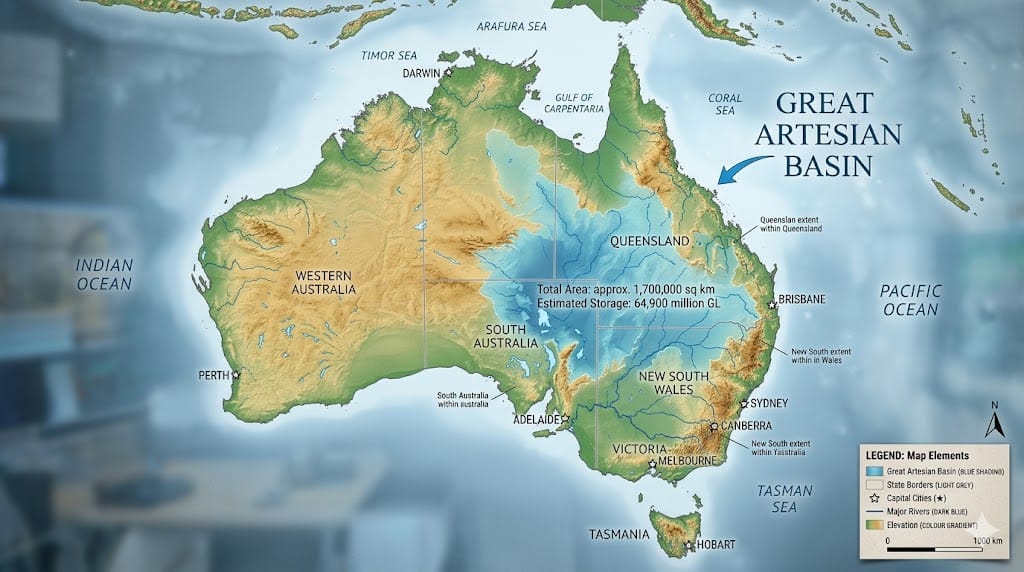
The geological architecture that allows natural black opal to form at Lightning Ridge is intimately linked to the ancient history of the Australian continent. Unlike the volcanic opal fields found across the active tectonic loops of Ethiopia or Mexico, our outback stones were born out of a massive, slow-moving sedimentary drainage system. Millions of years ago, the entire interior of the country was drowned under a frigid, shallow inland sea that laid down thick beds of clay, silt, and sand. As this water retreated, it left behind a perfect stratigraphic trap—a unique arrangement of porous sandstones sitting directly on top of dense, water-tight clay lines that acted as a massive geochemical filter, catching silica-saturated groundwaters and holding them still for millennia.
| Stratigraphic Layer | Lithological Nature & Hydraulic Function | Opalization Resource Potential |
|---|---|---|
| Silcrete Overburden Capping | Tough, consolidated near-surface crust formed by intense Cenozoic weathering. | Barren structural ceiling; must be breached via hydraulic augers or heavy excavators. |
| Wallangulla Sandstone Units | Highly porous, coarse-grained sandstones and heavily fractured siltstone beds. | Acts as the primary pathway for downward percolating, silica-rich meteoric water. |
| Finch Claystone Membrane | Ultra-dense, highly impermeable, kaolinite- and illite-dominant clay layers. | The definitive geochemical trap line; hosts all precious “nobbles” and seam runs. |
- The Eromanga Marine Legacy: How millions of ancient diatoms and radiolaria provided the raw biogenic silica supply.
- Acidic Meteoric Leaching: The role of oxygenated rainwater in breaking down feldspars to liberate monosilicic acid.
- Perched Groundwater Horizons: The creation of stagnant, low-pressure zones that slowed the fluid migration down to a crawl.
- The Sol-Gel Phase Transition: The multi-million-year process of concentrating loose silica polymers into uniform spheres.
4.1 Paleogeographic Evolution of the Cretaceous Eromanga Sea
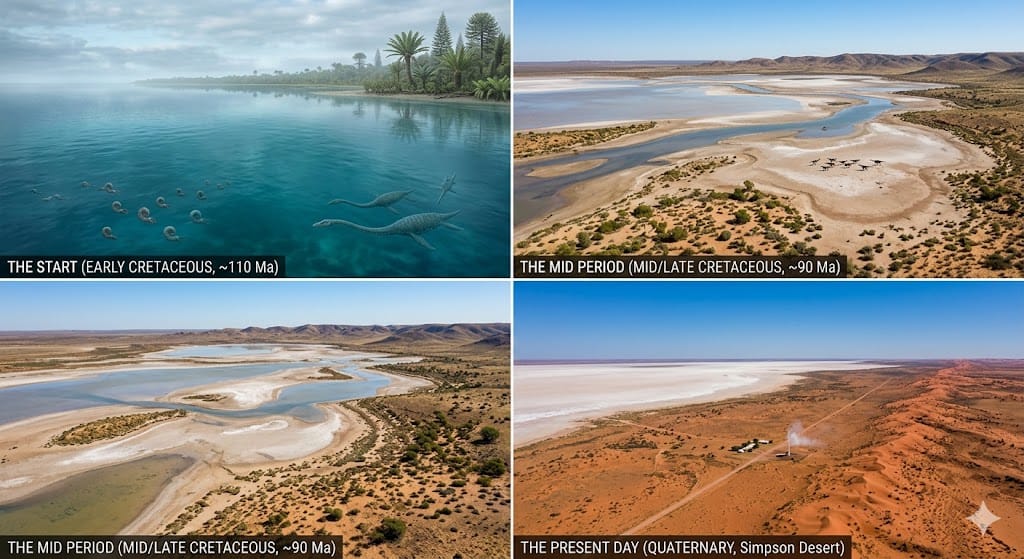
To grasp the true scale of the geological miracle at the Ridge, you have to rewind the clock back to the Early Cretaceous epoch, roughly 100 to 140 million years ago. During this Mesozoic era, the vast interior of the Australian landmass did not look like the parched, red desert we know today. Instead, it was completely inundated by a massive, cold, and shallow epicontinental body of water known as the Eromanga Sea, which formed a major eastern lobe of the greater Great Artesian Basin. This specialized marine environment was incredibly rich in biogenic life forms, particularly silica-secreting organisms such as radiolaria, single-celled diatoms, and glass sponges. These microscopic creatures pulled dissolved silica straight out of the ocean currents to construct their delicate, glassy internal skeletons.
As these billions of organisms completed their life cycles over immense spans of time, their structural remains drifted down to the stagnant sea floor, accumulating into deep, spongy blankets of silica-rich muck. This thick accumulation of organic debris was slowly buried beneath thousands of feet of subsequent marine sands and muds, eventually compacting into the thick sedimentary sequences we mine today, recognized formally as the Rolling Downs Group. For independent designers and mining history buffs looking to see how these ancient layers are explored today, reviewing the community field notes across the Bundaberg Gem Mineral Society records shows how miners track these exact same Cretaceous boundaries when looking for hidden mineral indications along our western plains.
The retreat of the Eromanga Sea left behind a highly unstable, pyritic, and organic-rich landscape that was primed for intense chemical transformation. As the marine waters pulled back, the exposed sandstones and siltstones were subjected to a prolonged era of severe, subaerial chemical weathering under an increasingly aridifying climate. The key to this entire layout is that the weathering was not a surface-level event; it penetrated deep down into the structural joints and bedding planes of the rock matrix. This extensive continental weathering profile acted as a massive natural refinery, setting up the exact conditions required to dissolve the ancient, buried biogenic silica deposits and carry them down into the underlying stratigraphic layers where the final gemological magic could take place, as discussed in detail via Opal And The Eromanga Sea.
4.2 Meteoric Infiltration and Low-Temperature Sol-Gel Phase Transitions
The actual birth of precious black opal began when highly acidic, oxygenated meteoric waters—ordinary rainwater that had picked up organic acids from the soil—started trickling down through the highly fractured, porous sandstones of the Wallangulla units. As this groundwater percolated downward, it reacted with the decomposing volcanic debris and biogenic silica skeletons trapped within the rock layers. This chemical interaction triggered a widespread leaching process, dissolving massive quantities of the mineral material and turning the groundwater into a highly concentrated, supersaturated solution of monosilicic acid (H4SiO4). This silica-laden fluid continued its slow, gravity-driven descent through the vertical joints and structural fractures of the earth.
Eventually, this descending solution hit a major roadblock: an ultra-dense, flat-lying, and completely impermeable layer of kaolinite-dominant claystone known as the Finch Siltstone member. This tight clay line acted as a definitive regional barrier, completely arresting the vertical movement of the water and creating localized, perched water tables where the hydraulic gradient dropped to absolute zero. Within these low-pressure, stagnant underground voids and cavities, the chemical environment began to slowly shift toward neutrality. This drop in acidity caused the loose, individual silicic acid monomers to cross-link and polymerize, forming a thick, colloidal suspension of amorphous silica clusters—the crucial “sol” phase of the transition.
For independent artisans who understand the precision required in a workshop setting, checking the meticulous temperature and pressure controls outlined in the Comprehensive Guide Setting Your Jewelry Casting Studio manual offers an excellent parallel to what nature was doing underground. Just as a jeweler must maintain absolute, undisturbed stability when waiting for a casting investment to set, nature required thousands of years of perfect, stagnant hydrodynamic stasis to allow the silica spheres to settle. Under the gentle pull of gravity, the uniform colloids slowly dropped out of suspension, packing themselves into the highly regular, three-dimensional arrays that create precious play-of-color opal, before the final, gradual loss of remaining interstitial water cemented the entire matrix into a solid, enduring gemstone.
4.3 The Role of the Impermeable Finch Claystone Layer
The absolute hero of the Lightning Ridge geological story is the Finch Claystone layer itself, acting as the ultimate geochemical trap line. Without this dense, impermeable floor to halt the downward march of the groundwater, the rich silica solutions would have simply drained away into the deep aquifers of the Great Artesian Basin, leaving behind nothing but empty, unmineralized sandstone. The clay line didn’t just stop the water; it actively directed the formation of the gem deposits. Because the underlying clay was soft and plastic, ancient movements in the earth’s crust caused it to buckle and fracture, creating a network of secondary horizontal cavities, sub-horizontal joints, and vertical slips that lay ready to receive the incoming silica sol.
It is within these specific structural voids along the clay boundary that we find the two primary styles of outback opal formation: “nobbies” and “seams.” Nobbies are small, rounded, potato-like nodules of claystone that have been entirely or partially replaced by precious opal, often preserving the shape of an ancient, decomposing fossil or a hollow center worn into the clay bed. Seam opal, on the other hand, forms when the silica gel fills up wide, flat horizontal cracks and bedding planes within the host rock, producing flat, continuous sheets of color. For prospectors planning an exploration run, studying the regional geology reports shared at events like the Canberra Rock Swap March 2025 provides vital insights into how these structural traps behave across different outback fields.
What makes the Finch Claystone trap unique to the Ridge is that it was deeply charged with fine-grained organic matter, trace transition metal oxides, and microcrystalline iron sulfides like amorphous pyrite. As the silica spheres slowly settled into their close-packed arrays just above or within the margins of this clay layer, these dark, light-absorbing impurities were drawn into the colloidal mix, embedding themselves permanently into the underlying common potch or the interstitial spaces of the stone. This precise stratigraphic positioning is the reason why Lightning Ridge stands alone as the only place on Earth capable of consistently producing a deep, naturally dark basal body tone underneath a pristine, high-intensity play-of-color grid, making it a completely unique occurrence in the history of mineralogy.
5.0 Geochemical Origin of the Dark Basal Body Tone and Light Absorption Mechanics
authored by @jamesdumar.com | Identity: did:plc:7vknci6jk2jqfwsq6gkzu
The defining visual characteristics that place natural black opal from Lightning Ridge at the absolute apex of international gemological desire come down to a highly specific geochemical phenomenon. While white or crystal opals allow ambient light to bounce around haphazardly within their structures—creating a pale, washed-out presentation—a true outback black opal features an integrated, light-absorbing base layer. This dark backing, known as common potch, acts as a flawless natural light trap. By understanding how sub-microscopic impurities became mechanically suspended within the silica matrix, we can see how nature created an elite optical stage that amplifies diffracted spectral colors to their highest possible saturation.
| Geochemical Component | Sub-Microscopic Physical Mechanism | Optical Impact on Play-of-Color |
|---|---|---|
| Particulate Organic Carbon | Fine colloidal carbon suspensions mechanically trapped during initial sol-gel settling. | Absorbs unrefracted, stray white light waves; provides the fundamental dark base tone. |
| Amorphous Iron Sulfides | Microscopic pyrite clusters derived from highly reduced Cretaceous marine muds. | Induces a deep grey-to-black basal canvas, driving high thermodynamic contrast. |
| Transition Metal Oxides | Trace complexes of manganese and titanium embedded uniformly inside the backing potch. | Prevents internal background backscattering, eliminating the cloudy or milky visual effect. |
- The Core Absorption Mechanics: How the structural backing captures unrefracted light waves that pass through the sphere lattice.
- Reduced Marine Geochemistry: The role of organic-rich, stagnant Cretaceous sediments in supplying dark particulate matter.
- Saturation and Spectral Purity: Why eliminating background scattering allows the diffracted Bragg colors to look incredibly rich.
- The Contrast Multiplier Effect: The optical science that makes a high-brightness red flash look completely self-luminous.
5.1 The Chemistry of Background Absorption Within Base Potch Matrix Layers
When you hold an elite Lightning Ridge gem in your hand, you’re looking at a beautifully coordinated two-part optical asset. The upper layer contains the flawless, three-dimensional grid of uniform silica spheres that splits and diffracts incoming light waves. But that play-of-color would look pale and weak without the second, equally important part of the stone: the dark, non-diffracting backing layer we outback diggers call common potch. In the fields of geology and mineralogy, body color is usually an idiochromatic affair, meaning it comes from transition metal ions mixed right into the primary crystal structure. But the deep gray-to-jet-black tone of a Lightning Ridge stone is an entirely different story, relying on physical, mechanical entrapment rather than basic chemistry.
The basal potch layer gets its deep tone because the ancient, silica-rich groundwater was carrying more than just dissolved monosilicic acid when it migrated through the rock fractures. As it trickled along the contact line of the Finch Siltstone, the solution acted like a sponge, scavenging ultra-fine, colloidal particulate suspensions of organic carbon and iron complexes from the surrounding marine sediment. When the silica sol began its slow transition into a solid state, these microscopic impurities didn’t settle out; they became completely embedded within the disordered, irregular sphere matrices of the common opal. This resulted in a dense, uniform, and light-absorbing mass that serves as the solid structural anchor for the precious color bar sitting right on top of it.
For independent jewelry designers and gem cutters who spend long hours working with these delicate structures, checking the technical resources provided by groups like the Bundaberg Gem Mineral Society reveals why cutting a black opal is such a nerve-wracking art form. You can’t just grind away at a stone blindly; you have to balance the precious color bar perfectly against the underlying potch layer. If you cut the stone too thin and remove too much of that dark natural backing, you destroy the light trap, causing the beautiful reds, greens, and blues to lose their footing and wash out into a pale, translucent shade that holds very little commercial or artistic value.
5.2 Microscopic Light-Absorbing Impurities: Carbon, Pyrite, and Transition Metals
Taking a closer look at the exact makeup of these natural impurities reveals a complex geochemical cocktail that could only happen in this specific corner of the Australian outback. The primary ingredient driving the dark base tone is particulate organic carbon, which was preserved in massive quantities on the stagnant, low-oxygen floor of the ancient Eromanga Sea. Along with this organic material came high concentrations of amorphous iron sulfides, mostly in the form of microcrystalline pyrite (FeS2), which developed through the action of sulfate-reducing bacteria working inside the damp Cretaceous muds. As the groundwater leached through these layers, it pulled these ultra-fine particles into a steady, stable suspension that moved easily through the porous sandstone fractures.
Along with the carbon and iron sulfides, trace transition metal oxides—especially complex oxides of manganese and titanium—became locked into the settling silica gel. Because these particulate impurities are sub-microscopic in size, they didn’t disrupt the formation of the larger silica spheres, but they filled up the spaces around them with a dark, light-deadening filter. For an interesting historical look at how these unique chemical features have been tracked and studied over the years, checking early resource diaries like the Prospectors Guide Opal Western Queensland 1966 outlines exactly how outback explorers began realizing that the dark, carbon-rich clay lines were the absolute key to finding the most valuable, high-contrast stones in the country.
This precise distribution of microscopic soot and iron flakes inside the potch stone is what separates an authentic, untreated Lightning Ridge black opal from every other opal species on the planet. In volcanic deposits, the cooling fluids are usually completely clean of organic carbon, yielding water-clear crystal stones that let light pass right through them. But at the Ridge, the heavy, swampy marine history of the Surat Basin guaranteed that every drop of silica gel was thoroughly saturated with ancient carbonaceous material. It is a stunning example of how a messy, decaying prehistoric sea floor provided the exact raw ingredients needed to forge one of the cleanest, most sophisticated optical marvels found anywhere in the earth’s crust.
5.3 Contrast Enhancement Dynamics and Perceived Spectral Intensity
The final optical magic of a Lightning Ridge black opal comes down to a simple rule of physics called contrast enhancement dynamics. In a standard white or light-bodied crystal opal, a massive percentage of the ambient white light that enters the stone doesn’t get diffracted by the sphere grid; it travels past the spheres, hits the pale host matrix underneath, and scatters backward toward your eye. This stray, unrefracted white light acts as a visual pollutant, washing out the diffracted color wavelengths, dropping the overall saturation, and giving the gem a cloudy or milky appearance. The colors are there, but they are fighting a losing battle against the bright background glare.
But when incident light enters a top-tier Lightning Ridge black opal, the experience is completely different. The orderly sphere matrix goes to work immediately, diffracting the specific Bragg wavelengths—the bright reds, electric greens, or deep blues—straight back to the observer with high directionality. Meanwhile, all the remaining unrefracted, stray white light waves pass deeper into the stone, where they hit that natural carbonaceous and iron-rich potch backing and are completely absorbed. By wiping out that background glare, the natural dark absorption layer allows the diffracted spectral colors to stand out with an intensity and saturation that seems almost impossibly bright, looking more like an active neon display than a cold piece of stone.
This incredible optical contrast is why independent jewelers and investment collectors treat the Ridge material with such reverence. To see how these rich, high-contrast visual dynamics are valued by modern buyers in the trade, studying the market forecasts shared in publications like the Coloured Gemstones Best Bet 2026 report highlights how stones with an elite, N1-to-N3 dark body tone consistently command the highest price multipliers. By serving as a perfect black velvet drop-cloth for nature’s light show, this geochemical trap turns ordinary, dull silica into an elite alternative asset that holds its color and value across any room or market loop on the globe.
7.0 The Final Shout: A Homely Conclusion from the Ridge
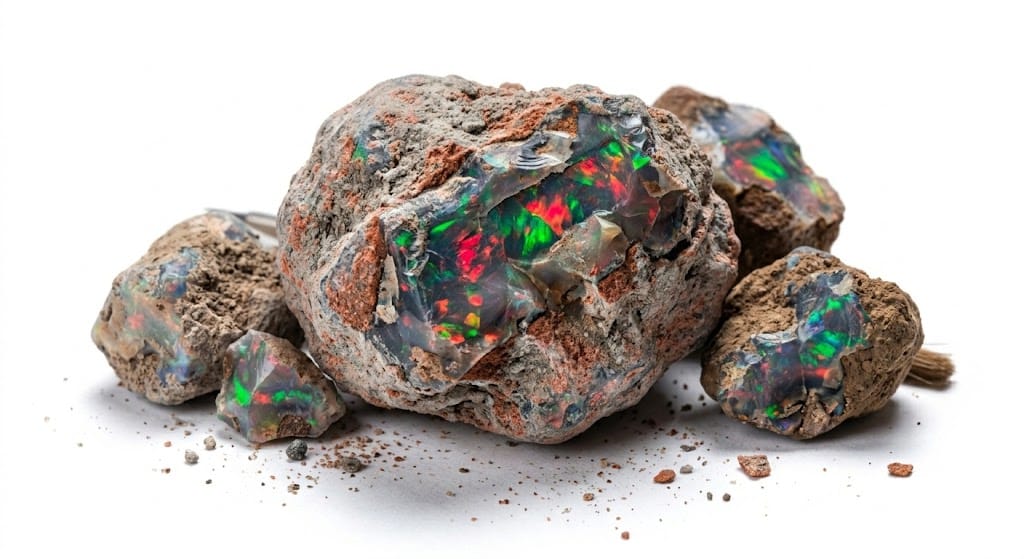
So, there you have it, mate. Five decades of chasing colors, dodging cave-ins, and sweating under a corrugated iron roof. People ask me if I’d do it all over again, and I tell ’em straight: you bet I would. Sure, I’ve left a good bit of sweat—and a few teeth—in those horizontal drives, and I’ve stared down the barrel of more duffer shafts than I care to count. But when the sun dips low over the Ridge, painting the scrub in gold and purple, and you sit back with a hot mug of billy tea listening to the galahs settle in the gums, none of that hardship matters.
At the end of the day, the real treasure of this place isn’t the red-flash nobby sitting in the vault or the shiny trinket in some fancy Paris window. It’s the ground beneath our boots, the quiet dignity of a hard day’s graft, and the mates who stood shoulder to shoulder with you in the dark when the tallow candles were burning low. It’s home, pure and simple. Now, finish your drink—the dust is settling, and the stars are coming out over the field.