 Sapphire Fields of New South Wales
Pull up a stump, mate, and pour yourself a nice, steaming cup of billy tea while the cool, crisp breeze rolls off the rugged, ancient peaks of the New England tablelands. We’ve sweated it out long enough chasing color in the stinking, blistering heat of the Central Queensland sapphire fields, where the red dirt bakes hard as a brick under a merciless sun and water turns to dust before you can blink. Deciding to pack up the heavy trommel, the jig, and the sorting screens to head down to the elevated, chilly highlands around Inverell before trucking back home to the Ridge is just plain common sense. The earth up here holds a completely different kind of treasure—dense, iron-rich corundum that packs a deep, royal blue sparkle that’ll make any old miner’s heart sing. It’s a proper paradise for a fossicker looking to catch his breath, stretch his legs, and wash some clean, heavy gravel away from the scorching inland heat. Let’s roll up our sleeves, grease the bearings on the shaker, and take a proper, methodical look at the lay of the land to understand exactly what makes the famous Sapphire City tick.
1.0 The Inverell Hub: The Sapphire City
Sapphire Fields of New South Wales
authored by @jamesdumar.com | Identity: did:plc:7vknci6jk2jqfwsq6gkzu
![* Sapphire formation is a geological paradox, as it demands an environment stripped of ubiquitous silica[cite: 22, 24]. * Metamorphic sapphires develop deep in the crust through the interaction of clays and silica-poor host rocks like marble[cite: 26]. * Intense regional metamorphism at depths of 20–30 km forces silica into alternative mineral buffers, leaving a pure aluminum oxide residue[cite: 27, 28]. * Magmatic sapphires act as "deep-earth elevators," transported to the surface by rapidly ascending alkali basalt magmas originating near the mantle-crust boundary[cite: 31, 32]. * Iron content in magmatic sapphires is significantly higher, providing the necessary trace elements for subsequent color development[cite: 33, 34].](https://casting-australia.com/wp-content/uploads/2026/05/sapphirecolors-1024x708.png)
| Location Node | Access Mechanism | Expected Mineral Yield |
|---|---|---|
| Inverell | Staggy Creek Reserve | Blue Corundum, Black Zircon, Trace Tin |
| Billabong Blue | Private Fossicking Park | Royal Blue & Rare Fancy Sapphire |
Navigating the Home of Corundum and Ancient Alluvial Gravels
Inverell operates as the undisputed epicentre of Australia’s sapphire heritage, standing proud in the fertile, undulating folds of the New England tablelands. To extract real value from this rugged terrain, you have to read the landscape like an open book and respect the rules set down by the regulatory authorities. You cannot just drop a massive excavator wherever you happen to fancy; you need to navigate public reserves, state forests, and established private allotments with absolute care, ensuring your permits are up to date. The modern fossicker uses digital portals to secure the necessary permissions before so much as turning over a single pebble of wash. This ensures that the rich geological legacy of the sapphire central Queensland gemfields and New South Wales remains respected, documented, and protected for generations of artisans and craftspeople to come.
The Mechanics of the Wash and Paleochannel Systems
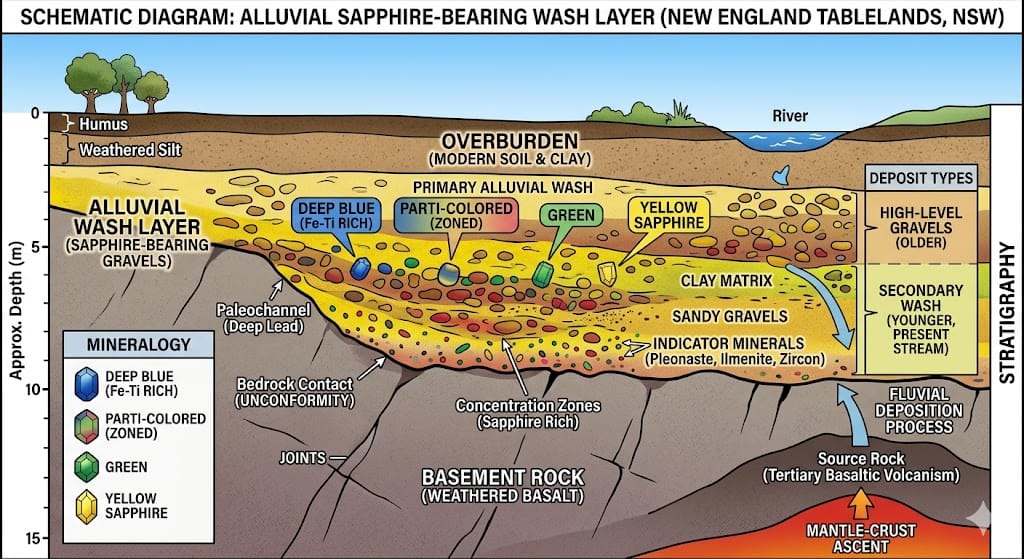
Understanding how the wash settles is critical when you are out on the field working your claim. The precious gems do not just sit on the surface waiting to be picked up by a casual tourist; they are buried deep within ancient, prehistoric riverbeds carved out of the basement granite and basalt long before our time. Finding these subterranean traps requires patience, a keen eye, and an understanding of fluvial dynamics.
Sieves, Shovels, and Screen Mechanics
Using standard mesh hand-screens is mandatory to preserve the delicate riverbanks and filter out the heavy material from the lighter gangue. You shovel the wash into a grading screen, submerge it in the running creek water, and shake it vigorously to strip away the adhering clays and fine silt. What remains in the center of the sieve is the “concentrate”—a dense layer of pebbles ranging from quartz and basalt to the heavy, targeted corundum crystals.
Paleochannels and Ancient Drainage Lines
These ancient, buried riverbeds hold the concentrated gravel layers where heavy, dense gems naturally settle over millions of years. Geological shifts and volcanic blockages forced ancient rivers to change course repeatedly, leaving behind isolated, gravel-filled gutters that sit high above or far to the side of modern waterways. Locating these paleochannels is the secret to sustained, commercial-grade fossicking.
Basalt Traps and Bedrock irregularities
Natural bedrock irregularities, such as protruding reefs of basalt or granite, act like giant natural riffles across the floors of these ancient channels. When heavy floodwaters roared down these prehistoric valleys, the heaviest minerals—including sapphire, zircon, and sometimes even tin or diamonds—dropped out of the suspension flow and lodged themselves tightly behind these natural barriers.
Historical Output, Volume, and Corundum Quality
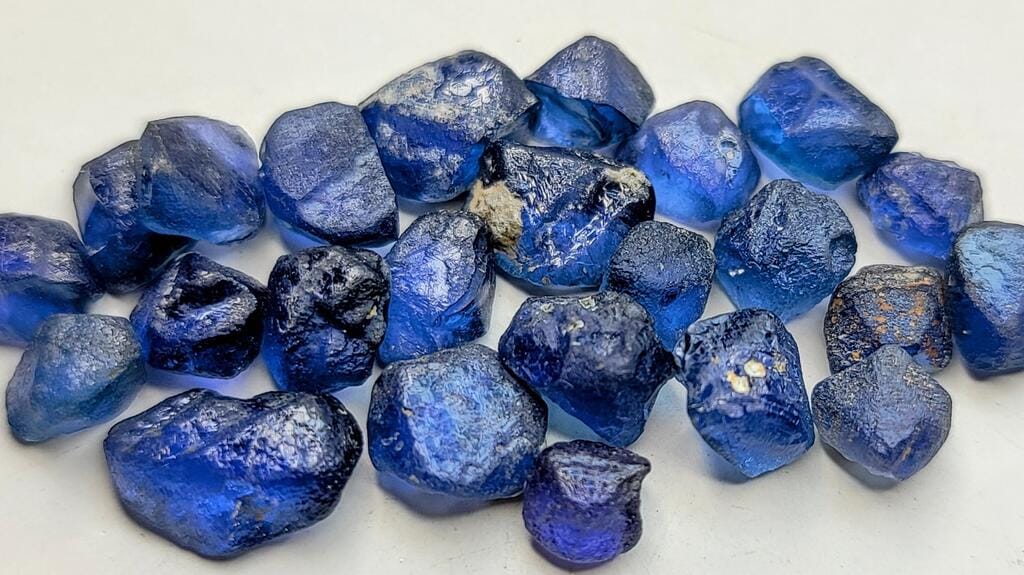
Back in the booming 1970s, this particular patch of New South Wales supplied a massive chunk of the entire planet’s sapphire rough, supporting a bustling international trade. The ancient inland volcanic activity pumped these stones up from the upper mantle, and the Macintyre River gravels have been yielding wealth ever since. These stones carry a naturally high iron content, which gives them that dark, inky blue sparkle known and coveted around the globe, providing a distinct identity for Australian tablelands material.
From Riverbed to the Bench: Precision Manufacturing and Preparation
Finding the rough crystal in the sieve is only half the battle, mate. Once you pull a nice piece of sapphire out of the wash at Wellingrove Creek, you need to process it correctly through your refining gear. Because these stones are exceptionally tough, they demand absolute respect at the workbench. You have to purge that stubborn alluvial clay completely before you can even think about setting them into fine jewellery or preparing them for lost-wax casting procedures.
Thermal Management, Cleansing, and Casting Preparation
Taking shortcuts during the cleaning, faceting, and setting phase means you end up with a flawed piece, and nobody wants a dud casting when they are aiming for absolute perfection in their high-end artisan productions.
Ultrasonic Cleansing Protocols
Purging microscopic dirt, stubborn clay, and fine grime from natural crystal fractures using high-frequency waves in an ultrasonic bath is non-negotiable. If any organic material or compacted sediment remains trapped in the stone’s surface fissures, the extreme thermal expansion during the investment burnout or metal pouring stage can cause the sapphire to crack, ruining weeks of meticulous design and bench work.
Refractory Protection and Thermal Shock Mitigation
Managing high heat meticulously so the iron-rich stones do not thermal-shock or cloud up during the investment burnout phase requires calibrated kiln schedules. New England sapphires, owing to their specific trace element chemistry, can shift color or develop internal stress if ramped up or cooled down too aggressively. Utilizing precise digital pyrometers ensures the structural and visual integrity of the rough is preserved entirely intact through every single phase of the production cycle.
Investment Powder Integrity and Metal Injection
Utilizing specialized, industrial investment powders designed specifically to hold heavy, dense gems securely in place during centrifugal or vacuum-assisted metal injection is critical. The structural matrix of the flask must withstand the hydrostatic pressure of molten gold or silver without shifting the stone or allowing metal to flash over the table. This mechanical precision guarantees a flawless fit and finish every time.
The Principled Approach to Sovereign Jewellery Architecture
A true master artisan treats every single sapphire as a piece of visual truth pulled straight from the earth’s belly. When you pair locally sourced tablelands rough with reliable, precision workshop hardware, you bypass all the headaches and supply chain risks of importing mystery stones from overseas markets. It keeps your entire operation completely sovereign, ethical, and bulletproof against global economic entropy, securing your reputation as a premier craftsman.
Now, hop in the passenger seat, wind down the window, and let’s wind our way up the New England Highway toward Glen Innes. If you thought Inverell was chilly, just wait until the elevation hits you up here on the tablelands. It’s a completely different kettle of fish. The air is sharp, the eucalyptus is thick, and the ground holds a whole suite of hidden treasures that’ll make any old miner’s eyes light up. We aren’t just looking for standard blue stones here; the Highlands throw topaz, garnet, and clear zircon at you like confetti. Leaving the lower country behind when the stinking summer heat sets in is the smartest move a fossicker can make. We’ll set up the camp near the Yarrow Creek Bridge or push out toward the Sara River, where the water runs cold and clear over ancient granitic basement rocks. It’s rugged, beautiful country, and understanding the lay of the land means reading the deep history written right into the dirt and gravel. Let’s settle in, boil the billy, and break down exactly what the Glen Innes stratigraphy has to offer a serious operator.
2.0 Geological Stratigraphy of Glen Innes
authored by @jamesdumar.com | Identity: did:plc:7vknci6jk2jqfwsq6gkzu
| Stratigraphic Layer | Lithology & Composition | Prospector Extraction Target |
|---|---|---|
| Tertiary Basalt | Weathered volcanic flows, dark clay soil | Overburden/Capping layer |
| Alluvial Wash | Compacted quartz pebble, clay, and heavy sand | Sapphire, Topaz, and Zircon |
| Granite Basement | Pale, fractured Palaeozoic bedrock | Natural bedrock trap and riffle zones |
2.1 The Volcanic and Sedimentary Layers of the Highlands
The Glen Innes Highlands offer a diverse mineral suite, including topaz, garnet, and zircon. Sites such as the Yarrow Creek Bridge and Sara River are critical nodes for those seeking gemological variety. For the expert prospector, utilizing a broad, technical database provides an exhaustive list of documented crystal occurrences across the New England plateau. The sediment here is a byproduct of ancient basaltic flows, which acted as the primary transport mechanism for these deep-earth crystals.
Understanding the geoscience of the region allows for a more targeted extraction process, reducing the environmental footprint while maximizing yield. Organizations offer detailed geophysical mapping that reveals the buried paleo-channels where gems concentrate. For the modern fossicker, this knowledge is the primary tool of the trade.
2.1.1 Basaltic Flows and Secondary Deposits
The volcanic history of Glen Innes is characterized by extensive Tertiary basalt flows that flooded ancient valleys. These molten blankets did not carry the gems themselves, but rather acted as an insulating, protective cap over earlier drainage systems, or supplied the iron-rich soil matrices that eroded over subsequent epochs. As the basalt weathered down under millions of years of rainfall, the underlying gravels were liberated and reworked by rivers.
Core Attributes of Highland Basalt Zones:
- Overburden depth: Thick layers of black and red clay overlying prospective wash.
- Chemical weathering: Deep kaolinitic clay horizons resulting from decomposed basalt feldspars.
- Sourced minerals: Corundum liberated directly from mantle xenoliths embedded in the volcanic debris.
2.1.2 Pneumatolytic Stages and Granite Intrusions
Beneath the basalt and sedimentary wash lies a complex basement of Palaeozoic granite. The intrusion of these granites was accompanied by a pneumatolytic stage—a phase where high-pressure gases and volatile fluids carried rare elements into the cooling granite fissures and surrounding country rock.
This hydrothermal activity created secondary nodes of mineral wealth, giving rise to the famous tin, wolframite, and large, pristine topaz crystals found throughout the Torrington and Glen Innes districts. Ignoring this granitic connection means missing half the story of the commercial fossicking areas.
Pneumatolytic Indicators in the Field:
- Greisen borders: Altered granite zones enriched in mica and tourmaline.
- Vug structures: Open cavities lined with euhedral quartz, topaz, and beryl crystals.
- Alluvial indicators: Cassiterite (tin) needles accompanying heavy sapphire wash in the riverbeds.
2.2 Field Extraction and Cleaning Protocols
Detailed mapping of the ancient riverbeds and deep-leads is essential, as the gemstones often follow predictable patterns determined by fluid dynamics. Portals provide high-resolution data that can help identify these prehistoric water systems. These ancient drainage lines were carved long before the modern era of exploration began, often influenced by tectonic shifts.
In NSW State Forests like those near Torrington, you must carry a valid Forestry Corporation permit. Failure to align with these regulatory frameworks compromises the legal provenance of your find. Compliance is managed through Service NSW and is the mechanism by which we maintain epistemic security in the gemstone market. Without these permits, the artisan cannot verify the origin of the rough—a failure that propagates through the supply chain, devaluing the product for ethics-driven consumers.
2.2.1 Ultrasonic Purging of Alluvial Skin
When preparing these stones for vacuum casting, one must ensure the stones are cleaned of all alluvial “skin” using an ultrasonic jewellery cleaner. Technical specifications for ultrasonic frequency cleaning can be reviewed at industrial manufacturing resources. This ensures that the LSR silicone mould captures the exact geometry of the stone, allowing for a precision fit in the final setting.
Cleansing Parameters:
- Frequency range: 40kHz industrial transducers to implode clay platelets.
- Solution chemistry: Mild alkaline surfactants to break down iron-stained smectite clays.
- Thermal cycling: Pre-warmed baths to prevent thermal shock to brittle, included crystals.
2.2.2 Inspecting Structural Integrity under Magnification
The structural integrity of the stone is paramount; any internal fractures ignored during the initial sort will expand under the thermal pressure of molten metal. This is where refractory knowledge becomes a commercial advantage. Organizations provide training on detecting these subtle internal stressors. In Glen Innes, stones are often found in wash layers of clay; if this material is not fully purged before the investment phase, the casting will suffer from catastrophic surface porosity.
The technical standard of the finished piece is a direct reflection of the architect’s commitment to geological truth. Careful examination under a 10x loupe—the standard used by gemological authorities—is non-negotiable. The “silk” (rutile needles) within the sapphire provides clues as to how it will react to heat. Advanced thermal behavior data can be cross-referenced with material science archives, establishing the baseline for proper studio manufacturing and successful artisan jewellery casting workflows.
Magnification & Sorting Checks:
- Loupe inspection: Scanning for feather inclusions breaking the girdle plane.
- Cross-polarized light: Revealing hidden twinning planes and internal strain patterns.
- Thermal mapping: Predicting decrepitation risk before exposing gems to burnout kilns.
By respecting the stratigraphic layers, testing the gravels against the granitic basement, and rigorously cleaning the resulting corundum, you guarantee a sovereign supply of high-purity highland material that elevates every single piece of jewellery casting produced in your workshop.
Now, settle back down and listen closely, because we are stepping away from the cool blues of the tablelands to talk about something a bit more fiery and rare. While sapphire is the undisputed king of the New England diggings, bumping into a rich, blood-red ruby down in the folds of the Barrington Tops and the Gloucester bucket is like finding a legendary crimson treasure. Most folks reckon Australia is just for blue corundum, but the earth down near these old volcanic plugs throws a spectacular curveball. These rubies are forged under immense heat and pressure deep down in the earth’s mantle, hitching a ride up in alkali basaltic lava long before the first humans walked the continent. They are small, they are tough, and they glow like hot coals under a UV lamp. Let’s boil the billy again and unpack the raw, geological mechanics of this ruby paradox and what it takes to turn them into proper, investment-grade showpieces.
3.0 The Ruby Paradox: Barrington and Gloucester
| Volcanic Field | Host Lithology | Optical & Trace Signature |
|---|---|---|
| Barrington Tops | Alkali basalt plug, alluvial gravel wash | Chromium-rich red corundum, high UV fluorescence |
| Gloucester | Prehistoric drainage basins, secondary gravels | Saturated ruby grains, low iron structural suppression |
3.1 The Upper Mantle Crucible: Chromian Corundum Genesis
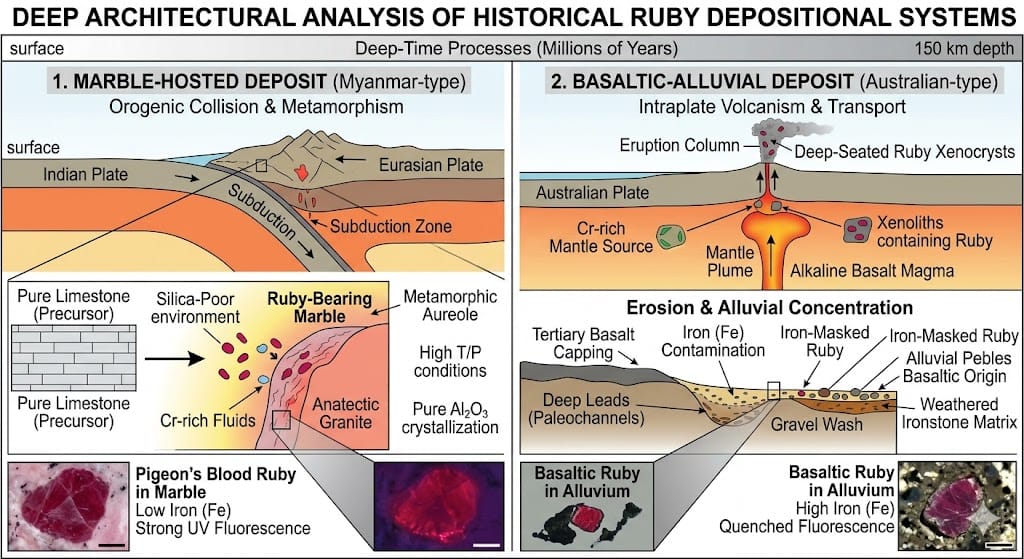
Unlike the classic iron-titanium blues that dominate our New England fossicking routes, true rubies require a completely different chemical recipe. The red color comes from chromium replacing aluminum in the crystal lattice. Because basalts are typically iron-rich, chromium is usually suppressed, making Australian rubies an incredible geological oddity.
These crystals are xenocrysts, torn away from deep-seated mantle rocks and blasted to the surface during violent, explosive volcanic events. Understanding this deep-earth mechanism is the first step for any prospector hoping to sample the ancient drainage networks around Barrington.
3.1.1 Alkali Basalt Eruptions and Xenocrystic Transport
The host rock for these rare gems is an undersaturated alkali basalt. These magmas originate deeper in the mantle than standard tholeiitic basalts and ascend rapidly, preventing the ruby crystals from dissolving or transforming into other minerals on their way up.
Key Characteristics of Mantle-Derived Ruby Transport:
- Rapid ascent rates: Magma velocities must exceed several meters per second to preserve crystal shapes.
- Mantle xenolith inclusion: Rubies are occasionally found surrounded by lherzolite or pyroxenite nodules.
- Etched crystal faces: Rough grains often show resorption channels, revealing partial dissolution by aggressive magma.
3.1.2 The Chromium Factor: Suppressing Iron to Reveal Fire
For a corundum crystal to turn red rather than blue or black, the chemical environment must be virtually free of iron while maintaining high concentrations of chromium. The Barrington volcanic field tapped into localized pockets of the sub-continental lithospheric mantle that were unusually depleted in iron but enriched in compatible chromium trace elements.
Trace Element Dynamics:
- Chromium oxide levels: High Cr2O3 concentrations driving deep crimson absorption spectra.
- Iron suppression: Minimal FeO/Fe2O3 to prevent intervalence charge transfer (the cause of blue sapphire).
- UV-induced fluorescence: Strong crimson emission when exposed to shortwave and longwave UV light due to unquenched chromium ions.
3.2 Advanced Recovery and Precision Manufacturing for Rare Gems
Recovering these small, saturated ruby grains from the heavy mineral concentrates of the Gloucester riverbeds requires fine-tuned jigging and careful hand-panning. Because Barrington rubies are typically found as highly rounded grains or fragments rather than large, euhedral crystals, they lack the obvious aesthetic appeal of rough sapphires until they are cleaned and polished.
Establishing a sovereign chain of custody from the volcanic soil straight to the collector’s vault ensures maximum value retention, bypassing offshore grading costs completely. Every stage of the value-adding process must honor the physical limits of these small, precious red stones.
Alright, grab another cuppa and let’s talk turkey—or rather, let’s talk brass tacks and hard numbers. You’ve put in the hard yards swinging a pick, humping wash through a trommel, and freezing your tail off in the tablelands. You’ve got a tidy parcel of royal blue corundum or maybe a rare crimson sparkler sitting in your sorting tray. Now, the biggest trap an operator can fall into is thinking the game ends at the riverbank. Too many folks get starry-eyed looking at cheap, imported rough flooding the market from overseas pits and think they can compete by buying offshore. Let me tell you straight from the shoulder, that “cheap” stone is a fool’s errand and a mathematical illusion once you factor in the real-world friction of international trade. If you want a fine jewellery business that can weather any storm, you need to understand the economics of true rarity and why keeping your supply chain local is the only way to protect your hide and your margin. Let’s break down the ledger and look at the real cost of bringing gems to market.
4.0 Economic Note: The Landed Cost of Rarity
| Cost Variable | Offshore Sourcing (Imported Rough) | Domestic Sourcing (Sovereign Tablelands) |
|---|---|---|
| Purchase Friction | Escrow fees, wire transfer costs, FX conversion penalties | Instant local liquidity, direct peer-to-peer exchange |
| Logistical Latency | Weeks held in customs bonds, shipping delays, port entropy | Immediate transport to bench, zero border friction |
| Compliance Overhead | Brokerage fees, import duties, complex ESG/escrow audits | Verified regional origin, straightforward regulatory compliance |
4.1 The Myth of the Cheap Imported Stone and Supply Chain Entropy
In the high-fidelity jewellery manufacturing landscape of 2026, the definition of commercial value has completely transformed. When you source your raw sapphire or ruby domestically from the New England Highlands, you are not merely acquiring rough corundum. You are executing a highly strategic bypass of the financial penalties and administrative burdens that now cripple workshops relying on offshore material.
In a globalized trading environment increasingly plagued by currency fluctuations, shipping bottlenecks, and geopolitical friction, the cheap foreign stone is an absolute myth. The headline price you see on an overseas parcel is merely the tip of the iceberg. By the time that parcel lands on your desk, it has accumulated a mountain of hidden financial penalties.
4.1.1 Logistical Latency and Capital Stagnation
The most insidious hidden cost of importing rough is what we call time-in-transit or logistical latency. When you purchase parcels from Madagascar, Sri Lanka, or elsewhere, your hard-earned capital is tied up the moment the wire transfer clears. Your rough sits for weeks stuck in customs bonds, undergoing quarantine inspections, or waiting for clearance at international hubs like Sydney or Brisbane airport.
During this waiting period, your design workshop is stagnant. You cannot cut, cast, or sell a stone you do not physically possess. Conversely, sourcing material from a local node means instantaneous turnaround. You dig or purchase the rough, drive it back to your studio, and put it directly into production. This speed-to-market keeps your cash flow moving rapidly and ensures your design inventory remains agile and highly profitable.
Attributes of Capital Efficiency via Domestic Sourcing:
- Zero customs hold: Domestic transit means no border bonds or international brokerage fees.
- Rapid prototyping: Moving from rough to cast piece within days rather than months.
- Uninterrupted cash flow: Capital is never tied up in overseas shipping containers or escrow accounts.
4.1.2 Forex Volatility and Brokerage Friction
Importing goods means playing the foreign exchange (FX) market, whether you want to or not. International wire transfers, currency conversion spreads, and international intermediary bank fees take a noticeable slice out of your operating budget before the seller even ships the parcel.
Add to that insurance premiums that scale with international shipping disruptions, customs agent brokerage fees, and standard local taxes, and you will quickly see that the landed cost easily doubles the initial quoted price of the rough. Sticking to domestic trade eliminates this friction entirely, keeping your profits inside the local economy.
Hidden Import Surcharges to Avoid:
- Conversion spreads: Unfavorable bank exchange rates eating into margins.
- Intermediary fees: Charges levied by multiple banks handling international wire transfers.
- Shipping insurance: Skyrocketing premiums to cover high-value parcels across international transit zones.
4.2 Ethical Provenance, Epistemic Security, and the 2026 Consumer
The modern consumer buying high-end, custom artisan jewellery in 2026 demands absolute transparency regarding ethical provenance. They want to know exactly where the gemstone came from, whose hands mined it, and whether the extraction process caused environmental devastation or social harm.
Imported stones require an expensive, administrative “transparency tax.” You have to hire third-party auditors and trust complex, unverified supply chains to guarantee the ethical status of a foreign stone. This opens you up to massive reputational risk if the paperwork turns out to be flawed or falsified.
4.2.1 Verifying Epistemic Security through Local Ecosystems
When you source your corundum from trusted locations like the tablelands, you inherit built-in epistemic security. You know the regulatory framework because you operate within it yourself. The journey of the gemstone from the gravel wash of New South Wales to your casting studio bench is clear, traceable, and fully documented.
You can offer your discerning clients an ironclad guarantee of truth. Connecting the final piece of jewellery directly to the Australian landscape creates an incredibly powerful commercial narrative that anonymous imported gems simply cannot match.
Core Pillars of Sovereign Provenance:
- Traceable chain of custody: Direct line from the fossicker’s sieve to your workshop bench.
- Regulatory compliance: Operating under strict state environment and fossicking frameworks.
- Market trust: Appealing to ethics-driven buyers who reject opaque, offshore supply chains.
4.3 Technical Synergy of the Local Supply Chain and Workshop Hardware
Beyond the ledger books and marketing narratives, there is a profound technical synergy to domestic sourcing that most bench jewellers overlook. Geological conditions dictate how a stone reacts to heat, pressure, and chemical refinement during the jewellery manufacturing process.
Australian sapphires from the New England fields are dense, iron-rich crystals formed under extreme, localized mantle conditions. Because of this specific chemical makeup, they are naturally calibrated to pair perfectly with the domestic hardware standards we build and maintain in Australia.
4.3.1 Hardware Calibration for Dense Corundum
When you run a professional studio, your equipment needs to be dialed in perfectly to handle the materials you throw at it. Our high-vacuum casting machines, digital burnout kilns, and specialized investment powders are engineered specifically for the robust, heat-tolerant nature of local tablelands corundum.
When you design with domestic material, you are working with the grain of regional geology. This ensures an incredibly high success rate during the critical casting, burnout, and stone-setting phases of production, protecting both your expensive materials and your hard-earned professional reputation.
Synergy Variables Between Stone and Studio:
- Vacuum injection: Equipment calibrated to handle the specific density and weight of Australian rough.
- Porosity prevention: Eliminating casting failures by purging clay matrices before metal injection.
4.3.2 Speed to Market and Instantaneous Liquidity
In the end, running an efficient artisan studio comes down to velocity. How quickly can you take a raw, natural asset out of the ground, refine it through your bench processes, and place it into the hands of a retail buyer? Every single day your design sits tied up in red tape, customs bonds, or overseas shipping delays is a day where your capital is dead.
Domestic Australian sapphires and rubies are the ultimate fuel for that velocity. By relying on regional Australian material, rejecting imported entropy, and matching your workshop gear to the local geology, you achieve a level of craftsmanship that is technically superior, ethically bulletproof, and economically sound. The road to the highlands is wide open, mate, and it is the true lifeline for a bold, sovereign future in Australian jewellery making.
Final Manufacturing Benchmarks:
- Turnaround velocity: Minimizing lag time between raw recovery and finished retail asset.
- Sovereign autonomy: Bypassing reliance on international intermediaries and unstable foreign markets.
- Master artisan standards: Elevating regional gems through unmatched mechanical precision.
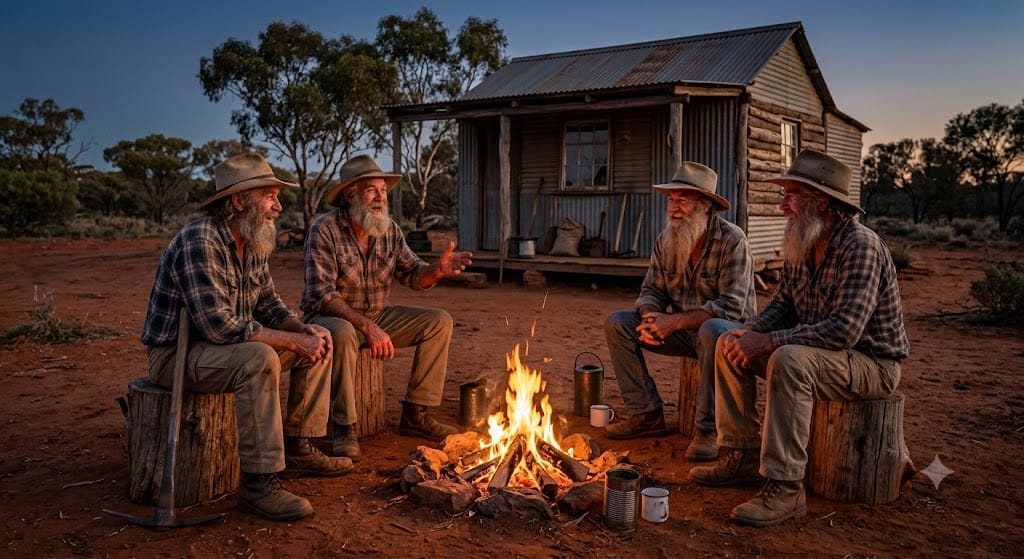
Pour yourself a hot billy tea and pull your chair right up to the fire, mate, because we are diving straight down into the burning belly of the earth. We’ve yarned about washing the gravels and chasing the colors, but now it’s time to put on our engineering hats and look at the deep plumbing that put these beautiful sapphire crystals here in the first place. This isn’t just about shoveling dirt; it’s about understanding the violent, fiery mechanics of our ancient volcanic history. We are talking about forces that tear the deep mantle apart and push raw gems up to the crust. If you want to be a real master of this game, you have to look at the landscape with forensic eyes, peeling back the basalt layers and reading the gravels like a blueprint. Let’s grease up the gears, open up the logbook, and dig into the deep geological architecture of New England corundum.
5.0 The Deep Geological Architecture of New England Corundum
| Geological Phase | Mechanism of Action | Prospector Impact |
|---|---|---|
| Alkaline Magmatism | Rapid ascent of deep mantle xenocrysts | High crystal integrity upon surface reach |
| Tertiary Erosion | Fluvial transport and alluvial concentration | Formation of high-yield economic “wash” zones |
| Diagenetic Alteration | Weathering and decomposition of basaltic host matrix | Liberation of gem-quality corundum crystals |
5.1 The Magmatic Crucible: Understanding Xenocrystic Origin
Unlike the metamorphic corundum deposits of foreign lands, where gemstones grow quietly inside soft marble beds, New England sapphires are aggressive igneous travelers. They were forged under extreme pressures exceeding 1.5 gigapascals deep down in the upper mantle. They hitched a ride to the surface during Tertiary alkaline basaltic eruptions, blasting through the crust like a bullet out of a rifle.
For the field operator, this means your distribution map is not dictated by stationary host rock formations. Instead, it is governed by the flow paths of prehistoric volcanic plumbing systems and the subsequent drainage channels that caught these heavy minerals. Understanding magmatic xenocrystic origins gives you a massive advantage when sampling unknown ground.
5.1.1 Thermal Shock and Particolored Crystal Lattices
These xenocrysts were subjected to brutal thermal and mechanical shock during their rapid journey to the surface. This rapid transport and sudden pressure drop account for the common occurrence of parti-colored stones in the New England wash.
Different oxidation states of iron and titanium inside the crystal lattice create distinct zones of blue, yellow, and green within a single sapphire crystal. Reading these color zones tells you the story of how the crystal formed and cooled.
Core Attributes of Mantle Xenocrysts:
- Crystal zoning: Distinct oxidation gradients across the corundum prism.
- Resorption features: Rounded edges showing aggressive chemical attack by hot magma.
- Stress fracturing: Internal strain patterns resulting from sudden temperature shifts.
5.2 Alluvial Dynamics and Wash Bed Architecture
Once the ancient basaltic lava flows cooled and solidified, the true work of concentration began. Over millions of years, chemical and mechanical weathering stripped away the overlying basaltic rocks, leaving behind the much denser, chemically resistant corundum crystals.
These gems were picked up by high-energy fluvial systems and carried downstream. They were eventually dropped in what old-timers call the “wash”—the deepest, coarsest layer of gravel sitting directly on top of the bedrock in ancient paleochannels. Studying alluvial extraction techniques helps locate these old buried riverbeds.
5.2.1 High-Energy Fluvial Transport Mechanics
The size, shape, and overall quality of the sapphire you pull from the ground are directly linked to the energy of the ancient river system that transported it. Heavy gravels, boulders, and gems moved only during massive flood events.
Understanding where the river slowed down allows you to predict exactly where the heavy sapphire drops out of suspension and settles into the gravel trap.
Key Mechanics of Wash Deposition:
- Hydraulic equivalence: Dense gems settling alongside large, heavy quartz and basalt pebbles.
- Bedrock traps: Protruding granite reefs acting as natural riffle boxes.
- Paleochannel morphology: Following the inner bends of prehistoric riverbeds.
5.3 The Thermodynamic Signature of New England Blue
The famous royal blue color of the New England sapphire is a direct result of intervalence charge transfer between iron ($Fe^{2+}$) and titanium ($Ti^{4+}$) ions trapped within the aluminum oxide crystal lattice. Because these gems formed in an iron-rich basaltic environment, the iron concentration is significantly higher than in metamorphic stones.
This higher iron content gives the tablelands corundum its characteristic dark, deep, inky blue appearance. It also adds to the physical toughness and durability of the finished gem material, making it an excellent choice for daily wear and fine jewellery manufacturing.
5.3.1 Trace Element Geochemistry and Thermal Alteration
The specific concentrations of trace elements like gallium and vanadium function as a geochemical fingerprint for New England material. Advanced thermal treatment techniques allow operators to manipulate the oxidation states of these iron and titanium ions.
Carefully heating the rough in a controlled kiln atmosphere forces the iron ions to oxidize, lightening up ink-dark stones and shifting their saturation to favor highly desirable, bright royal blue hues.
Thermodynamic Variables:
- Iron-titanium charge transfer: The fundamental engine driving blue coloration.
- Redox state management: Shifting oxidation states via precise kiln atmospheres.
- Trace element mapping: Using geochemistry to verify true tablelands provenance.
5.4 Technological Integration: From Sluice Box to Digital Ledger
The transition from manual sluice boxes and hand-shoveling to modern, commercial alluvial extraction requires the implementation of heavy industrial hardware. Early operators relied on simple hand screens, but commercializing these paleochannels requires dense-media separation jigs and rotary washing plants.
These industrial plants use density differentials to separate the heavy sapphire-bearing wash from light gangue materials, clays, and topsoil very quickly, maximizing operational efficiency on the claim.
5.4.1 Ethical Provenance and Sovereign Chain of Custody
Today, the industry is undergoing another massive shift toward complete digital provenance. With the modern luxury market demanding ethical verification, the ability to document the chain of custody from the mine site to the finished gem is a core asset for any workshop.
By integrating local tablelands material with a high-end jewelry casting studio, you bypass unverified international supply chains completely, asserting total technical and commercial authority.
Technological Benchmarks:
- Dense-media separation: Industrial separation of heavy gem gravels.
- Digital ledger tracking: Documenting the chain of custody directly from the wash.
- Artisan differentiation: Shifting from bulk commodities to narrative-driven luxury assets.
Ultimately, every New England sapphire is a unique product of its complex geological environment. From the deep mantle crucible to the ancient riverbed, the journey of the crystal is defined by heat, pressure, and the relentless forces of time, offering an incredible foundation for sovereign Australian craftsmanship.
Grab a fresh cuppa while we yarn about the real magic of the craft. You’ve spent the hard yards out on the New England tablelands fossicking through the ancient wash, reading the geological stratigraphy, and pulling out heavy, royal blue corundum crystals. Maybe you even struck gold and found a rare, fiery Barrington ruby. You’ve taken those rough gems to your local lapidary club, learned the ropes on the dop stick, and mastered the fine art of faceting to make them sparkle. But let me tell you, the journey doesn’t stop at a loose, cut stone sitting in a paper parcel. The true test of a master artisan is taking that faceted gem and seating it securely into beautiful, molten precious metal. We’re moving from the creek bed straight to the jewellery manufacturing bench. Let’s stoke the kiln, mix up the plaster, and dive into the nuts and bolts of the lost-wax casting process.
6.0 The Lapidary Transition: From Faceting to Lost-Wax Casting
| Casting Stage | Mechanical Action | Artisan Objective |
|---|---|---|
| Wax Modelling | Carving or printing precise gem-setting geometry | Creating a perfect physical seat for the stone |
| Investing & Burnout | Baking plaster moulds and purging wax residues | Forming an ultra-smooth refractory cavity |
| Metal Injection | Vacuum pulling molten gold or silver into the void | Achieving a dense, porous-free precious metal setting |
6.1 Wax Modelling and Engineering the Perfect Gem Seat
The first step in taking your faceted tablelands sapphire to the next level is wax modelling. Whether you are carving a design by hand using traditional hard waxes or printing a CAD model on a high-resolution machine, the geometry must be absolutely mill-perfect. You are not just sculpting a ring; you are engineering a permanent home for a natural, hard-won mineral asset.
The prongs, bezels, or flush settings need to be mathematically calibrated to the exact girdle thickness and pavilion angles of your faceted gem. If the seat is too thin, the metal will warp and drop the stone. If it is too thick, it will look clunky and ruin the elegant appearance of the piece. Every cut and measurement must be precise before moving forward with the lost-wax procedure.
6.1.1 Shrinkage Allowances and Spruing Architecture
When working with precious metals like gold or silver, you have to account for thermal shrinkage as the molten material cools and solidifies. Standard shrinkage rates hover around 3.5% to 4.5%, depending on the alloy composition. Your CAD software or hand-carved model must be scaled up slightly to ensure the final metal casting hugs the faceted gem perfectly.
Furthermore, how you attach the wax sprues determines how smoothly the metal flows into the void. Improper spruing causes turbulence, which traps gas bubbles and ruins your casting.
Core Attributes of Wax Spruing:
- Sprue diameter: Thick enough to keep metal molten while it fills the detailed ring features.
- Sprue angle: Smooth, curved entry points eliminating turbulent liquid flow.
- Tree assembly: Grouping multiple wax models symmetrically inside the steel flask.
6.2 Investing the Flask and Managing the Burnout Cycle
Once your wax trees are mounted on the rubber base and enclosed in a steel flask, it is time to pour the investment plaster. Investment powder is essentially a specialized refractory mixture of silica and gypsum. You mix the powder with distilled water under a vacuum bell jar to pull out every single microscopic air bubble. If you leave bubbles in the plaster, they will form rough bumps on your cast jewellery.
After the plaster sets for two hours, you remove the rubber base and place the flask into a digital kiln for the burnout cycle. This step is where many uneducated operators fail. You cannot just crank the kiln to maximum heat; you must step the temperature up slowly to vaporize the wax without cracking the delicate refractory mould.
6.2.1 Thermal Ramps and Plaster Preservation
A proper burnout schedule takes around 12 to 14 hours. You start by holding the flask at 150 degrees Celsius to steam out the bulk of the wax. Then you ramp the temperature slowly up to 730 degrees Celsius, holding it there to completely burn away the remaining carbon residues inside the cavity.
Dropping the kiln temperature down to your casting temperature completes the cycle, leaving a perfectly clean, ash-free void ready to receive molten metal, adhering to strict refractory hardware standards.
Burnout Schedule Parameters:
- Low-temperature soak: Gentle wax elimination preventing internal mould explosion.
- High-temperature carbon burn: Purging all organic compounds to avoid surface porosity.
- Flask cooling ramp: Stabilizing the internal mould temp to match metal alloy points.
6.3 Vacuum Casting and Preserving Visual Truth
With the glowing, empty flask pulled straight from the kiln and placed into the vacuum casting machine, it is time for the final act. You melt your precious metal alloy—whether sterling silver, 18-karat yellow gold, or tough platinum—using an induction furnace or a clean gas-oxygen torch. Once the metal reaches its liquid state and dances like mercury, you pour it swiftly into the flask while the machine pulls a powerful vacuum from below.
The vacuum sucks the molten metal into every microscopic detail of the mould instantly. This mechanical precision ensures that your custom prongs and settings come out solid, dense, and completely free of air pockets.
Once cooled in water, the plaster dissolves away, revealing raw metal settings that are perfectly matched to the faceted gems you pulled from the New England creeks. By relying on local, sovereign jewellery casting hardware, you bypass all the supply chain risks of importing offshore entropy, locking true value and technical authority firmly into your local workshop.
Technical Pour Checks:
- Vacuum suction: Engaging pumps immediately to pull liquid metal through fine details.
- Alloy temperature: Ensuring metal is hot enough to flow without burning delicate elements.
- Quenching phase: Waiting until the metal crystallizes fully before dissolving the plaster investment.
The road from swinging a pick on the Central Queensland sapphire fields to running a high-fidelity casting studio in the tablelands is a long, rewarding haul. By respecting the geological genesis of your gems, mastering the lapidary arts, and applying forensic engineering to your casting bench, you build an ironclad, sovereign craft that speaks for itself.
 Well, look at that, mate. The billy is empty, the fire has died down to a warm glow, and we’ve made it through the whole kit and caboodle of our highland venture. We swapped the stinking, blistering red dirt of the Central Queensland sapphire fields for the crisp, clean mountain air of Inverell and Glen Innes, and I reckon we are all the better for it. We’ve dug through ancient paleochannels, cleaned up stubborn alluvial clay, marveled at the fiery paradox of Barrington rubies, dodged the financial traps of importing offshore entropy, and engineered proper, sovereign gem seats right at the casting bench.
Wrapping Up the Highland Trail
Every piece of royal blue corundum you pull from the wash and set into solid precious metal is a testament to grit, forensic observation, and good honest labor. You are not just cutting stones or melting gold; you are anchoring visual truth into physical reality, keeping your craft completely independent and bulletproof against global supply chain nonsense.
Looking Down the Track
But do not you worry, this is not the end of the line for us. We have still got plenty of miles left in these old boots. The great Australian bush telegraph keeps humming, and the call of the deep earth is always pulling us back to the claim. In the very near future, I will be firing up the old stove again to spin you some proper, dusty yarns about chasing the elusive, flashing fire of pipe opal out in the harsh, sun-baked Cretaceous beds of Lightning Ridge and the far western deserts. We’ll talk about dry-blowing, noodling the dumps, and dodging the ghosts of old-timers past.
Until then, keep your sieves clean, your metals pure, and your eyes sharp for the color, mate. I’ll be right here waiting by the campfire when you are ready for the next run.
If you want he real scientific low down with all the $50 words, my other mate James Dumar writes scientific whitepapers on the chemistry and geology of the fields here.